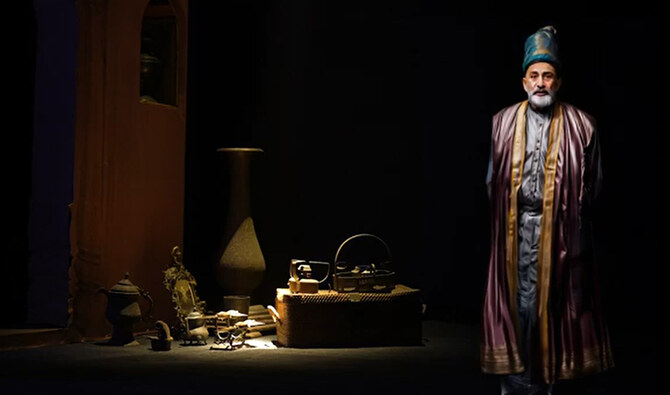
ISLAMABAD: Jashn-e-Rekhta, an annual festival celebrating the Urdu language, will bring to life celebrated poet Mirza Asadullah Baig Khan during its 2025 edition in Dubai via a life-sized hologram next month, the organizer said on Wednesday, offering an enthralling experience for millions of fans of the poet in the subcontinent.
Khan was born on Dec. 27, 1797, in India’s Agra city and was a well-known poet in the Persian and Urdu languages. Referred to popularly simply as “Ghalib,” he remains one of the most popular and influential masters of the Urdu language in both India and Pakistan long after his death in 1869. His poetry is characterized by sadness, the result of a tragic life that saw him orphaned at an early age and losing all seven of his children in their infancy.
Jashn-e-Rekhta is an annual event organized by Rekhta International Cultural Events since 2015. It celebrates Urdu and is dedicated to its language, literature and culture. The two-day festival will be held in Dubai from Feb.1-2 at the iconic Zabeel Park.
The event will bring together around 100 artists, poets and performers from India, Pakistan and other countries. Along with Ghalib’s hologram, another standout feature is the “Dial-e-Poet,” an artificial intelligence (AI) powered rotary phone booth that allows attendees to listen to the voices of iconic poets such as Faiz Ahmed Faiz, Jaun Elia and Ahmed Faraz.
“We will have a hologram display where a real life-size holographic image of Ghalib will appear and we, in fact, are calling it meet with Mirza Ghalib, as he actually narrates his two-and-half-minute speech,” Satish Gupta, the head of programs and festivals at Rekhta told Arab News over the phone from Dubai.
“It will be like he is attending the festival himself just to give his followers a feeling of actually meeting him.”
Gupta described the festival as “more than just an event,” calling it a celebration of Urdu’s beauty and its power to bridge cultures and bring people together.
The “Dial-A-Poet” experience features vintage rotary phones where visitors can dial specific numbers assigned to five iconic poets, including Rahat Indori, Ahmed Faraz and Faiz Ahmed Faiz, he said.
“Using advanced AI voice cloning, the phones play pre-recorded recitations of the poets’ works, offering a one-way interaction that brings their timeless poetry to life in an innovative and immersive way,” Gupta said.
He said the festival will feature around 10 to 12 programs featuring over 95 artists, lead performers and their teams.
“The lineup includes groups, bands and dance troupes from India, Pakistan and a Sufi qawwali group from Bali, Indonesia,” he added.
Gupta said the festival’s first day will showcase the debut performance of a women’s qawwali group presenting the essence of spiritual music.
“This will be followed by Piyush Mishra’s Ballimaaraan, exploring the cultural ties between Delhi and Lahore through music and Shafqat Amanat Ali’s Maah-e-Tamaam, offering a soulful and rhythmic musical journey,” he said.
The second day of the festival will feature a panel discussion on Urdu in films. Participants include prominent Pakistani actors Saba Qamar, Imran Abbas and Adeel Hashmi, Gupta said.
This will be followed by a session involving famed Indian poet, lyricist and screenwriter Javed Akhtar and Pakistani screenwriter Zehra Nigah, who will discuss the connection between films and Urdu literature.
“Arfa Sayeda Zehra and Samina Peerzada will explore Urdu as a language of love and friendship, while Ali Sethi’s musical performance, Shaam Dhale, will conclude the festival on a romantic note,” he said.
In addition to the performances, visitors can enjoy the “Aiwan-e-Zaiqa Food Festival” highlighting South Asian and Middle Eastern cuisines, or explore the Rekhta Bazaar featuring books, handicrafts and merchandise that celebrate Urdu’s artistic heritage, Gupta said.


![]()

‘Meet with Ghalib’: Urdu festival in Dubai to bring iconic poet to life via hologram
Short Url
https://arab.news/phvtv
‘Meet with Ghalib’: Urdu festival in Dubai to bring iconic poet to life via hologram
- Two-day Urdu festival “Jashn-e-Rekhta” will be held from Feb. 1-2 at Dubai’s Zabeel Park
- Mirza Ghalib (1797-1869) is considered by experts, critics as the greatest Urdu poet of all time
Latest updates



Recommended


© 2026 SAUDI RESEARCH & PUBLISHING COMPANY, All Rights Reserved And subject to Terms of Use Agreement.