World must keep pressure on Israel after Gaza truce: Palestinian PM

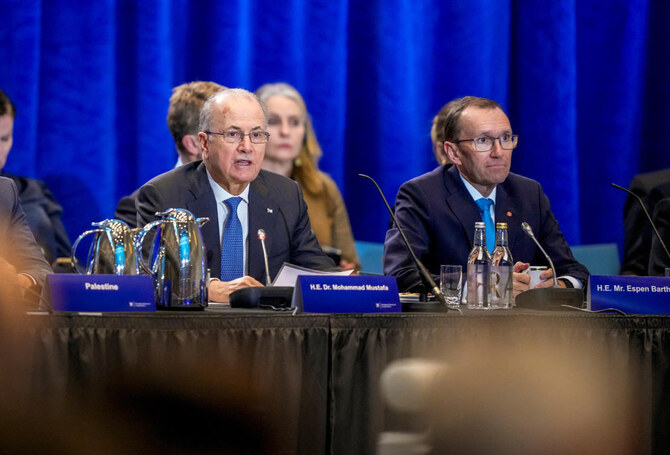
Palestinian Prime Minister Muhammed Mustafa and Norwegian Foreign Minister Espen Barth Eide attend a meeting of the Global Alliance for the implementation of the two-State Solution at Oslo City Hall in Oslo, Norway, January 15, 2025.(Reuters)
Short Url
Updated 15 January 2025
Follow

World must keep pressure on Israel after Gaza truce: Palestinian PM

  • Israel must “be shown what’s right and what’s wrong, and that the veto power on peace and statehood for Palestinians will not be accepted … any longer”: Mustafa

OSLO: The international community will have to maintain pressure on Israel after an hoped-for ceasefire in Gaza so it accepts the creation of a Palestinian state, Palestinian Prime Minister Mohammed Mustafa said on Wednesday.
A ceasefire agreement appears close following a recent round of indirect talks between Israel and Hamas, with US Secretary of State Antony Blinken saying late Tuesday that a deal to end the 15-month war was “on the brink.”
“The ceasefire we’re talking about ... came about primarily because of international pressure. So pressure does pay off,” Mustafa said before a conference in Oslo.
Israel must “be shown what’s right and what’s wrong, and that the veto power on peace and statehood for Palestinians will not be accepted and tolerated any longer,” he told reporters.
He was speaking at the start of the third meeting of the Global Alliance for the Implementation of the Two-State Solution to the Israeli-Palestinian Conflict, gathering representatives from some 80 states and organizations in Oslo.
Norwegian Foreign Minister Espen Barth Eide, the host of the meeting, said a “ceasefire is the prerequisite for peace, but it is not peace.”
“We need to move forward now toward a two-state solution. And since one of the two states exists, which is Israel, we need to build the other state, which is Palestine,” he added.
According to analysts, the two-state solution appears more remote than ever.
Prime Minister Benjamin Netanyahu, firmly supported by US President-elect Donald Trump, is opposed to the creation of a Palestinian state.
Israel is not represented at the Oslo meeting.
Norway angered Israel when it recognized the Palestinian state, together with Spain and Ireland, last May, a move later followed by Slovenia.
In a nod to history, Wednesday’s meeting was held in the Oslo City Hall, where Yasser Arafat, Yitzhak Rabin and Shimon Peres received the Nobel Peace Prize in 1994.
The then-head of the Palestinian Liberation Organization, Israeli prime minister and his foreign minister were honored for signing the Oslo accords a year earlier, which laid the foundation for Palestinian autonomy with the goal of an independent state.


Gaza ceasefire enters phase two despite unresolved issues

Updated 8 sec ago
Follow

Gaza ceasefire enters phase two despite unresolved issues

  • Under the second phase, Gaza is to be administered by a 15-member Palestinian technocratic committee operating under the supervision of a so-called “Board of Peace,” to be chaired by Trump

JERUSALEM: A US-backed plan to end the war in Gaza has entered its second phase despite unresolved disputes between Israel and Hamas over alleged ceasefire violations and issues unaddressed in the first stage.
The most contentious questions remain Hamas’s refusal to publicly commit to full disarmament, a non-negotiable demand from Israel, and Israel’s lack of clarity over whether it will fully withdraw its forces from Gaza.
The creation of a Palestinian technocratic committee, announced on Wednesday, is intended to manage day-to-day governance in post-war Gaza, but it leaves unresolved broader political and security questions.
Below is a breakdown of developments from phase one to the newly launched second stage.

Gains and gaps in phase one

The first phase of the plan, part of a 20-point proposal unveiled by US President Donald Trump, began on October 10 and aimed primarily to stop the fighting in the Gaza Strip, allow in aid and secure the return of all remaining living and deceased hostages held by Hamas and allied Palestinian militant groups.
All hostages have since been returned, except for the remains of one Israeli, Ran Gvili.
Israel has accused Hamas of delaying the handover of Gvili’s body, while Hamas has said widespread destruction in Gaza made locating the remains difficult.
Gvili’s family had urged mediators to delay the transition to phase two.
“Moving on breaks my heart. Have we given up? Ran did not give up on anyone,” his sister, Shira Gvili, said after mediators announced the move.
Israeli Prime Minister Benjamin Netanyahu said efforts to recover Gvili’s remains would continue but has not publicly commented on the launch of phase two.
Hamas has accused Israel of repeated ceasefire violations, including air strikes, firing on civilians and advancing the so-called “Yellow Line,” an informal boundary separating areas under Israeli military control from those under Hamas authority.
Gaza’s Hamas-run health ministry said Israeli forces had killed 451 people since the ceasefire took effect.
Israel’s military said it had targeted suspected militants who crossed into restricted zones near the Yellow Line, adding that three Israeli soldiers were also killed by militants during the same period.
Aid agencies say Israel has not allowed the volume of humanitarian assistance envisaged under phase one, a claim Israel rejects.
Gaza, whose borders and access points remain under Israeli control, continues to face severe shortages of food, clean water, medicine and fuel.
Israel and the United Nations have repeatedly disputed figures on the number of aid trucks permitted to enter the Palestinian territory.

Disarmament, governance in phase two

Under the second phase, Gaza is to be administered by a 15-member Palestinian technocratic committee operating under the supervision of a so-called “Board of Peace,” to be chaired by Trump.
“The ball is now in the court of the mediators, the American guarantor and the international community to empower the committee,” Bassem Naim, a senior Hamas leader, said in a statement on Thursday.
Trump on Thursday announced the board of peace had been formed and its members would be announced “shortly.”
Mediators Egypt, Turkiye and Qatar said Ali Shaath, a former deputy minister in the Ramallah-based Palestinian Authority, had been appointed to lead the committee.
Later on Thursday, Egyptian state television reported that all members of the committee had “arrived in Egypt and begun their meetings in preparation for entering the territory.”
Al-Qahera News, which is close to Egypt’s state intelligence services, said the members’ arrival followed US Middle East envoy Steve Witkoff’s announcement on Wednesday “of the start of the second phase and what was agreed upon at the meeting of Palestinian factions in Cairo yesterday.”
Shaath, in a recent interview, said the committee would rely on “brains rather than weapons” and would not coordinate with armed groups.
On Wednesday, Witkoff said phase two aims for the “full demilitarization and reconstruction of Gaza,” including the disarmament of all unauthorized armed factions.
Witkoff said Washington expected Hamas to fulfil its remaining obligations, including the return of Gvili’s body, warning that failure to do so would bring “serious consequences.”
The plan also calls for the deployment of an International Stabilization Force to help secure Gaza and train vetted Palestinian police units.
For Palestinians, the central issue remains Israel’s full military withdrawal from Gaza — a step included in the framework but for which no detailed timetable has been announced.
With fundamental disagreements persisting over disarmament, withdrawal and governance, diplomats say the success of phase two will depend on sustained pressure from mediators and whether both sides are willing — or able — to move beyond long-standing red lines.