

‘All options exhausted,’ army chief tells political leaders on militant attacks from Afghanistan

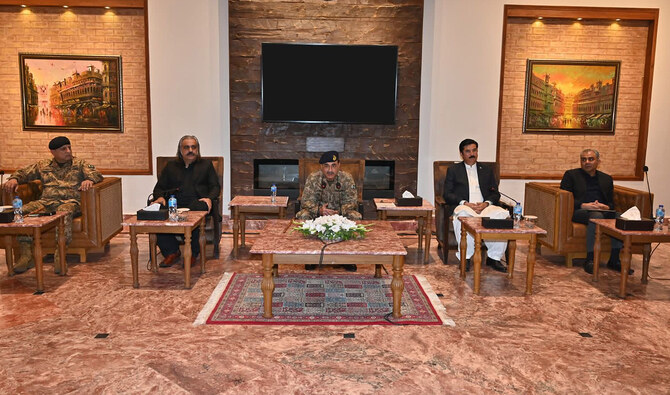
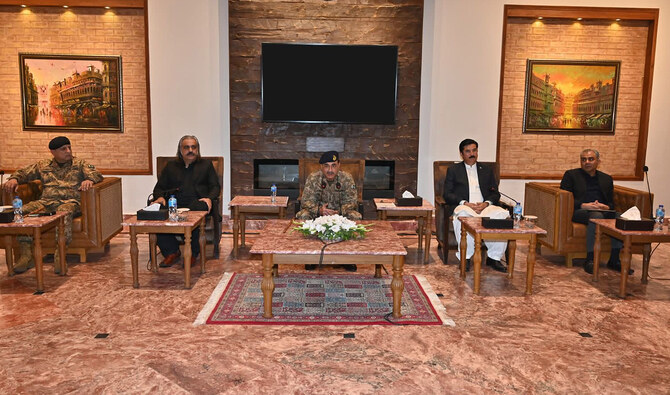
Pakistan’s army chief, General Asim Munir (center) holds meeting with political leaders of Khyber Pakhtunkhwa province in Peshawar, Pakistan, on January 13, 2025. (Pakistan Army)
Short Url
Updated 15 January 2025
Follow

‘All options exhausted,’ army chief tells political leaders on militant attacks from Afghanistan

  • General Asim Munir explained the situation this week after politicians in Peshawar called for negotiations with Kabul
  • All parties unanimously expressed support for targeted actions against TTP militants, as per meeting participants

KARACHI: Pakistan’s army chief, General Asim Munir, told political leaders in Peshawar this week the country had “exhausted all options” to persuade Afghanistan to curb cross-border militant attacks, expressing regret the administration in Kabul had failed to restrain armed factions, a participant of the meeting said on Tuesday.

General Munir visited Peshawar on Monday, where he received a briefing on the current security situation and ongoing counter-terrorism operations in Khyber Pakhtunkhwa (KP), which borders Afghanistan.

Pakistan has struggled to contain escalating militant violence in KP since a fragile truce between the Tehreek-e-Taliban Pakistan (TTP) and the government collapsed in November 2022. Officials in Islamabad say the TTP leadership is based in Afghanistan from where its attacks on Pakistani civilians and security forces are “facilitated” by the Afghan authorities, an allegation denied by Kabul.

During his visit to Peshawar, the army chief engaged with leaders from various political parties, including Chief Minister Ali Amin Gandapur. During the meeting, political representatives expressed “vivid clarity on unflinching support” for the armed forces and law enforcement agencies in the nation’s fight against extremist violence and agreed on the need for a unified front against militant networks, according to the Inter-Services Public Relations (ISPR), the military’s media wing.

“We have exhausted all our options,” Aftab Sherpao, a former federal minister who heads the Qaumi Watan Party and attended the meeting, told Arab News over the phone, quoting the army chief.

Sherpao said the top Pakistani general issued the comment while responding to political leaders advocating for talks and avoiding confrontation with the Afghan Taliban administration.

“He [the army chief] also said some foreign countries were also engaged in talks to persuade the Taliban in Kabul, but terrorist attacks still continue against Pakistan,” Sherpao added.

Professor Muhammad Ibrahim, another participant and leader of the Jamaat-e-Islami (JI) Party, corroborated the information, saying that almost all political parties agreed that negotiations with Kabul should continue.

“Almost all political parties emphasized the need for negotiations with Afghanistan, arguing that war is not the solution,” he said.

“The army chief said the negotiations were still going on, but no positive outcome had emerged so far,” Ibrahim continued. “In response we stressed that a positive outcome will eventually come, and talks should continue.”

The JI leader also quoted the army chief as saying the military was not planning a full-scale operation against the TTP but was carrying targeted intelligence-based actions.

Brig. Mehmood Shah, an expert on Pakistan-Afghanistan affairs, criticized the Afghan Taliban for failing to honor the 2020 Doha Agreement, which ended the Afghan war on the condition that Kabul would prevent its soil from being used by militants against other countries.

“The world knows that in the Doha Agreement, the US explicitly stated that Afghanistan must not allow its territory to be used against its neighbors,” he said. “The US is not Afghanistan’s neighbor, so why was it so insistent?”

Shah said the international community knew Afghanistan had been allowing its land to be used against its neighbors.

He noted that Pakistan, a nuclear-capable country with an air force, had shown restraint despite its capabilities.

“Pakistan has been in dialogue with Afghanistan, but Afghanistan is unwilling to act against the TTP,” Shah continued. “If Pakistan then carries out operations inside Afghanistan, Kabul should not complain.”

According to Pakistan’s state broadcaster, PTV News, the army chief informed the meeting that the primary points of contention between Pakistan and Afghanistan were the presence of the banned TTP on Afghan soil and cross-border attacks.


Pakistani, Uzbek leaders urge business community to help achieve $2 billion trade target

Updated 4 sec ago
Follow

Pakistani, Uzbek leaders urge business community to help achieve $2 billion trade target

  • Pakistan and Uzbekistan have steadily increased economic ties in recent years, with bilateral trade volume reaching nearly $500 million
  • President Shavkat Mirziyoyev says business community is ‘most important bridge’ linking both nations, promising favorable business climate

ISLAMABAD: Pakistan Prime Minister Shehbaz Sharif and Uzbekistan President Shavkat Mirziyoyev on Friday urged businesspersons from both countries to help the two countries achieve a bilateral trade target of $2 billion within the next five years.

The two leaders made the call while addressing traders, industrialists from both countries at the Pakistan Uzbekistan Business Forum in Islamabad during President Mirziyoyev’s visit to the South Asian country.

Pakistan and Uzbekistan have steadily increased economic ties in recent years as Pakistan offers landlocked Central Asian states greater access to global markets, aiming to position itself as a regional transit hub.

Pakistan was the first Central Asian partner with which Uzbekistan signed a bilateral Transit Trade Agreement, along with a Preferential Trade Agreement in March 2022, covering 17 items, which became operational in 2023.

“We agreed that political goodwill must be matched by economic actions and words must be converted into implementation,” Sharif said, citing his visit to Tashkent last year which had helped brought annual bilateral trade to nearly $450 million.

“Today, ladies and gentlemen, we will strengthen last night’s protocol by signing another document today, which will give you vistas of opportunities to sit down together, B2B (business to business), have wonderful discussions with your counterparts and come to arrangements in terms of joint ventures, investments in Uzbekistan and Pakistan.”

Sharif was referring to the protocol signed between the two countries on Thursday to establish a joint working group to formulate a five-year action plan to take bilateral trade to $2 billion. Both sides also signed 28 agreements focused on areas such as defense cooperation, climate change, disaster risk reduction, disaster management, agriculture, exports of fruits, and mining and geosciences.

President Mirziyoyev said the increase in bilateral trade to half-a-billion dollars was an outcome of their talks held in Tashkent in Feb. last year.

“Over the course of very comprehensive and detailed discussions yesterday, we together decided that this is far [from] being enough,” he told businessperson from both countries.

The Uzbek president said business community is the “most important bridge” in linking the two nations and it was their job as heads of the state to ensure favorable conditions for them.

“Success of this agreement is in your hands,” he told the attendees, assuring them of eliminating any obstacles and bottlenecks in the process.

Later, Pakistan President Asif Ali Zardari conferred the Nishan-e-Pakistan, the highest civilian award of the country, on President Mirziyoyev at a televised ceremony.

The Nishan-e-Pakistan is awarded to individuals who have rendered services of highest distinction to the national interest of Pakistan and has often been conferred on visiting Heads of State as a mark of respect and friendship.