

Pakistan expects $40 billion as World Bank announces decade-long development framework

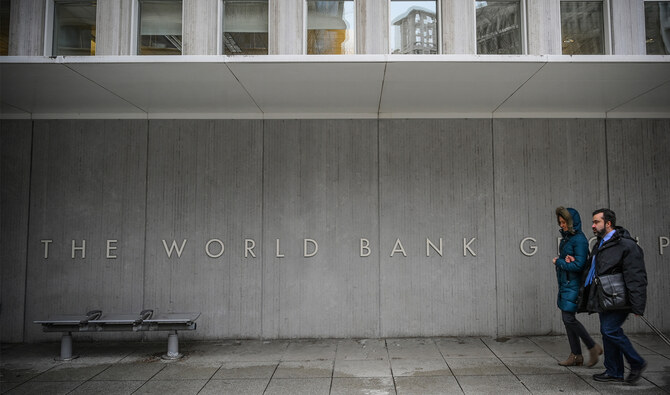
Two perosns walk by the building of the Washington-based global development lender, The World Bank Group, in Washington on January 17, 2019. (AFP/File)
Short Url
Updated 15 January 2025
Follow

Pakistan expects $40 billion as World Bank announces decade-long development framework

  • World Bank Group’s Country Partnership Framework is designed to support inclusive and sustainable growth
  • The framework aims to focus on education, health care, environmental resilience and financial management

ISLAMABAD: The World Bank Group’s (WBG) Boards of Executive Directors on Tuesday announced a decade-long Country Partnership Framework (CPF) for Pakistan, a plan the administration in Islamabad hopes will channel $40 billion in economic support to drive inclusive and sustainable development.

The country plan is a strategic framework that shapes the WBG’s long-term engagement with a country. It is built on a thorough assessment of the nation’s critical challenges and opportunities, ensuring that the group’s financial, technical and advisory resources are precisely aligned with the country’s development priorities for optimal impact.

According to the World Bank, the new framework for Pakistan targets six major areas, including education, health care, environmental resilience and financial management.

“Our new decade-long partnership framework for Pakistan represents a long-term anchor for our joint commitment with the Government to address some of the most acute development challenges facing the country,” said Najy Benhassine, World Bank Country Director for Pakistan. “Support to policy and institutional reforms that boost private sector-led growth and create fiscal space to finance the investments needed to address these challenges will remain key in our engagements.”

According to a statement from Pakistan’s Economic Affairs Division, the World Bank and its partner institutions have committed a total of $40 billion under the framework. This includes $20 billion from the International Development Association (IDA) and the International Bank for Reconstruction and Development (IBRD), while an additional $20 billion will come from the International Finance Corporation (IFC), which focuses on private sector development.

The WBG noted that the country plan aims to reduce child stunting by improving access to clean water, sanitation and nutrition services, while also addressing learning poverty through better foundational education.

Other priorities include bolstering resilience to floods and climate-related disasters, improving food and nutrition security, promoting cleaner energy and better air quality, and enhancing fiscal management to create space for development spending.

Zeeshan Sheikh, IFC Country Manager for Pakistan and Afghanistan, highlighted the importance of private sector participation in these areas, saying, “We are focused on prioritizing investment and advisory interventions that will help crowd-in much needed private investment in sectors critical for Pakistan’s sustainable growth and job creation, including energy and water, agriculture, access to finance, manufacturing and digital infrastructure.”

The framework also includes cross-cutting measures such as expanding social safety nets, advancing financial inclusion and enhancing digital and transport connectivity to protect vulnerable populations, particularly women.

Since commencing operations in Pakistan in 1950, the WBG has provided over $48.3 billion in assistance through IBRD, invested $13 billion via IFC to advance private sector-led growth, and delivered $836 million in guarantees through Multilateral Investment Guarantee Agency (MIGA).

Currently, the WBG’s portfolio in Pakistan includes 106 projects with a total commitment of $17 billion.


PCB sets Feb. 11 as date for player auction for Pakistan Super League 11th edition

Updated 25 January 2026
Follow

PCB sets Feb. 11 as date for player auction for Pakistan Super League 11th edition

  • The squad composition would be a minimum of 16 players and a maximum of 20
  • The number of foreign players would be five to seven depending on the squad size

ISLAMABAD: The Pakistan Cricket Board (PCB) on Sunday announced that the player auction for the 11th edition of the Pakistan Super League (PSL) will be held on Feb. 11, setting the stage for franchises to begin assembling squads for the country’s premier Twenty20 tournament.

The development came after a workshop regarding PSL player auction at the Qaddafi Stadium, which was presided over by PCB Chairman Mohsin Naqvi and PSL CEO Salman Naseer.

The workshop was attended by PSL officials, all eight franchise representatives, members of Pakistan’s T20 World Cup squad, PCB officials and other capped players.

“The HBL PSL management shared a detailed presentation on the mechanics of the retention and the auction process and consulted with all the participants,” the PCB said.

“It was agreed that the HBL PSL player auction will take place on Wednesday, 11 February.”

The squad composition would be a minimum of 16 players and maximum of 20 players per franchise. The number of foreign players would be five to seven depending on the squad size, according to the PCB.

It would be mandatory for the franchises to play minimum of three and maximum of four foreign players in the playing XI. The teams are also required to have minimum of two uncapped Under 23 players in the squad and one in the playing XI.

Players either retained or picked in the auction will be engaged for two-year contracts with their respective franchise teams, the board said, adding that franchise teams will be able to retain a maximum of seven players for the 12th edition of the tournament.

“I’m delighted that a consultative and productive session was held between the franchises, players and management today resulting in informed and strategic decisions which will pave the way for bright future for the HBL PSL,” Naqvi said.

“The Player Auction model is a landmark step for the HBL PSL, offering players better financial opportunities through an increased salary purse and a transparent acquisition process, while making the league more competitive and attractive.”

PSL CEO Naseer said the player auction system modernizes player recruitment by promoting fairness, transparency, and market-driven value, strengthening the PSL’s appeal for both players and franchises.

“Today’s workshop saw all views being taken into consideration and this rich feedback will be reflected in our execution of a successful player auction scheduled next month,” he said.

PSL has become a key pillar of the country’s cricket economy, providing financial stability to the PCB and serving as a talent pipeline for the national team. The 11th edition of the league is set to begin from Mar. 26 while the final is expected to be played on May 3, as per the PCB’s schedule.