New border crossing with Iran to boost legal trade and curb smuggling, Pakistan says

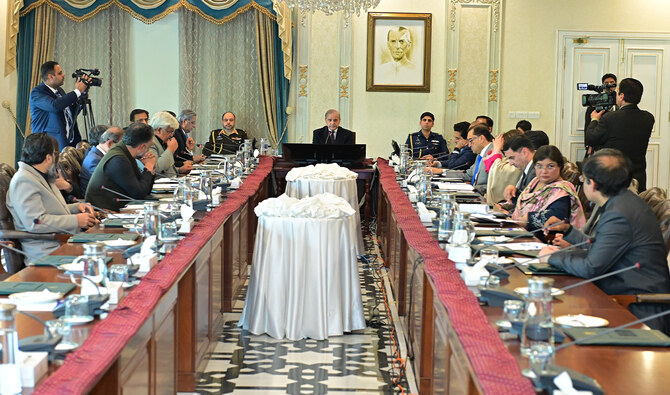
Pakistan's Prime Minister Shehbaz Sharif chairs a meeting in Islamabad, Pakistan, on 13 January 2025. (PID/File)
Short Url
Updated 14 January 2025
Follow

New border crossing with Iran to boost legal trade and curb smuggling, Pakistan says

  • Pakistan and Iran have tried to boost trade by setting up border markets, implementing barter system
  • International sanctions on Iran have hampered economic collaboration between the two countries

ISLAMABAD: Prime Minister Shehbaz Sharif on Tuesday expressed hope a newly inaugurated border crossing between Pakistan and Iran in Panjur would encourage legal trade between the two neighboring states and help curb smuggling, which has long plagued the region.

Pakistan and Iran have intensified efforts in recent years to expand bilateral trade by establishing border markets and implementing barter trade mechanisms.

In April last year, Iran’s late President Ebrahim Raisi described the existing trade volume between the two countries as “not acceptable” during his visit to Pakistan. He said his government had agreed with Islamabad to boost bilateral trade to $10 billion within the foreseeable future.

In the absence of adequate formal trade, smuggling has become a significant issue along the porous 959-kilometer border, where local communities on both sides often rely on the illicit trade of goods, particularly Iranian fuel.

“A new crossing has been inaugurated at the Pakistan-Iran border in Panjgur, which will promote legal trade and help curb smuggling,” Sharif said during a federal cabinet meeting in Islamabad, referring to the new opening this month in the Kohak-Cheedgi area of Panjgur. “I thank our brotherly country Iran for their full cooperation in this regard.”

International sanctions, particularly those imposed by the United States, have significantly hampered economic collaboration between the two countries. This is particularly evident in the shape of the stalled Iran-Pakistan gas pipeline project. While Iran completed its section in 2011, Pakistan halted construction due to fears of US sanctions, stalling a project that could have alleviated Pakistan’s energy shortages.

According to the Institute for Strategic Studies, Research and Analysis, a local think tank in Islamabad, trade between the two countries has also suffered owing to the same reason.

Iran’s exports to Pakistan were approximately $1.4 billion in 2022, while Pakistan’s exports to Iran stood at $842.8 million.

The think tank also says Iran’s exports to Pakistan have grown at an annual rate of 13.5 percent over the past 24 years, whereas Pakistan’s exports to Iran have declined by up to 44 percent annually.

During Raisi’s visit, both sides signed memoranda of understanding and agreements covering fields such as trade, science, technology, agriculture, health and culture.

The visit was also seen as a step toward mending fences between the two nations, which had experienced strained ties following unprecedented tit-for-tat missile strikes earlier that year.


Pakistan says responding to Afghan ‘offensive operations’ after border fire as tensions escalate

Updated 26 February 2026
Follow

Pakistan says responding to Afghan ‘offensive operations’ after border fire as tensions escalate

  • Afghan Taliban spokesperson says “large-scale offensive operations” launched against Pakistani military bases
  • Pakistan says Afghan forces opened “unprovoked” fire across multiple sectors along shared border

ISLAMABAD: Afghanistan’s Taliban authorities said on Thursday they had launched “large-scale offensive operations” against Pakistani military bases and installations, prompting Pakistan to say its forces were responding to what it described as unprovoked fire along the shared border.

The escalation follows Islamabad’s weekend airstrikes targeting what it said were Tehreek-e-Taliban Pakistan (TTP) and Daesh militant camps inside Afghanistan in response to a wave of recent bombings and attacks in Pakistan. Islamabad said the strikes killed over 100 militants, while Kabul said dozens of civilians were killed and condemned the attacks as a violation of its sovereignty.

In a post on social media platform X, Afghan government spokesperson Zabihullah Mujahid said Afghanistan had launched “large-scale offensive operations” in response to repeated violations by the Pakistani military.


Pakistan’s Ministry of Information said Afghan forces had initiated hostilities along multiple points of the frontier.

“Afghan Taliban regime unprovoked action along the Pakistan–Afghanistan border given an immediate, and effective response,” the ministry said in a statement.

The statement said Pakistani forces were targeting Taliban positions in the Chitral, Khyber, Mohmand, Kurram and Bajaur sectors, claiming heavy Afghan casualties and the destruction of multiple posts and equipment. It added that Pakistan would take all necessary measures to safeguard its territorial integrity and the security of its citizens.


Separately, security officials said Pakistani forces had carried out counterattacks in several border sectors.

“Pakistan’s security forces are giving a befitting reply to the unprovoked Afghan aggression with full force,” a security official said, declining to be named. 

“The Pakistani security forces’ counter-attack destroyed Taliban’s hideouts and the Khawarij fled,” they added, referring to TTP militants. 

The claims from both sides could not be independently verified.

Cross-border violence has intensified in recent weeks, with Pakistan blaming a surge in suicide bombings and militant attacks on militants it says are based in Afghanistan. Kabul denies providing safe havens to anti-Pakistan militant groups.

The clashes mark the third major escalation between the neighbors in less than a year. Similar Pakistani strikes last year triggered weeklong clashes before Qatar, Türkiye and other regional actors mediated a ceasefire in October.

The 2,600-kilometer (1,600-mile) frontier, a key trade and transit corridor linking Pakistan to landlocked Afghanistan and onward to Central Asia, has faced repeated closures amid tensions, disrupting commerce and humanitarian movement. Trade between the two nations has remained closed since October 2025.