

Biden calls for immediate ceasefire in call with Netanyahu, White House says

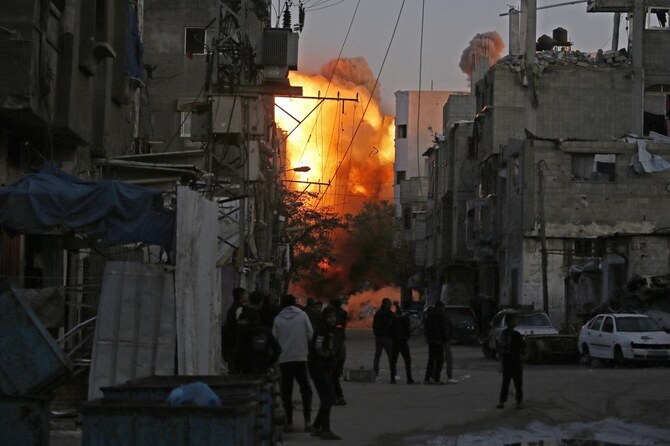
Smoke rises from a building destroyed in Israeli airstrike at the Bureij camp for Palestinian refugees in the central Gaza Strip on January 12, 2025. (AFP)
Short Url
Updated 13 January 2025
Follow

Biden calls for immediate ceasefire in call with Netanyahu, White House says

  • Development takes place as US officials race to reach Gaza ceasefire deal before Biden leaves office
  • Parties were “very, very close” to reaching a deal, still have to get it across finish line, says Biden aide

WASHINGTON: US President Joe Biden spoke on Sunday with Israeli Prime Minister Benjamin Netanyahu, the White House said, as US officials race to reach a Gaza hostage and ceasefire deal before Biden leaves office on Jan. 20.
Biden and Netanyahu discussed efforts underway to reach a deal to halt the fighting in the Palestinian enclave and free the remaining hostages there, the White House said in a statement after the two leaders spoke by telephone.
Biden “stressed the immediate need for a ceasefire in Gaza and return of the hostages with a surge in humanitarian aid enabled by a stoppage in the fighting under the deal,” it said.
Netanyahu updated Biden on progress in the talks and on the mandate he has given his top-level security delegation now in Doha in order to advance a hostage deal, Netanyahu said in a statement.
The two leaders also discussed “the fundamentally changed regional circumstances following the ceasefire deal in Lebanon, the fall of the Assad regime in Syria, and the weakening of Iran’s power in the region,” the White House said.
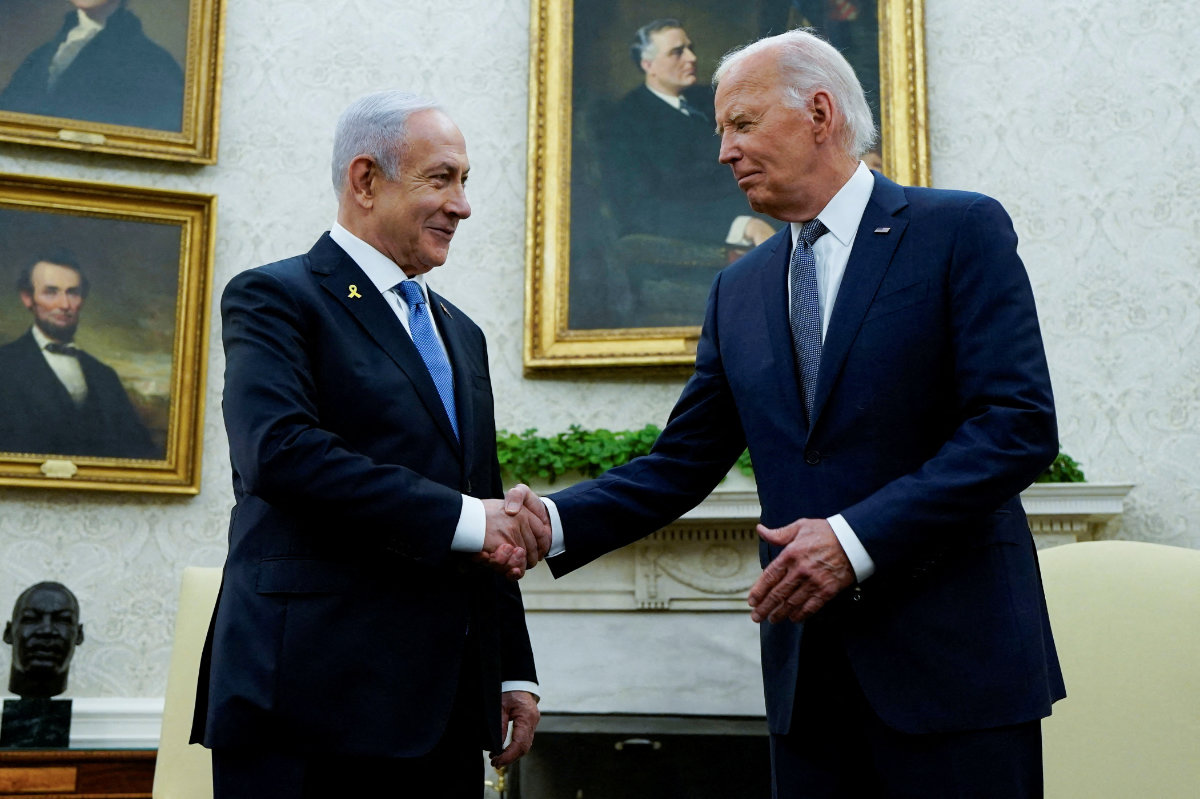


This photo taken on July 25, 2024, shows US President Joe Biden, right, meeting with Israeli Prime Minister Benjamin Netanyahu at the White House in Washington. (REUTERS File)

Biden’s national security adviser Jake Sullivan told CNN’s “State of the Union” program earlier on Sunday that the parties were “very, very close” to reaching a deal, but still had to get it across the finish line.
He said Biden was getting daily updates on the talks in Doha, where Israeli and Palestinian officials have said since Thursday that some progress has been made in the indirect talks between Israel and militant group Hamas.
“We are still determined to use every day we have in office to get this done,” Sullivan said, “and we are not, by any stretch of imagination, setting this aside.”
He said there was still a chance to reach an agreement before Biden leaves office, but that it was also possible “Hamas, in particular, remains intransigent.”
During their call, Netanyahu also thanked Biden for his lifelong support of Israel and “the extraordinary support from the United States for Israel’s security and national defense,” the White House said.
Israel launched its assault in Gaza after Hamas fighters stormed across its borders in October 2023, killing 1,200 people and taking more than 250 hostages, according to Israeli tallies.
Since then, more than 46,000 people have been killed in Gaza, according to Palestinian health officials, with much of the enclave laid to waste and gripped by a humanitarian crisis, and most of its population displaced.
Vice President-elect JD Vance told the “Fox News Sunday” program in an interview taped on Saturday that he expects a deal for the release of US hostages in the Middle East to be announced in the final days of the Biden administration, maybe in the last day or two.
President-elect Donald Trump, a staunch supporter of Israel, has strongly backed Netanyahu’s goal of destroying Hamas. He has promised to bring peace to the Middle East, but has not said how he would accomplish that.


Year after Assad’s downfall, Syrians shows strong support for Al-Sharaa

Updated 10 sec ago
Follow

Year after Assad’s downfall, Syrians shows strong support for Al-Sharaa

  • Survey finds Syrians are hopeful for the future, back the government’s progress following Assad’s demise
  • Saudi Arabia is the most popular foreign country, Trump also given firm support

LONDON: As Syrians this week marked one year since the downfall of Bashar Assad, a survey conducted inside the country has found overwhelming support for the new president and placed Saudi Arabia as the most popular international partner.

The former president fled the country on Dec. 8, 2024, after a lightning offensive by opposition forces reached Damascus, bringing an end to 14 years of civil war.

The campaign was spearheaded by Ahmad Al-Sharaa, who now serves as the country’s president and has pressed ahead with efforts to stabilize Syria and rebuild relations with international partners.

Those efforts were recognized in a recently published survey that found that 81 percent of those asked were confident in the president and 71 percent in the national government.

There was also strong backing for key institutions, with more than 70 percent supporting the army and 62 percent in favor of the courts and legal system.

It was carried out during October and November by Arab Barometer, a US-based nonprofit research network.

The survey questioned more than 1,200 randomly selected adults in person across the country, asking their thoughts on a range of issues, including the government’s performance, the economy and security.

The strong support shown for Al-Sharaa is at a level that would be the envy of most Western governments and comes as Syria faces many deep challenges.

The cost of rebuilding the country has been placed at more than $200 billion by the World Bank, the economy has been devastated and the country has faced outbreaks of sectarian violence.

Al-Sharaa has worked to end Syria’s international isolation, building support from countries in the region and successfully lobbying the US to lift sanctions.

A key backer has been Saudi Arabia, which has offered political and economic support. The survey placed the Kingdom as the most popular foreign country with 90 percent viewing Saudi Arabia favorably.

Qatar was also popular, with more than 80 percent viewing the emirate as favorable and 73 percent admiring Turkey.

Most of those asked — 66 percent — also viewed the US favorably, an appreciation of President Donald Trump’s decision to ease sanctions and the impact that will have on the daily lives of Syrians.

After meeting Al-Sharaa in Washington last month, Trump announced a partial suspension of sanctions after already easing many sections of the sanctions regime against the country.

The survey found 61 percent have a positive view of Trump, a figure higher than in much of the Middle East.

There was much less enthusiasm, however, for Washington’s efforts for Syria to normalize relations with Israel.

Only 14 percent supported such a move and just 4 percent had a favorable opinion of Israel.

During the tumult of Assad’s demise, Israel’s military occupied a further swathe of southern Syria and has regularly launched attacks on the country in the last year.

More than 90 percent of Syrians said they viewed Israel’s occupation of the Palestinian territories and strikes on Iran, Lebanon and Syria as critical threats to their security.

Writing jointly in Foreign Policy magazine, Salma Al-Shami and Michael Robbins from Arab Barometer said the survey results provided reasons to be optimistic about Syria’s future.

“We found that the country’s people are hopeful, supportive of democracy and open to foreign assistance,” they said. “They approve of and trust their current government.”

But the authors also said the results provided some reasons for concern, particularly over the state of the economy and internal security.

Support for the government also dropped off sharply in regions largely home to the Alawite ethno-religious group.

The Assad dynasty that ruled Syria for more than 50 years belonged to the Alawite minority and members of the group held many of the positions of power during that rule.

The survey showed that Syrians view the economy as a major concern, with just 17 percent happy with its performance and many worried about inflation, jobs and poverty.

Some 86 percent said their incomes did not cover their expenses and 65 percent said they had struggled to buy food in the previous month.

There was also concern about security, with 74 percent supportive of any government effort to collect weapons from armed groups and 63 percent viewing kidnapping as a critical threat.

Marking the anniversary of Assad’s downfall on Monday, Al-Sharaa said the government was working to build a strong Syria, consolidate its stability and safeguard its sovereignty.