ISLAMABAD: The renovation of Gaddafi Stadium in Pakistan’s eastern Lahore city will be completed this week, Pakistan Cricket Board (PCB) Chairman Mohsin Naqvi said on Sunday, with all major structural work finished and final touches being applied ahead of the upcoming ICC Champions Trophy.
The PCB has been renovating stadiums in Lahore and Karachi for the 2025 Champions Trophy scheduled to take place in Feb. across three venues: Lahore, Karachi, and Rawalpindi. This will be the first ICC tournament held in Pakistan since the 1996 World Cup.
Pakistani fans have long expressed dissatisfaction with the country’s stadiums, particularly the National Bank Stadium in Karachi, citing a lack of basic facilities and a subpar viewing experience for spectators.
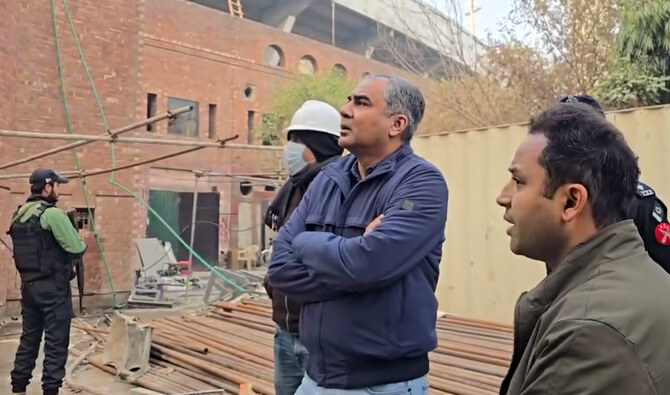
On Sunday, the PCB chairman paid a visit to Gaddafi Stadium and inspected the upgradation, renovation and finishing work on the ground, expressing his satisfaction over the pace of work at the iconic venue.
“Gaddafi Stadium, with all its modern facilities, will be ready this month. The work is being carried out at a swift pace,” he said.
“We are set to install brand new and comfortable seats for the fans, with an enhanced view, and work on new LED lights on the light towers is well underway.”
The stadium is set to transform into a world-class facility, featuring over 34,000 seats, brand-new scoreboards on both sides and state-of-the-art floodlights, ensuring exceptional visibility for both players and spectators after sunset.
“The fans will now be able to enjoy laser light shows during night games as well,” Naqvi said. “We are striving to make the ICC Champions Trophy a memorable event in Pakistan.”
The ICC Champions Trophy 2025 will take place from February 19 till March 9, with matches hosted across Pakistan and Dubai in a hybrid model.
The tournament’s structure follows a compromised decision after India refused to play in Pakistan, citing “security concerns.” Exercising its rights as the host nation, Pakistan designated Dubai as the neutral venue for India’s matches, ensuring all teams’ participation.
In Pakistan, Karachi, Lahore and Rawalpindi will host three group-stage games each. Lahore is also set to host the second semifinal. Dubai will host all three of India’s group matches and the first semifinal, should India qualify.
The tournament opener on Feb. 19 will feature Pakistan taking on New Zealand in Karachi, while India will face Bangladesh in Dubai on Feb. 20.
This will be the ninth edition of the ICC Champions Trophy, after an eight-year hiatus. The last tournament took place in England in 2017. The event will feature top eight teams in world cricket competing for one of the sport’s most prestigious titles.

Pakistan to finish Gaddafi Stadium renovation this month for upcoming Champions Trophy
https://arab.news/6d5qz
Pakistan to finish Gaddafi Stadium renovation this month for upcoming Champions Trophy
- The Champions Trophy tournament is set to begin on Feb. 19 in Karachi with Pakistan taking on New Zealand
- The stadium will feature over 34,000 seats, brand-new scoreboards and laser light shows during night games
Economists flag high production costs, low exports as key risks for Pakistan in 2026
- Financial experts urge government to address high interest and taxation rates to attract more foreign direct investment this year
- Economists note strong performance by Pakistan’s stock market, reduced inflation as key macroeconomic gains in the last year
KARACHI: Pakistani economists and business leaders urged the government on Wednesday to cut high production costs, arrest inflation and increase exports to capitalize on macroeconomic gains in 2025 as the country prepared to ring in the new year.
Prime Minister Shehbaz Sharif this week highlighted his government’s economic achievements over the past two years, saying that inflation had fallen from 29.2 percent to 4.5 percent, while foreign exchange reserves had more than doubled from $9.2 billion to $21.2 billion.
While Pakistan reported some economic gains during the year, such as comparatively low inflation, a $100 million current account surplus in November and a strong performance by the stock market, economist Sana Tawfik said deeper reforms were still needed to address pressing economic issues.
“When we talk about stability and growth, we cannot deny that there are challenges in the economy,” Tawfik, head of research at Arif Habib Limited, told Arab News. “High energy tariffs, interest rates and the broader cost of doing business need to be addressed if Pakistan wants to sustain growth, boost exports and attract foreign investment.”
Pakistan reported consumer inflation at 6.1 percent in November, saying it was projected to remain within the moderate 5.5-6.5 percent range in December.
Muhammad Rehan Hanif, president of the Karachi Chamber of Commerce and Industry (KCCI), agreed that high power tariffs were eroding the effectiveness of Pakistan’s exports.
“Our interest rate is still 10.5 percent, while the region is at six or seven percent,” Hanif lamented. “[While] electricity costs around 12 cents per unit here, compared to about nine cents in Bangladesh.”
The KCCI president also pointed to the country’s poor infrastructure, particularly that of its commercial capital Karachi, as a major challenge for the year ahead.
He said dilapidated roads, poor drainage and poor industrial conditions were damaging Pakistan’s image for visiting buyers and diplomats, discouraging investment.
“Infrastructure is the biggest challenge the industrialists in Karachi are facing,” he explained.
‘EXPORTS ARE OUR LIFELINE’
More troubling for Pakistan is the fact that foreign direct investment (FDI) inflows fell by more than 25 percent to $927 million during the July-November period, as per data from the central bank. Pakistan’s FDI inflows have never surged beyond $3 billion in nearly 20 years.
Economists say high energy costs along with interest and taxation rates are responsible for low FDI in the country.
Hanif stressed the importance of increasing Pakistan’s exports to ensure macroeconomic gains in 2026.
“Exports are our lifeline,” he said. “When 7 to 8 million Pakistanis abroad can generate $37 billion [in remittances], why are 250 million people here exporting only $32 billion?“
Tawfik agreed, saying that shifting to an export-driven economic model was essential for long-term sustainability.
“It is about time that we move from an import-driven economy to an export-driven one,” she said, adding that macroeconomic stability was a prerequisite for restoring investor confidence and attracting FDI.
Meeting the International Monetary Fund’s benchmarks, ensuring timely inflows from creditors and continuing reforms such as privatization of state-owned enterprises (SOEs) will also be critical in 2026, she added.
‘YEAR OF MACROECONOMIC STABILITY’
Despite these challenges, financial experts recognized that 2025 marked a clear improvement for Pakistan compared to the previous two years.
“The year 2025 can be described as a year of macroeconomic stability and overall, we saw some improvement in different macroeconomic indicators,” Tawfik said.
She noted that inflation, which had surged to a record 38 percent in May 2023, had been reduced to single-digit figures in 2025.
Pakistan’s Finance Adviser Khurram Schehzad said this week the Pakistan Stock Exchange has delivered 50 percent-plus returns in US dollar terms since January 2025, making it one of the “best markets in Asia.”
Tawfik said 2026 could see “positive” developments if the government maintains macroeconomic stability.
The economist said she expected growth at around 3.7 percent, inflation to remain within the central bank’s five to seven percent target range and a relatively stable exchange rate with modest depreciation.
However, she cautioned that without addressing high energy costs, easing business conditions and boosting exports, the government could risk squandering its hard-won macroeconomic gains.
“It is important to take all stakeholders on the same page and work in the same direction for overall economic betterment.”