ISLAMABAD: Pakistan and China have resolved to undertake high-quality of development of a second phase of the China-Pakistan Economic Corridor, or CPEC 2.0, that would focus on industrialization, Pakistan’s foreign ministry said on Thursday.
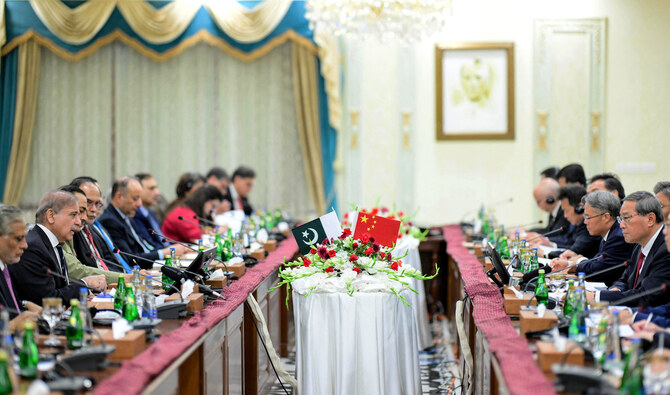
The statement came after a 5th meeting of the CPEC Joint Working Group on International Cooperation and Coordination (JWG-ICC) was held in Beijing. It was co-chaired by Pakistan’s Foreign Secretary Amna Baloch and Chinese Vice Foreign Minister Sun Weidong.
China and Pakistan enjoy a close strategic partnership, with the latter’s location on the Arabian Sea providing Beijing an overland route toward the Gulf of Aden and onto the Suez Canal, and enabling Chinese ships to avoid the potential chokepoint of the Malacca Strait.
During the delegation level talks, the two sides reviewed with satisfaction the progress made since the 4th meeting of the JWG-ICC held in Islamabad in January 2024, according to the Pakistani foreign ministry.
“Both sides reaffirmed their commitment to the high quality development of CPEC 2.0, with its emphasis on industrialization and Special Economic Zones (SEZs) as well as on clean energy, agriculture and livelihood projects,” it said in a statement.
“The meeting also acknowledged the pivotal role of CPEC in promoting regional connectivity, win-win cooperation and common prosperity, including through partnerships with other countries.”
Since its initiation in 2013, CPEC has seen tens of billions of dollars funneled into massive transport, energy and infrastructure projects in Pakistan. But the undertaking has been hit by Islamabad struggling to keep up its financial obligations as well as attacks on Chinese targets by militants.
During a visit to China in June last year, Pakistan Prime Minister Shehbaz Sharif had announced both countries had mutually decided to enhance economic cooperation that would enter its next phase with five new corridors.
The Chinese vice foreign minister said 2.0 would focus on growth, livelihood and innovation, and reinforce Pakistan’s national development framework centered on ‘5 Es,’ representing exports, e-Pakistan, energy, environment and equity.
Foreign Secretary Baloch described CPEC as the cornerstone of China-Pakistan economic cooperation as well as a “shining symbol” of the enduring friendship between the two countries.
Both sides expressed resolve to deepen cooperation in the fields of media, cultural exchanges and people-to-people linkages to accelerate the building of a “China-Pakistan Community of Shared Future in the New Era.”
Separately, both countries also held a 4th round of Pakistan-China Bilateral Political Consultations (BPC), at which they reaffirmed commitment to further deepening their partnership.
The two sides also exchanged views on a range of regional and international issues and agreed to further enhance their mutual coordination and consultations, according to the Pakistani foreign ministry.
“Both sides agreed to further deepen their mutual partnerships in sectors such as information technology, agriculture and clean energy, driven by the concept of win-win cooperation and pursuit of people centric, inclusive development,” it said.
“The two sides underscored the need to strengthen their mutual coordination at the multilateral forums, including at the United Nations Security Council.”
Later, the foreign secretary also held a meeting with Executive Vice Foreign Minister Ma Zhaoxu and exchanged views on Pakistan-China relations as well as regional and international issues of common interest.


![]()

Pakistan, China reaffirm commitment to ‘CPEC 2.0’ focusing on industrialization
Short Url
https://arab.news/vjxf9
Pakistan, China reaffirm commitment to ‘CPEC 2.0’ focusing on industrialization
- Since 2013, CPEC has seen tens of billions of dollars funneled into massive transport, energy and infrastructure projects in Pakistan
- CPEC 2.0 will focus on industrialization and special economic zones as well as on clean energy, agriculture and livelihood projects
Latest updates


Recommended


© 2026 SAUDI RESEARCH & PUBLISHING COMPANY, All Rights Reserved And subject to Terms of Use Agreement.