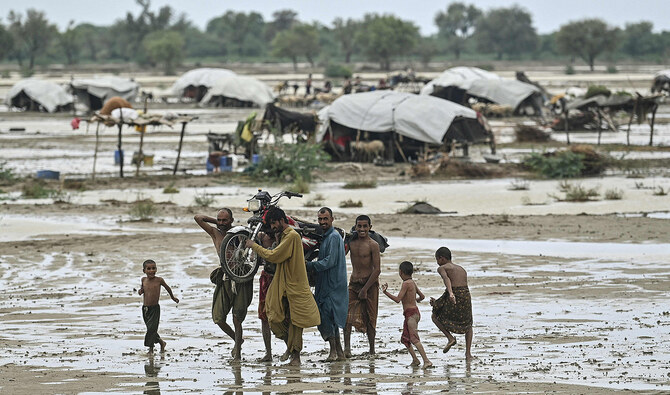
KARACHI: A fact-finding mission conducted by a network of rights activists in South Asia on Friday criticized Pakistan’s response to the devastating 2022 floods, highlighting significant shortcomings in housing, sanitation and health care for flood-affected communities in Sindh.
The 2022 floods, triggered by unprecedented monsoon rains and glacial melt, displaced millions, killed over 1,700 people and caused damages exceeding $35 billion, leaving vast areas submerged for months.
The fact-finding team of South Asians for Human Rights (SAHR) visited Sindh, surveying several districts, including Larkana, Shikarpur, Nawabshah and Hyderabad, from January 6-10 to assess the government’s compensation and rehabilitation efforts.
“The preliminary findings contradict the provincial government’s claims of launching one of the world’s largest housing projects for flood affectees,” said Ahmad Rafay Alam, an environmental lawyer and SAHR Bureau Member, during a press conference in Karachi.
The mission raised serious concerns over the proposed one-room “flood-resilient” housing model, calling it insufficient and lacking essential amenities such as kitchens and toilets.
“With skyrocketed inflation, the Rs300,000 ($1,077) compensation per house is unreasonably low,” SAHR said in a statement.
It maintained there was not much consultation while designing the houses, questioning their climate resilience and warning they were unlikely to survive future disasters.
“More severe natural calamities will impact this vulnerable population, and it is highly unlikely that these structures can withstand another heavy rain,” it noted.
In Dhand, a village near Mohenjo Daro, SAHR found that only four out of 40 destroyed houses had been rebuilt.
“Some families still live in tents or neighbors’ homes, and with average family sizes of six people, it is impossible to live in these single rooms, especially when some family members are married,” it said.
The regional rights network urged the government to conduct fresh surveys to ensure no genuinely affected individuals were left out. It informed that many residents had reported difficulty in finding their names on government beneficiary lists, delaying relief.
SAHR also highlighted poor sanitation and health care in affected areas, reporting that villages lacked drainage systems, leading to outbreaks of diarrhea, malaria and skin infections.
Arab News reached out to provincial officials, including Sindh’s Information Minister Sharjeel Memon and Chief Minister Murad Ali Shah’s spokesperson Rasheed Channa, but received no response.
Sadia Javed, another government spokesperson, said she would review the mission’s findings but had not responded by the time of filing this report.

Rights network criticizes flood compensation and rehabilitation efforts in Sindh
https://arab.news/zmpw6
Rights network criticizes flood compensation and rehabilitation efforts in Sindh
- Network’s fact-finding team says not much consultation was done while designing houses for flood-hit families
- It says these one-room ‘flood-resilient’ structures lack basic amenities like toilets, can’t withstand heavy rain
Pakistan PM orders accelerated privatization of power sector to tackle losses
- Tenders to be issued for privatization of three major electricity distribution firms, PMO says
- Sharif says Pakistan to develop battery energy storage through public-private partnerships
ISLAMABAD: Pakistan’s prime minister on Monday directed the government to speed up privatization of state-owned power companies and improve electricity infrastructure nationwide, as authorities try to address deep-rooted losses and inefficiencies in the energy sector that have weighed on the economy and public finances.
Pakistan’s electricity system has long struggled with financial distress caused by a combination of factors including theft of power, inefficient collection of bills, high costs of generating electricity and a large burden of unpaid obligations known as “circular debt.” In the first quarter of the current financial year, government-owned distribution companies recorded losses of about Rs171 billion ($611 million) due to poor bill recovery and operational inefficiencies, official documents show. Circular debt in the broader power sector stood at around Rs1.66 trillion ($5.9 billion) in mid-2025, a sharp decline from past peaks but still a major fiscal drain.
Efforts to contain these losses have been a focus of Pakistan’s economic reform program with the International Monetary Fund, which has urged structural changes in the energy sector as part of financing conditions. Previous government initiatives have included signing a $4.5 billion financing facility with local banks to ease power sector debt and reducing retail electricity tariffs to support economic recovery.
“Electricity sector privatization and market-based competition is the sustainable solution to the country’s energy problems,” Prime Minister Shehbaz Sharif said at a meeting reviewing the roadmap for power sector reforms, according to a statement from the prime minister’s office.
The meeting reviewed progress on privatization and infrastructure projects. Officials said tenders for modernizing one of Pakistan’s oldest operational hubs, Rohri Railway Station, will be issued soon and that the Ghazi Barotha to Faisalabad transmission line, designed to improve long-distance transmission of electricity, is in the initial approval stages. While not all power-sector decisions were detailed publicly, the government emphasized expanding private sector participation and completing priority projects to strengthen the electricity grid.
In another key development, the prime minister endorsed plans to begin work on a battery energy storage system with participation from private investors to help manage fluctuations in supply and demand, particularly as renewable energy sources such as solar and wind take a growing role in generation. Officials said the concept clearance for the storage system has been approved and feasibility studies are underway.
Government briefing documents also outlined steps toward shifting some electricity plants from imported coal to locally mined Thar coal, where a railway line expansion is underway to support transport of fuel, potentially lowering costs and import dependence in the long term.
State authorities also pledged to address safety by converting unmanned railway crossings to staffed ones and to strengthen food safety inspections at stations, underscoring broader infrastructure and service improvements connected to energy and transport priorities.