


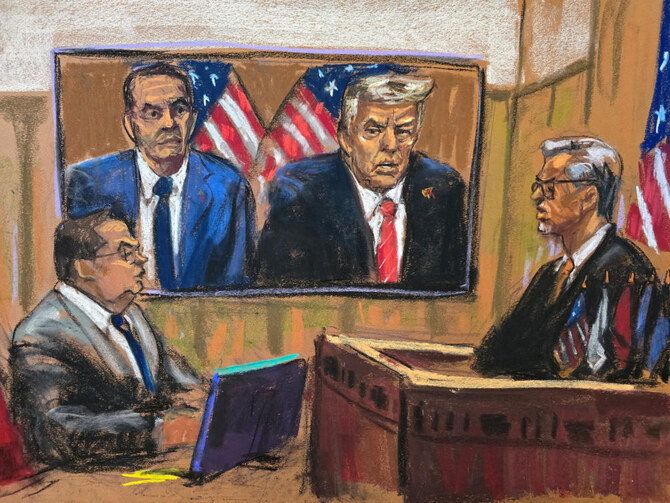
NEW YORK: President-elect Donald Trump was sentenced Friday to no punishment in his historic hush money case, a judgment that lets him return to the White House unencumbered by the threat of a jail term or a fine.
With Trump appearing by video from his Florida estate, the sentence quietly capped an extraordinary trial rife with moments unthinkable in the US only a few years ago.
It was the first criminal prosecution and first conviction of a former US president and major presidential candidate. The New York case became the only one of Trump’s four criminal indictments that has gone to trial and possibly the only one that ever will. And the sentencing came 10 days before his inauguration for his second term.
In roughly six minutes of remarks to the court, a calm but insistent Trump called the case “a weaponization of government” and “an embarrassment to New York.” He maintained that he did not commit any crime.
“It’s been a political witch hunt. It was done to damage my reputation so that I would lose the election, and, obviously, that didn’t work,” the Republican president-elect said by video, with US flags in the background. Beside him at his Mar-a-Lago property was defense lawyer Todd Blanche, whom Trump has tapped to serve as the second-highest ranking Justice Department official in his incoming administration.
After the roughly half-hour proceeding, Trump said in a post on his social media network that the hearing had been a “despicable charade.” He reiterated that he would appeal his conviction.
Manhattan Judge Juan M. Merchan could have sentenced the 78-year-old to up to four years in prison. Instead, Merchan chose a sentence that sidestepped thorny constitutional issues by effectively ending the case but assured that Trump will become the first president to take office with a felony conviction on his record.
Trump’s no-penalty sentence, called an unconditional discharge, is rare for felony convictions. The judge said that he had to respect Trump’s upcoming legal protections as president, while also giving due consideration to the jury’s decision.
“Despite the extraordinary breadth of those protections, one power they do not provide is the power to erase a jury verdict,” said Merchan, who had indicated ahead of time that he planned the no-penalty sentence.
As Merchan pronounced the sentence, Trump sat upright, lips pursed, frowning slightly. He tilted his head to the side as the judge wished him “godspeed in your second term in office.”
Before the hearing, a handful of Trump supporters and critics gathered outside. One group held a banner that read, “Trump is guilty.” The other held one that said, “Stop partisan conspiracy” and “Stop political witch hunt.”
Manhattan District Attorney Alvin Bragg, whose office brought the charges, is a Democrat.
The norm-smashing case saw the former and incoming president charged with 34 felony counts of falsifying business records, put on trial for almost two months and convicted by a jury on every count. Yet the legal detour — and sordid details aired in court of a plot to bury affair allegations — didn’t hurt him with voters, who elected him in November to a second term.
“The American voters got a chance to see and decide for themselves whether this was the kind of case that should’ve been brought. And they decided,” Blanche said Friday.
Prosecutors said that they supported a no-penalty sentence, but they chided Trump’s attacks on the legal system throughout the case.
“The once and future president of the United States has engaged in a coordinated campaign to undermine its legitimacy,” prosecutor Joshua Steinglass said.
Afterward, Trump was expected to return to the business of planning for his new administration. He was set later Friday to host conservative House Republicans as they gathered to discuss GOP priorities.
The specific charges in the hush money case were about checks and ledgers. But the underlying accusations were seamy and deeply entangled with Trump’s political rise.
Trump was charged with fudging his business’ records to veil a $130,000 payoff to porn actor Stormy Daniels. She was paid, late in Trump’s 2016 campaign, not to tell the public about a sexual encounter she maintains the two had a decade earlier. He says nothing sexual happened between them and that he did nothing wrong.
Prosecutors said Daniels was paid off — through Trump’s personal attorney at the time, Michael Cohen — as part of a wider effort to keep voters from hearing about Trump’s alleged extramarital escapades.
Trump denies the alleged encounters occurred. His lawyers said he wanted to squelch the stories to protect his family, not his campaign. And while prosecutors said Cohen’s reimbursements for paying Daniels were deceptively logged as legal expenses, Trump says that’s simply what they were.
Trump’s lawyers tried unsuccessfully to forestall a trial, and later to get the conviction overturned, the case dismissed or at least the sentencing postponed.
Trump attorneys have leaned heavily into assertions of presidential immunity from prosecution, and they got a boost in July from a Supreme Court decision that affords former commanders-in-chief considerable immunity.
Trump was a private citizen and presidential candidate when Daniels was paid in 2016. He was president when the reimbursements to Cohen were made and recorded the following year.
Merchan, a Democrat, repeatedly postponed the sentencing, initially set for July. But last week, he set Friday’s date, citing a need for “finality.”
Trump’s lawyers then launched a flurry of last-minute efforts to block the sentencing. Their last hope vanished Thursday night with a 5-4 Supreme Court ruling that declined to delay the sentencing.
Meanwhile, the other criminal cases that once loomed over Trump have ended or stalled ahead of trial.
After Trump’s election, special counsel Jack Smith closed out the federal prosecutions over Trump’s handling of classified documents and his efforts to overturn his 2020 election loss to Democrat Joe Biden. A state-level Georgia election interference case is locked in uncertainty after prosecutorFaniWillis was removed from it.


