

Saudi Arabia takes up position as secretariat of global coral reef body

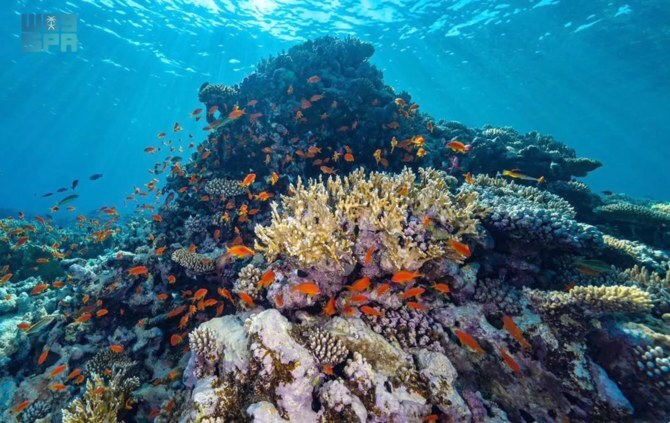
Saudi Arabia on Friday officially assumed its position as secretariat of the International Coral Reef Initiative, an organization that works to protect the planet’s coral reefs. (SPA/File Photo)
Short Url
Updated 10 January 2025
Follow

Saudi Arabia takes up position as secretariat of global coral reef body

  • Coral reefs sustain 25 percent of the world’s marine biodiversity and generate an estimated $9.9 trillion annually in ecosystem services

JEDDAH: Saudi Arabia on Friday officially assumed its position as secretariat of the International Coral Reef Initiative, an organization that works to protect the planet’s coral reefs.

Representing 102 members and 45 countries responsible for 75 percent of the world’s reefs, ICRI plays a role in tackling environmental and economic challenges facing these vital ecosystems.

The virtual handover ceremony was attended by international representatives, including Peter Thomson, the UN’s special envoy for the ocean, as well as representatives from organizations such as the International Union for Conservation of Nature and the US State Department.

The Kingdom’s tenure as head of the body was confirmed during the ICRI’s 38th General Meeting in September 2024 and will be led by the Kingdom’s General Organization for the Conservation of Coral Reefs and Turtles in the Red Sea, also known as SHAMS.

“Saudi Arabia’s role as ICRI secretariat underscores our unwavering commitment to a sustainable future for coral reefs worldwide,” said Dr. Khaled Asfahani, CEO of SHAMS and chair of ICRI. “Through science, innovation, and collaboration, we aim to protect these vital ecosystems, ensuring their resilience for future generations while maintaining their invaluable contributions to the global economy.”

Coral reefs sustain 25 percent of the world’s marine biodiversity and generate an estimated $9.9 trillion annually in ecosystem services, from fisheries to tourism.

Yet, they are under siege from climate change, pollution, and overfishing. With Saudi Arabia at the helm, ICRI will craft its 2025–2027 Action Plan to address these threats.

The plan seeks to expand membership to include countries representing 90 percent of global coral reefs, strengthen regional collaborations in the Red Sea, South Asia, and East Africa, and integrate reef resilience into global biodiversity policies.


Royal reserve intensifies efforts for environmental conservation

Updated 05 December 2025
Follow

Royal reserve intensifies efforts for environmental conservation

  • Protection contributes toward sustainability to align with Saudi Vision 2030

RIYADH: The King Salman bin Abdulaziz Royal Reserve Development Authority is intensifying efforts to protect the vegetation, wildlife, and public property within its reserve, the largest in the Kingdom at 130,700 sq. km.

Distinguished by its nature, terrain and archaeological sites (some dating back to 8000 B.C.), its protection contributes to environmental sustainability and aligns with Saudi Vision 2030’s goal of making the Kingdom a global environmental tourist destination, the Saudi Press Agency reported.

The authority’s efforts include enforcing regulations against violators, in partnership with the Special Forces for Environmental Security; rehabilitating damaged lands affected by overgrazing and desertification; planting nearly 4 million seedlings; rehabilitating 750,000 hectares of degraded land to restore plant life; and distributing tonnes of native wild seeds.

The authority has urged adherence to regulations, stressing continuous monitoring and enforcement against violations.

The royal reserve, a vast ecological haven across the Northern Borders, Jouf, Tabuk and Hail regions, is a vital hub for migratory birds. It is home to more than 290 bird species, with 88 percent being migratory and 12 percent resident.

This accounts for 58 percent of all bird species recorded in the Kingdom. The reserve also protects 26 bird species listed as threatened on the International Union for Conservation of Nature Red List.

The reserve serves as the Kingdom’s first stop for flocks arriving from Asia and Europe in the autumn, and their last station before departing in spring.

With its rich biodiversity, balanced environment and varied landscapes, the reserve also stands as a natural sanctuary, hosting remarkable species such as the steppe eagle, the eastern imperial eagle, and the houbara bustard.