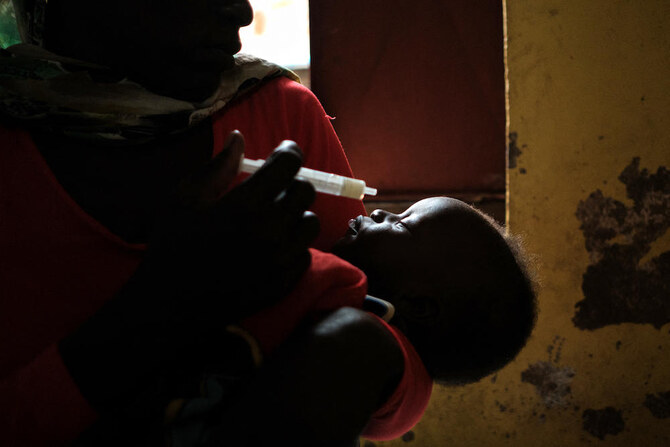
PORT SUDAN, Sudan: An estimated 3.2 million children under the age of five are expected to face acute malnutrition this year in war-torn Sudan, according to the United Nations Children’s Fund (UNICEF).
“Of this number, around 772,000 children are expected to suffer from severe acute malnutrition,” Eva Hinds, UNICEF Sudan’s Head of Advocacy and Communication, told AFP late on Thursday.
Famine has already gripped five areas across Sudan, according to a report last month by the Integrated Food Security Phase Classification (IPC), a UN-backed assessment.
Sudan has endured 20 months of war between the army and the paramilitary Rapid Support Forces (RSF), killing tens of thousands and, according to the United Nations, uprooting 12 million in the world’s largest displacement crisis.
Confirming to AFP that 3.2 million children are currently expected to face acute malnutrition, Hinds said “the number of severely malnourished children increased from an estimated 730,000 in 2024 to over 770,000 in 2025.”
The IPC expects famine to expand to five more parts of Sudan’s western Darfur region by May — a vast area that has seen some of the conflict’s worst violence. A further 17 areas in western and central Sudan are also at risk of famine, it said.
“Without immediate, unhindered humanitarian access facilitating a significant scale-up of a multisectoral response, malnutrition is likely to increase in these areas,” Hinds warned.
Sudan’s army-aligned government strongly rejected the IPC findings, while aid agencies complain that access is blocked by bureaucratic hurdles and ongoing violence.
In October, experts appointed by the United Nations Human Rights Council accused both sides of using “starvation tactics.”
On Tuesday the United States determined that the RSF had “committed genocide” and imposed sanctions on the paramilitary group’s leader.
Across the country, more than 24.6 million people — around half the population — face “high levels of acute food insecurity,” according to IPC, which said: “Only a ceasefire can reduce the risk of famine spreading further.”

UN says 3 million Sudan children facing acute malnutrition
https://arab.news/racxh
UN says 3 million Sudan children facing acute malnutrition
- Famine has already gripped five areas across Sudan, according to a report last month
- Sudan has endured 20 months of war between the army and the paramilitary forces
As Iran conflict spills over, Iraq’s Kurds say ‘this war is not mine’
- The Kurds, an ethnic minority with a distinct culture and language, are rooted in the mountainous region spread across Turkiye, Syria, Iraq and Iran
- American bases there have come under fire, as have positions held by Iranian Kurdish parties — the same ones US President Donald Trump said it would be “wonderful” to see storm Iran
SORAN, Iraq: On a deserted road not too far from the border between Iran and Iraqi Kurdistan, Satar Barsirini looked up at the sky, now streaked with jets and drones.
Iraq’s Kurdish region has found itself caught in the crossfire of a regional war triggered by US and Israeli attacks on the Islamic republic.
Dressed like the Kurdish fighters he once served alongside, Barsirini still wears the khaki shalwar, fitted jacket and scarf wrapped around his waist.
Though recently retired, he refuses to give up his peshmerga uniform as he tills his small plot of land.
The rumble of jets and hum of drones “come from everywhere. Especially at night,” he told AFP in the hamlet of Barsirini, dozens of kilometers from the border.
He described the “shiver in our flesh” as the drones hit the ground outside.
“I feel bad for the people, because we have paid a lot in blood to liberate Kurdistan... We just want to live.”
Irbil, the autonomous region’s capital, and the valleys leading to the border have been targeted by Tehran and the Iraqi armed groups it supports.
American bases there have come under fire, as have positions held by Iranian Kurdish parties — the same ones US President Donald Trump said it would be “wonderful” to see storm Iran.
But Iran warned on Friday it would target facilities in Iraqi Kurdistan if fighters crossed into its territory.
“This isn’t my war,” said 58-year-old Barsirini.
He recalled the brutal repression and flight into the snowy mountains after the 1991 Kurdish uprising that followed the first Gulf War.
- ‘Dangerous people’ -
The uprising was repressed, leading to an exodus of two million Kurds to Iran and Turkiye.
“When we fled the cities for our lives, we went to Iran. They helped us, they gave us shelter and food,” he said.
The Kurds would not forget that, Barsirini stressed, adding that they could not just “turn against them” now to support the US and Israel.
“I don’t trust (Americans). They are dangerous people,” he said.
The Kurds, an ethnic minority with a distinct culture and language, are rooted in the mountainous region spread across Turkiye, Syria, Iraq and Iran.
They have long fought for their own homeland, but for decades suffered defeats on the battlefield and massacres in their hometowns.
They make up one of Iran’s most important non-Persian ethnic minority groups.
A week of war has gripped daily life in Iraqi Kurdistan, residents told AFP.
“People are afraid,” said Nasr Al-Din, a 42-year-old policeman who, as a child, lived through the 1991 exodus — “thrown on a donkey’s back with my sister.”
“This generation is different from the older ones” that have seen “seen fighting.”
Now, he said, you could be “sitting down in your home... and all of a sudden a drone hits your house.”
“We may have to go into town or somewhere safer,” said Issa Diayri, 31, a truck driver waiting in a roadside garage, his lorry idle for lack of deliveries from Iran.
- ‘Shouldn’t get involved’ -
Soran, a small town of 3,000 people about 65 kilometers (40 miles) from the border, was hit Thursday by a drone that fell in the middle of a street.
There, baker Yussef Ramazan, 42, and his three apprentices, hurriedly made bread before breaking their fast.
But, living so close to the Iranian border, he said “people are afraid to come and buy it.”
He told AFP he did not think it was a good idea “for the Kurdish region to get involved in this war.”
“We are not even an independent country yet. We would like to become one, but we are nothing for now, so we shouldn’t get involved in these situations.”
Across the street, Hajji watched from his empty dry cleaning shop as the road cleared.
Before the war, the town was crowded as evening fell, he said, declining to give his full name.
“But after the drone explosion, no one was here. In five minutes, everyone left the street and no one was out.”


