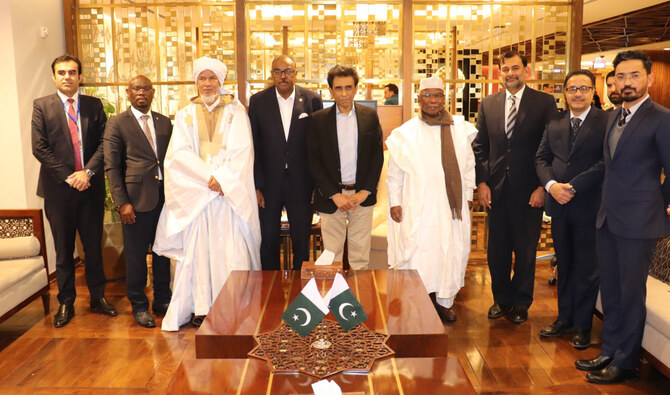
ISLAMABAD: Organization of Islamic Cooperation (OIC) Secretary-General Hissein Brahim Taha has arrived in Pakistan to attend a global conference on girls’ education in Muslim countries, according to the Pakistani education ministry.
Pakistan’s education ministry will host the global conference titled, “Girls’ Education in Muslim Communities: Challenges and Opportunities,” in Islamabad on Jan. 11-12.
Around 150 representatives from 47 countries, including education experts, religious scholars, diplomats, and politicians are expected to partake in the summit.
Pakistani Education Minister Khalid Maqbool Siddiqui received the OIC secretary-general upon arrival in the South Asian country.
“Bringing together global leaders, educators, and changemakers to discuss innovative solutions and inspire progress for #GirlsEducation in Muslim communities,” the Pakistani education ministry said on Friday.
“This landmark event is a step toward creating opportunities, breaking barriers, and empowering future generations. Let’s ensure #EducationForAll and drive meaningful #GlobalConversations that transform lives!“
Prime Minister Shehbaz Sharif will inaugurate the conference and deliver a keynote address at the opening session on Saturday. Pakistan’s foreign office said Sharif will reaffirm the nation’s commitment to promoting girls’ education and gender equality.
An “Islamabad Declaration” will be announced at the end of the conference on Sunday that would outline decisive steps to transform girls’ education in Islamic countries, according to Siddiqui.
Nobel Peace Prize Laureate Malala Yousafzai will also attend the summit in person, a spokesperson for the Malala Fund charity confirmed.
Yousafzai was evacuated from Pakistan in 2012 after being shot by the Pakistan Taliban, who were enraged by her activism, and she has returned to the country only a handful of times since.
“I am excited to join Muslim leaders from around the world for a critical conference on girls’ education,” she said Friday in a post on X.
“On Sunday, I will speak about protecting rights for all girls to go to school, and why leaders must hold the Taliban accountable for their crimes against Afghan women & girls.”
Pakistan’s neighbor Afghanistan is the only country in the world where girls and women are banned from going to secondary schools and universities.
On Thursday, Siddiqui said the primary aim of the conference is to stress the implementation of the Islamic message, which clearly states that both men and women have the right to education.
“By promoting girls’ education, we can build better homes, a better society and a stronger nation,” he said.
The Pakistani education minister hoped that Afghanistan would also join representatives from other Islamic countries and attend the conference in Islamabad.
“We have extended an invitation to Afghanistan to participate in this conference and hope that their delegation will attend as it is a very important neighboring country,” he told reporters at a media briefing in Islamabad.
Since the Taliban’s return to power in 2021, at least 1.4 million Afghan girls have been denied access to secondary education, according to a report by the United Nations International Children’s Emergency Fund (UNICEF) released in August last year.
Siddiqui said everyone respects tribal customs and cultures, but all such practices must align with Islamic values in Muslim countries, adding that nothing holds precedence over them.
“In Islam, there is no justification for restricting women’s education,” he added.


![]()

OIC secretary-general arrives in Pakistan to attend summit on girls’ education in Muslim countries
Short Url
https://arab.news/j39pc
OIC secretary-general arrives in Pakistan to attend summit on girls’ education in Muslim countries
- The conference’s aim is to stress Islam’s message that both men, women have right to education
- Nobel Peace Prize Laureate Malala Yousafzai will also attend the summit in Islamabad in person
Latest updates





© 2026 SAUDI RESEARCH & PUBLISHING COMPANY, All Rights Reserved And subject to Terms of Use Agreement.