EU medical aid crosses into Syria from Turkiye

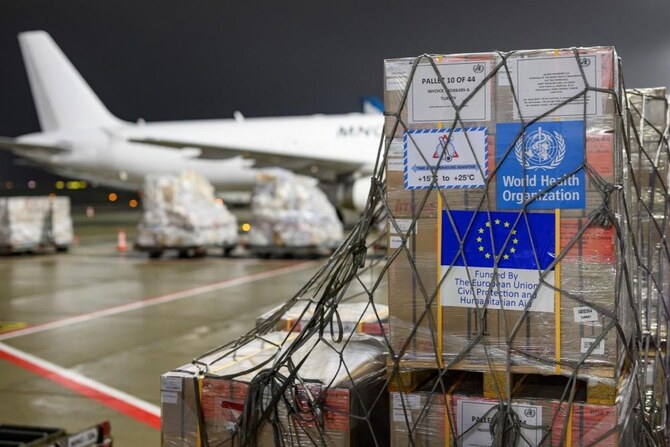
The aim is to support Syria’s battered healthcare system following the ouster of Bashar Assad on Dec. 8. (AFP/File)
Short Url
Updated 09 January 2025
Follow

EU medical aid crosses into Syria from Turkiye

ISTANBUL: Some 55 tonnes of EU-funded medical supplies entered northwestern Syria from Turkiye on Thursday, a UN health official said.
Part of an EU air bridge to Syria, the supplies crossed Turkiye’s southern Cilvegozu border post and were taken to a warehouse in the northwestern city of Idlib, Mrinalini Santhanam of the World Health Organization said.
“There’s one more air bridge, and it is planned for February,” she said, adding that it was “still in the planning stages” with talks “to determine the volume and the scale.”
The supplies, distributed to Idlib and the Aleppo region health care centers, are part of an EU humanitarian bridge announced by Brussels on Dec. 13.
The aim is to support Syria’s battered healthcare system following the ouster of Bashar Assad on Dec. 8.
Included in the shipment were 8,000 emergency surgical kits, anesthetic supplies, IV fluids, sterilization materials, and medications to prevent disease outbreaks, the WHO said.
The civil war, which broke out in 2011, devastated Syria’s health care system, with “almost half of the hospitals (there) not functional,” WHO planning analyst Lorenzo Dal Monte said in late December.
He said the 50-tonne shipment from Dubai included “mainly trauma and surgical kits.”
Another five tonnes of supplies were brought in from another stockpile in Demark, including emergency health kits as well as winter clothing and water purification tablets, the WHO said.


Israel begins demolishing residential buildings in West Bank camp

Updated 4 sec ago
Follow

Israel begins demolishing residential buildings in West Bank camp

  • The 25 buildings were home to about 100 families in the Nur Shams refugee camp
  • Israeli military claims demolitions are part of effort to root out armed groups in northern areas of the territory
NUR SHAMS, occupied West Bank: Israeli bulldozers began demolishing 25 buildings housing Palestinians in a refugee camp on Wednesday, in what the military said was an effort to root out armed groups in northern areas of the occupied West Bank.
The buildings, home to some 100 families, are in the Nur Shams camp, a frequent site of clashes between Palestinian militants and Israeli forces.
Israeli military bulldozers and cranes tore through the structures early Wednesday, sending thick plumes of dust into the air, an AFP journalist reported. Many residents watched from a distance.
The military said the demolitions were part of an operation against militants.
“Following ongoing counterterrorism activity by Israeli security forces in the area of Nur Shams in northern Samaria, the commander of the Central Command, Major General Avi Bluth, ordered the demolition of several structures due to a clear and necessary operational need,” the military told AFP in a statement.
“Areas in northern Samaria have become a significant center of terrorist activity, operating from within densely populated civilian areas.”
Earlier this year, the military launched an operation it said was aimed at dismantling Palestinian armed groups from camps in northern West Bank — including Nur Shams, Tulkarem and Jenin.
“Even a year after the beginning of IDF operations in the area, forces continue to locate ammunition, weapons, and explosive devices used by terrorist organizations, which endanger IDF soldiers and impair operational freedom of action,” the military said on Wednesday.
Earlier in December, AFP reported residents of the targeted buildings retrieving their belongings, with many saying they had nowhere to go.
The demolitions form part of a broader Israeli strategy aimed at easing access for military vehicles within the densely built refugee camps of the West Bank.
Israel has occupied the Palestinian territory since 1967.
Nur Shams, along with other refugee camps in the West Bank, was established after the creation of Israel in 1948, when hundreds of thousands of Palestinians were displaced from their homes in what is now Israel.
With time, the camps they established inside the West Bank became dense neighborhoods not under their adjacent cities’ authority. Residents pass on their refugee status from one generation to the next.
Many residents believe Israel is seeking to destroy the idea of the camps themselves, turning them into regular neighborhoods of the cities they flank, in order to eliminate the refugee issue.