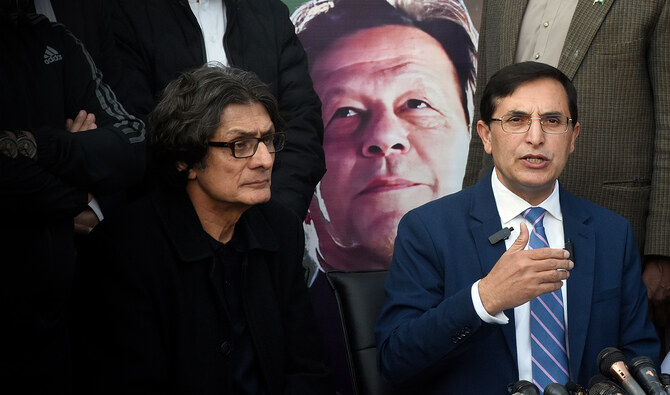
ISLAMABAD: Former prime minister Imran Khan has allowed his Pakistan Tehreek-e-Insaf (PTI) party to submit its demands in writing to the government during the next round of negotiations between the two sides, Khan’s top aide and PTI Chairman Gohar Ali Khan said on Wednesday, as both sides attempt to break the political deadlock in the country.
The second round of discussions between the two sides took place on Jan. 2 ended inconclusively after Khan’s party demanded more time to meet and consult the ex-PM before submitting their demands in writing.
Khan’s ouster in a parliamentary no-trust vote in 2022 has plunged Pakistan into a political crisis, particularly since he was jailed in August 2023 on corruption and other charges. His party has regularly held protests to demand his release, with many of the demonstrations turning violent.
“Today Khan has said that you can give our demands in writing [to the government],” Gohar Ali Khan told reporters after his meeting with the former prime minister at the central prison in Rawalpindi. “So we will give our demands at the negotiation table in writing.”
Khan’s party has previously stated two demands: the release of all political prisoners and the establishment of judicial commissions to investigate protests on May 9, 2023, and Nov. 26, 2024, which the government says involved Khan supporters, accusing them of attacking military installations and government buildings.
“We will present our two demands in writing because even though there is no need to do so, we don’t want it to [delay the talks] by using it as a reason,” he said.
At a press conference on Wednesday evening, Special Assistant to the Prime Minister on Political Affairs Rana Sanaullah said talks between both sides had been paused as National Assembly Speaker Ayaz Sadiq, who is heading the government’s delegation, has left the country on an “emergency” visit to a foreign country.
“As soon as he returns, the second meeting that they want [with Imran Khan] will be held and after that we expect that they will present their demands seriously,” Sanaullah told reporters.
The next date for talks between the PTI and the government has not been finalized. Last week, Senator Irfan Siddiqui, a member of the government’s negotiation committee, said the talks could encounter “serious hurdles” due to the PTI’s failure to submit its demands in writing at the next meeting.

Imran Khan has allowed party to submit demands to Pakistan government in writing — aide
https://arab.news/vusw3
Imran Khan has allowed party to submit demands to Pakistan government in writing — aide
- Second round of discussions between both sides ended inconclusively last week after Khan’s party demanded more time to consult ex-PM
- PM’s special assistant on political affairs says negotiations to resume after National Assembly Speaker Ayaz Sadiq returns from overseas trip
Pakistan’s deputy PM says country will not send forces to Gaza to disarm Hamas
- Ishaq Dar says Pakistan open to peacekeeping but Gaza’s internal security is Palestinian responsibility
- Pakistan’s top religious clerics from different schools have warned against sending forces to Palestine
ISLAMABAD: Deputy Prime Minister Ishaq Dar said on Saturday Pakistan was willing to contribute to an international peacekeeping force in Gaza, though it would not deploy troops to disarm or de-weaponize Hamas.
The statement follows media reports saying Washington views Pakistan as a potentially significant contributor given its battle-hardened military and wants it to be part of International Stabilization Force (ISF), which is part of United States President Donald Trump’s 20-point framework for a Gaza peace plan.
The plan announced by Trump at the White House on September 29 was formally adopted at the Sharm El-Sheikh Peace Summit in October. Co-chaired by Trump and Egyptian President Abdel Fattah El-Sisi, the summit brought together leaders from 27 countries to sign the “Trump Declaration for Enduring Peace and Prosperity.”
Deployment of troops from Muslim-majority countries during a transitional stabilization phase is a key part of the plan before the war-ravaged Palestinian territory moves toward reconstruction and a longer-term political settlement.
“If they say that we should go and start fighting, disarm Hamas, de-weaponize them, and go and destroy the tunnels that Hamas has built until now, that is not our job,” Dar, who is also the country’s foreign minister, told reporters during a year-end briefing in Islamabad.
He emphasized there was clarity between Pakistan’s civil and military leadership over the matter.
“We have a very complete understanding on this matter that we cannot do that kind of work,” he added.
The deputy prime minister said Pakistan had been using the term “peacekeeping” and had never used the phrase “peace enforcement” while discussing the force.
“I have been very clear: Pakistan will be happy to join if the mandate is not peace enforcement and disarming and de-weaponizing Hamas.”
The government’s stance comes amid growing domestic pressure over the issue.
On Monday, a group of Pakistan’s top religious leaders, chaired by prominent scholar Mufti Taqi Usmani, warned the government against yielding to what they described as international pressure to send forces to Gaza.
In a joint statement from Karachi, the clerics — representing Deobandi, Barelvi, Ahl-e-Hadees and Shia schools of thought — said that Washington wanted Muslim countries to send their forces to Gaza to disarm Hamas.
“Several Muslim governments have already refused this, and pressure is being increased on Pakistan,” it added.
Addressing such concerns, Dar said Pakistan would not land its forces in Palestine to “fight Muslims.”
Israel has repeatedly called for the disarmament of Hamas as a precondition for any long-term settlement, and the United Nations Security Council has also endorsed the ISF framework in November.
However, Dar maintained during the media briefing the internal security of Gaza was the Palestinian responsibility.
“The Palestinian Authority, their government, it is their job, it is the job of their law enforcement agency,” he said
The deputy prime minister also highlighted Pakistan’s involvement in the “Arab Islamic Group of Eight,” including Saudi Arabia, Jordan, Egypt, the United Arab Emirates, Qatar, Turkiye and Indonesia, which has been coordinating on the crisis.
He said the efforts of these countries had brought some peace to Palestine and reduced bloodshed.
“Our declared policy is that there should be an independent two-state solution,” he continued while calling for pre-1967 borders.


