Imran Khan has allowed party to submit demands to Pakistan government in writing — aide

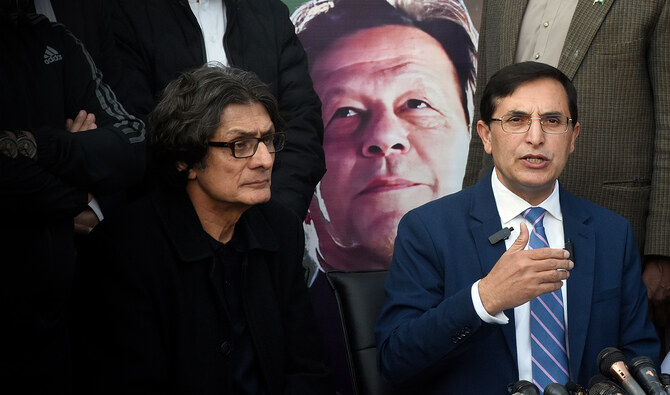
Gohar Ali Khan, chairman of Pakistani former Prime Minister Imran Khan’s Pakistan Tehreek-Insaf (PTI) party, addresses a press conference at the party’s office in Islamabad on February 10, 2024. (REUTERS/File)
Short Url
Updated 08 January 2025
Follow

Imran Khan has allowed party to submit demands to Pakistan government in writing — aide

  • Second round of discussions between both sides ended inconclusively last week after Khan’s party demanded more time to consult ex-PM
  • PM’s special assistant on political affairs says negotiations to resume after National Assembly Speaker Ayaz Sadiq returns from overseas trip 

ISLAMABAD: Former prime minister Imran Khan has allowed his Pakistan Tehreek-e-Insaf (PTI) party to submit its demands in writing to the government during the next round of negotiations between the two sides, Khan’s top aide and PTI Chairman Gohar Ali Khan said on Wednesday, as both sides attempt to break the political deadlock in the country. 
The second round of discussions between the two sides took place on Jan. 2 ended inconclusively after Khan’s party demanded more time to meet and consult the ex-PM before submitting their demands in writing.
Khan’s ouster in a parliamentary no-trust vote in 2022 has plunged Pakistan into a political crisis, particularly since he was jailed in August 2023 on corruption and other charges. His party has regularly held protests to demand his release, with many of the demonstrations turning violent.
“Today Khan has said that you can give our demands in writing [to the government],” Gohar Ali Khan told reporters after his meeting with the former prime minister at the central prison in Rawalpindi. “So we will give our demands at the negotiation table in writing.”
Khan’s party has previously stated two demands: the release of all political prisoners and the establishment of judicial commissions to investigate protests on May 9, 2023, and Nov. 26, 2024, which the government says involved Khan supporters, accusing them of attacking military installations and government buildings.
“We will present our two demands in writing because even though there is no need to do so, we don’t want it to [delay the talks] by using it as a reason,” he said.
At a press conference on Wednesday evening, Special Assistant to the Prime Minister on Political Affairs Rana Sanaullah said talks between both sides had been paused as National Assembly Speaker Ayaz Sadiq, who is heading the government’s delegation, has left the country on an “emergency” visit to a foreign country. 
“As soon as he returns, the second meeting that they want [with Imran Khan] will be held and after that we expect that they will present their demands seriously,” Sanaullah told reporters. 
The next date for talks between the PTI and the government has not been finalized. Last week, Senator Irfan Siddiqui, a member of the government’s negotiation committee, said the talks could encounter “serious hurdles” due to the PTI’s failure to submit its demands in writing at the next meeting.


Pakistan’s president defends ongoing strikes in Afghanistan, urges Kabul to dismantle militants

Updated 02 March 2026
Follow

Pakistan’s president defends ongoing strikes in Afghanistan, urges Kabul to dismantle militants

  • Afghanistan on Thursday launched attacks in retaliation for Pakistani airstrikes the previous Sunday
  • Pakistan’s military says it is only targeting Afghan military installations to avoid civilian casualties

ISLAMABAD: Pakistan’s president on Monday defended his country’s ongoing military strikes in neighboring Afghanistan, saying Islamabad tried all forms of diplomacy before targeting militants operating from Afghan territory, and called on the Taliban government in Kabul to disarm groups responsible for attacks in Pakistan.

Pakistan earlier said it is in “open war” with Afghanistan, alarming the international community. The border area remains a stronghold for militant organizations including Al-Qaeda and the Daesh (Islamic State) group.

“(The Afghan Taliban) must choose to dismantle the terror groups that survive on conflict and its war economy,” Asif Ali Zardari said during a speech to lawmakers, adding that “no state accepts serial attacks on its soil.”

Afghanistan on Thursday launched attacks in retaliation for Pakistani airstrikes the previous Sunday. Since then, Pakistan has carried out operations along the border, with Information Minister Attaullah Tarar claiming the killing of 435 Afghan forces and the capture of 31 Afghan positions.

Kabul has denied such claims.

In Afghanistan, the deputy government spokesman Hamdullah Fitrat said Pakistan’s military fired mortar shells at a refugee camp in eastern Kunar province, killing three children and injuring three others.

Afghanistan’s defense ministry said Afghan forces carried out strikes targeting a Pakistani military facility near Paktia province, causing “substantial losses and heavy casualties.”

Pakistan’s military did not respond to questions. It has said Pakistan is only targeting Afghan military installations to avoid civilian casualties.

Pakistan has witnessed a surge of violence in recent months and blames it on the outlawed Pakistani Taliban, known as Tehreek-e-Taliban Pakistan or TTP. It operates both inside Pakistan and from Afghan territory.
Islamabad accuses Afghanistan’s Taliban government of providing safe havens for the TTP, which Kabul denies.

The latest cross-border fighting ended a ceasefire brokered by Qatar and Turkiye in October. The two sides failed to reach a permanent agreement during talks in Istanbul.

Zardari reiterated Pakistan’s call for talks, saying, “We have never walked away from dialogue.”

The Pakistani leader again accused Afghanistan of acting as a proxy for India by sheltering militant groups.

“Stop being used by another country as a battlefield for their ambitions,” he said.

Zardari cited a recent report from the United Nations Security Council’s monitoring team that described the presence of militant groups in Afghanistan as an extra-regional threat.