

Key Pakistan-China highway reopened after six days as protest over power outages ends

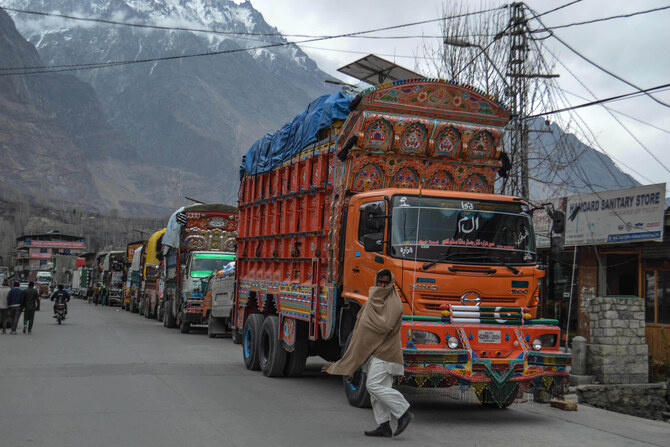
Stranded trucks stand along the Karakoram Highway, blocked by residents during a sit-in protest against power outages in Khaplu city, in Pakistan’s mountainous Gilgit-Baltistan region, on January 7, 2025. Hundreds of people blocked a highway on January 7 in Pakistan’s mountainous northern region in protest against power outages lasting longer than 20 hours, as temperatures plunged to minus 15 degrees Celsius. (AFP)
Short Url
Updated 08 January 2025
Follow

Key Pakistan-China highway reopened after six days as protest over power outages ends

  • Protesters were demanding an end to over 20-hour-long power outages in northern Pakistan
  • Protests ended after center agreed to allocate funds to run thermal generators, says official

KHAPLU, Gilgit-Baltistan: A key highway connecting Pakistan and China via land was reopened for trade and traffic on Wednesday after remaining blocked for six days, as hundreds of protesters agreed to end a sit-in protest against lengthy power outages in the country’s north. 
The protest, which began last week, involved residents, political parties and civil society groups who had blocked the Karakorum Highway (KKH) in Gilgit-Baltistan (GB) region against power outages for over 20 hours. 
The KKH, a vital trade and strategic route linking Pakistan with China, was obstructed at Aliabad, the district headquarters of Hunza. The area plays a critical role in bilateral trade facilitated by the China-Pakistan Economic Corridor (CPEC), which has increased since an agreement to keep the Khunjerab Pass open year-round for economic exchanges.
Protesters had demanded the GB government operate thermal generators to reduce the duration of the power outages during winters. The regional government said it was unable to run thermal generators due to lack of funds. 
Iman Shah, a spokesperson for the GB government, said a high-level meeting in Islamabad was held by the prime minister’s adviser on political affairs, Rana Sanaullah, to discuss the issue. It was decided that the center would allocate funds to run thermal generators in winter while a round of negotiations between protesters and the GB government was held in Hunza, he said. 
“After assuring to fulfil all of their demands, the sit-in has been called off by the protesters,” Shah told Arab News. 
“The thermal generators will be run in all power crisis-hit districts of GB. At least four hours of power will be provided via thermal generators,” Shah added.
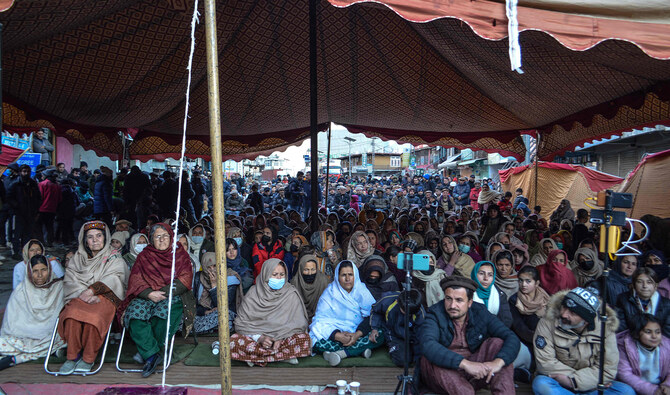


Residents stage a sit-in protest against power outages as they block the Karakoram Highway in Khaplu city, in Pakistan's mountainous Gilgit-Baltistan region, on January 7, 2025. (AFP)

Baba Jan, a member of the committee formed by protesters, confirmed a government delegation, including the GB additional chief secretary, held negotiations with protesters in Hunza on Wednesday. 
“And they announced to meet all of our written demands,” Jan told Arab News. “That’s why we decided to end the protest,” he said. 
“The KKH is opened for all kinds of traffic and protest have peacefully dispersed and returned their homes.”
Power cuts, known locally as load shedding, are a chronic issue in Pakistan, with many areas facing significant disruptions. The harsh winters in GB exacerbate the problem, leaving residents without adequate heating or access to essential services.
Faizullah Faraq, the GB government’s spokesperson, attributed lengthy power outages to the low flow of water during winters.


Pakistan Supreme Court halts trial of prominent lawyer over alleged anti-military tweets

Updated 7 sec ago
Follow

Pakistan Supreme Court halts trial of prominent lawyer over alleged anti-military tweets

  • Top court orders lower court to pause proceedings after lawyers allege due-process breaches
  • Mazari-Hazir, husband face charges under cybercrime law that carry up to 14 years in prison

ISLAMABAD: Pakistan’s Supreme Court on Thursday halted the cybercrime trial of prominent human rights lawyer Imaan Mazari-Hazir and her husband, Hadi Ali Chattha, after their lawyers argued that a lower court had recorded witness testimony in their absence, violating due-process rules.

Mazari-Hazir, one of Pakistan’s most outspoken civil liberties lawyers, and Chattha are being prosecuted under the Prevention of Electronic Crimes Act (PECA) over posts on X that authorities say incited ethnic divisions and portrayed the military as involved in “terrorism.” Both reject the allegations. If convicted under the relevant PECA provision, they face a prison term of up to 14 years.

The case has drawn broad attention in Pakistan’s legal community because Mazari-Hazir, who has been repeatedly detained over her criticism of the security establishment, argues that the trial court ignored basic procedural guarantees despite her medical leave request. The case also comes as Pakistan faces sustained scrutiny over the use of PECA against activists, journalists and political dissenters, with lawyers arguing that lower courts often move ahead without meeting minimum fair-trial standards.

The couple’s lawyer, Riasat Ali Azad, said his clients filed a petition in the Supreme Court because the lower court had moved ahead improperly.

“Today, the Supreme Court of Pakistan has stayed the lower court proceedings, the trial court proceedings and has said that the [Islamabad] High Court should decide our pending revision petition for which a date has already been fixed,” he told reporters.

Azad said the violation was clear under Pakistan’s Code of Criminal Procedure, which requires evidence to be recorded in the presence of the accused.

“Yet, on that very day, evidence of four witnesses was recorded in their absence, and a state counsel was appointed to conduct cross-examination on their behalf,” he said. “All these things are against the right to a fair trial under Articles 10 and 10-A.”

A three-judge bench led by Justice Muhammad Hashim Khan Kakar ordered the trial court to pause proceedings and instructed the Islamabad High Court to hear the couple’s pending criminal revision petition first.

The trial had been scheduled to resume on Dec.15, but the Supreme Court’s stay now freezes proceedings before both the additional sessions judge and the special PECA court. 

The Islamabad High Court is expected to hear the criminal revision petition next week.

Chattha, who is also a lawyer, said the SC ruling underscored the need for procedural safeguards.

“It is a victory for the constitution and the law,” he said, arguing that the trial court had ignored their request to re-record witness statements in their presence.