

Sharif says Pakistan’s tax slabs ‘prohibitive’ but vows to honor IMF commitments

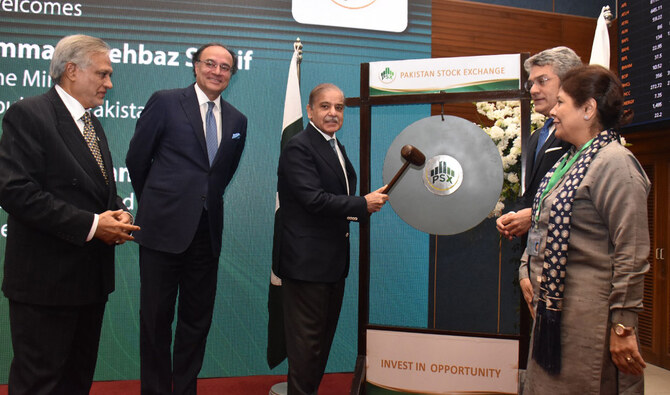
Pakistan Prime Minister Shehbaz Sharif rings the ceremonial gong during his visit to Pakistan Stock Exchange in Karachi on January 8, 2025. (PMO)
Short Url
Updated 08 January 2025
Follow

Sharif says Pakistan’s tax slabs ‘prohibitive’ but vows to honor IMF commitments

  • Shehbaz Sharif is in Karachi on day-long visit to inaugurate project to streamline customs clearance
  • Says Pakistan needs to build its relationship with the International Monetary Fund, achieve its targets

KARACHI: Prime Minister Shehbaz Sharif admitted on Wednesday that Pakistan’s tax slabs were “prohibitive” and were hindering businesses from growing but reiterated his government’s commitment to honor pledges made to the International Monetary Fund (IMF). 
Pakistan’s assembly passed the national budget in June 2024 with a challenging tax revenue target of Rs13 trillion ($46.66 billion) for the financial year starting July 1, 2024. This target was up about 40 percent from the last financial year. 
Islamabad’s move was in line with the IMF’s demands, which has urged Pakistan to undertake fiscal reforms, which include increasing its tax revenue and base. The measures helped Pakistan secure a $7 billion, 37-month financial bailout from the international lender last year. 
“Now see it is evident that our tax slabs, they are prohibitive,” Sharif told businesspersons and investors during a visit to the Pakistan Stock Exchange (PSX). 
“They won’t let businesses run. They won’t support investments. But we are in an IMF [International Monetary Fund] program mode. We have to honor the IMF’s commitments,” he added.
He said Islamabad could not afford to say “goodbye” to the IMF currently. 
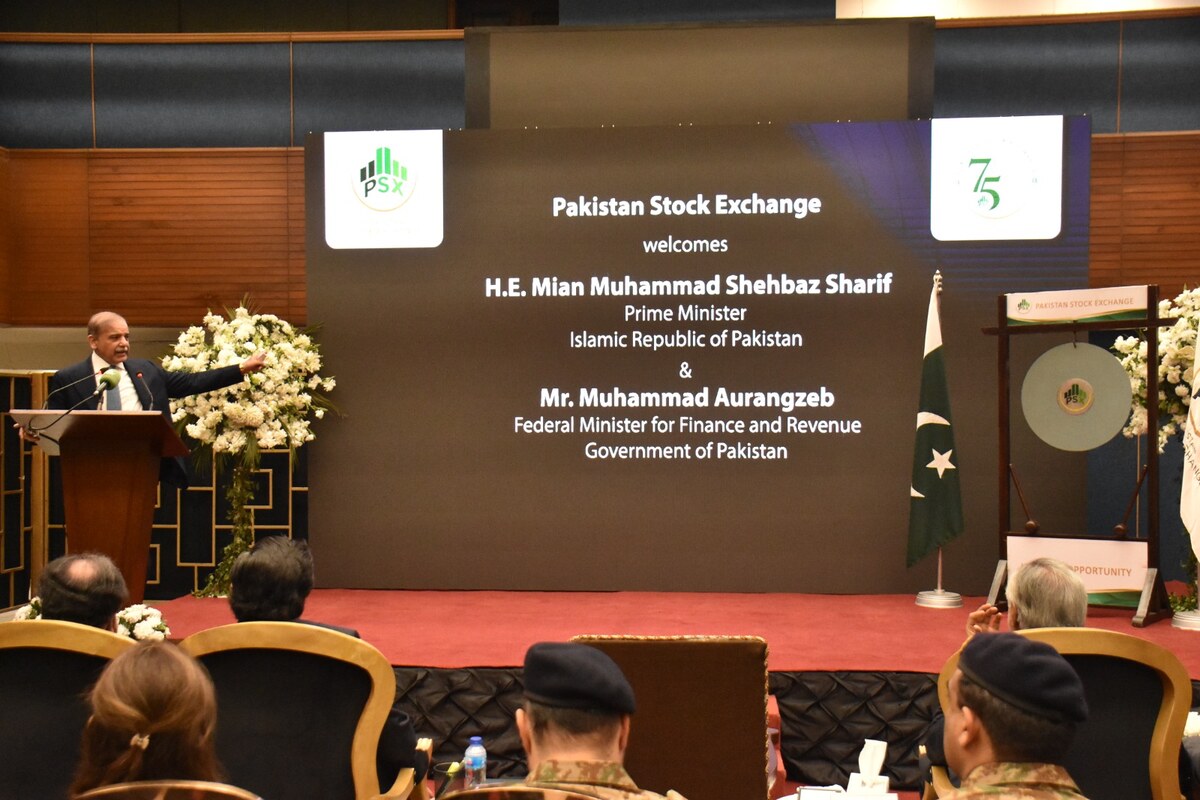


Pakistan Prime Minister Shehbaz Sharif addresses a ceremony at the Pakistan Stock Exchange in Karachi on January 8, 2025, to celebrate achievements by the equity market being the world’s second best performing market in 2024. (Photo courtesy: PMO)

“At present, we need to build this relationship and achieve those targets,” he said.
Sharif emphasized that while the IMF had set a target for Pakistan’s tax-to-GDP ratio at 10.6 percent, the government had managed to enhance it to 10.8 percent. 
“We now need to push forward to meet our goals,” he said. “We need to build up our finances, and to do that, we need loans from banks, capital investments for day-to-day expenses, and running operations.”
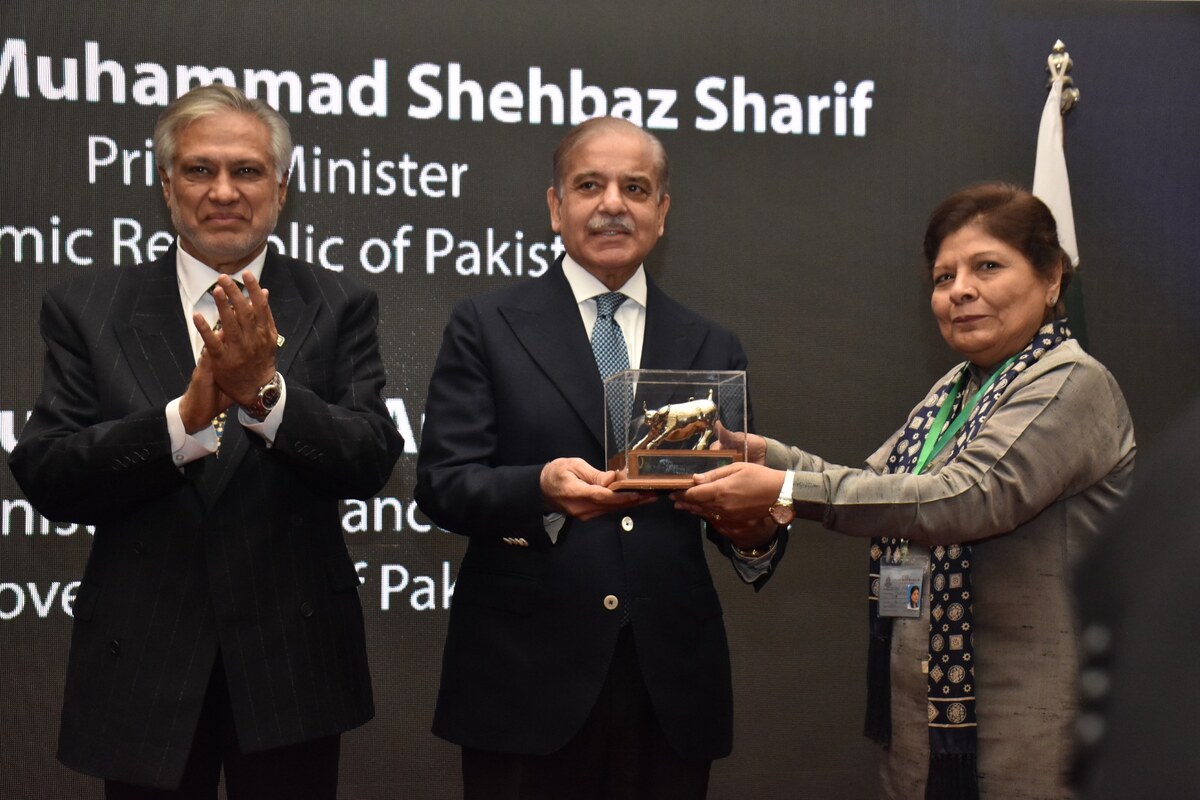


Pakistan Stock Exchange Chairperson Shamshad Akhtar (right) gives a souvenir to Prime Minister Shehbaz Sharif during his visit to Pakistan Stock Exchange in Karachi on January 8, 2025. (PMO)

Sharif also praised Pakistan’s business community, noting that some of its “bright minds” who were not just billionaires but “trillionaires,” were key to the country’s economic backbone as they were generating income, creating jobs and contributing to taxes.
His PSX visit comes at a time when the government aims to unlock both foreign and domestic investment to overcome a prolonged economic crisis. Pakistani officials have described the stock market’s strong performance last year as a reflection of growing investor confidence and the administration’s commitment to fiscal reforms and improved business facilitation.
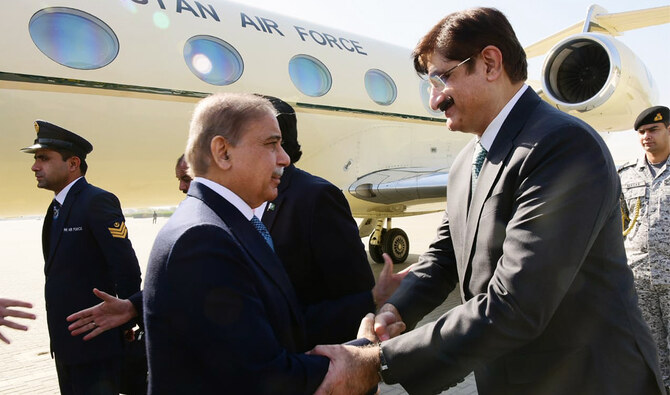


Murad Ali Shah (right), Chief Minister of Pakistan's Sindh province, receives Prime Minister Shehbaz Sharif in Karachi on January 8, 2025. (PID)

PM Sharif also inaugurated the Faceless Customs Assessment System during his visit to Karachi, launched as a pilot project in December 2024 that aims to streamline customs clearance through automation. 
By minimizing human interaction, the system seeks to enhance transparency, reduce clearance times and improve trade facilitation.
The initiative marks the first step in a broader government plan to scale up the system to upcountry ports and border stations in the coming months.
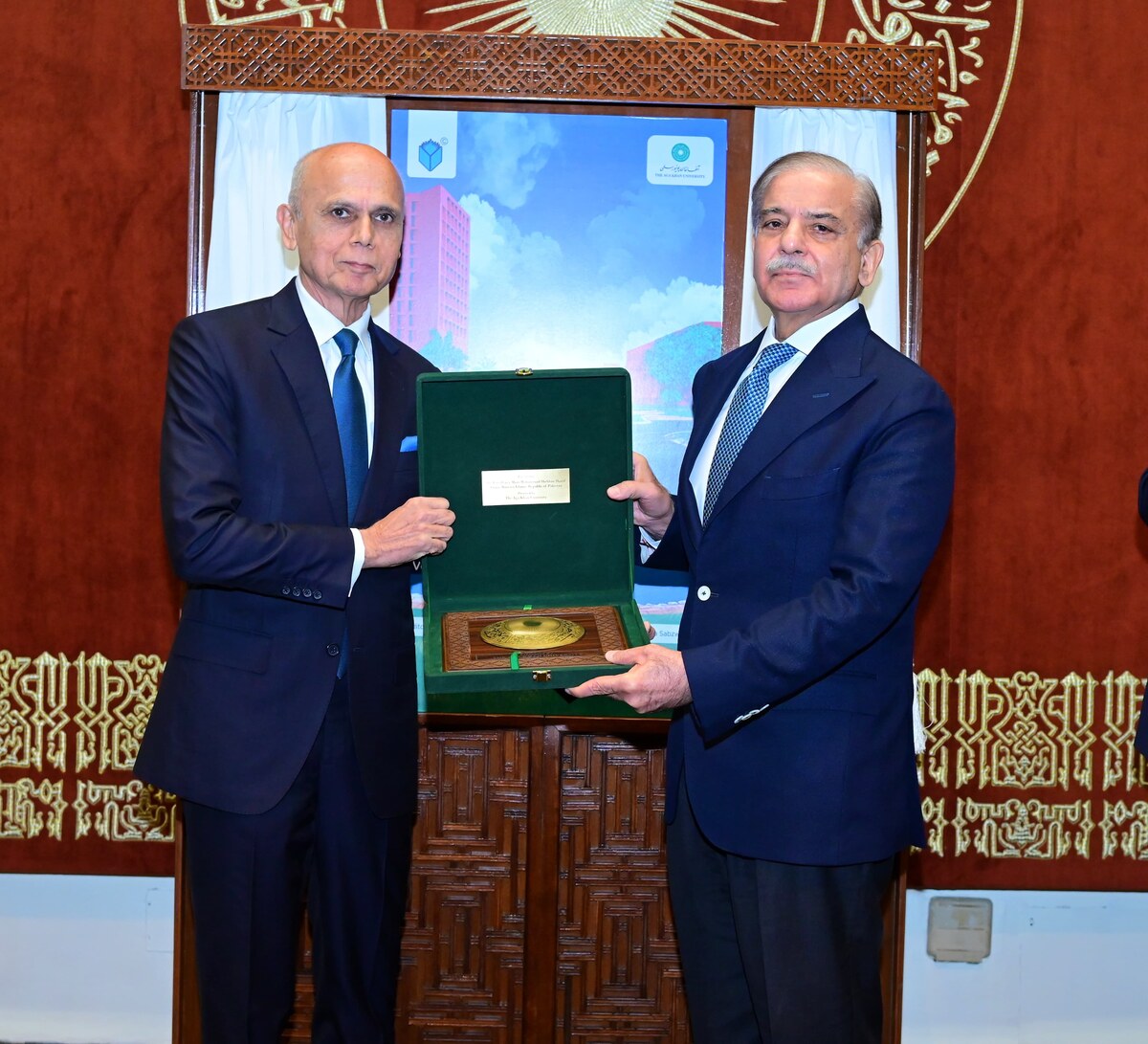


Pakistan Prime Minister Shehbaz Sharif receives a souvenir at the Aga Khan University in Karachi on January 8, 2025. (PMO)

Sharif attended the launch of the "Manual of Clinical Practice Guidelines" at Aga Khan University, calling it a milestone in Pakistan's health care sector. The guidelines are expected to standardize medical practices and improve health care delivery nationwide.


Curfew extended in Gilgit-Baltistan, probe ordered after deadly Khamenei protests

Updated 03 March 2026
Follow

Curfew extended in Gilgit-Baltistan, probe ordered after deadly Khamenei protests

  • At least 15 people were killed in clashes with law enforcement agencies over the weekend in Gilgit-Baltistan
  • Government also announces a de-weaponization campaign, crackdown on hate speech and cybercrime in region

ISLAMABAD: The government in Pakistan’s Gilgit-Baltistan (GB) region on Tuesday extended a curfew in Gilgit district and ordered a judicial probe into violent protests over the killing of Iranian Supreme Leader Ali Khamenei in US-Israeli strikes last week, an official said.

At least 15 people were killed in clashes with law enforcement agencies over the weekend in GB, where protesters torched and vandalized several buildings, including United Nations regional offices, an army-run school, software technology park and a local charity building.

The violence prompted regional authorities to impose curfew in Gilgit and Skardu districts on March 2-4 as officials urged people to stay indoors and cooperate with law enforcers, amid widespread anger in Pakistan, particularly among members of the Shiite minority, over Khamenei’s killing.

On Tuesday, the GB government convened to review the situation and announced the extension of curfew in Gilgit among a number of security measures as well as ordered the establishment of a judicial commission to investigate the weekend violence in the region.

“The government has made it clear that the law will strictly take its course against elements involved in vandalism at government institutions, private properties and incidents of vandalism in Gilgit and Skardu and no kind of mischief will be tolerated,” Shabbir Mir, a GB government spokesperson, said in a statement.

“In view of the security situation, curfew will remain in force in Gilgit, while the decision to extend the curfew in Skardu will be taken keeping the ground realities and the changing situation in view.”

The statement did not specify how long the curfew will remain in place in Gilgit.

Besides the formation of the judicial commission to investigate the violent clashes, the government also decided to launch a large-scale de-weaponization campaign in the entire Gilgit district, for which relevant institutions have been directed to immediately complete all necessary arrangements, according to Mir.

In addition, a crackdown has been ordered on hate speech, spread of fake news and cybercrime.

“The aim of these decisions is to ensure the rule of law, protect the lives and property of citizens and crack down on miscreants,” he said. “Approval has also been given to immediately survey the affected infrastructure and start their restoration work on priority basis.”

Demonstrators in Pakistan’s southern port city of Karachi also stormed the US Consulate on Sunday, smashing windows and attempting to burn the building. Police responded with batons, tear gas, and gunfire, leaving 10 people dead and more than 50 injured.

Pakistani authorities have since beefed up security at US diplomatic missions across the country, including around the US consulate building in Peshawar, to avoid any further violence.