WASHINGTON: President-elect Donald Trump’s Middle East envoy Steve Witkoff said on Tuesday he hopes to have good things to report about hostages held by Hamas in Gaza by the time Trump is sworn in as US president on Jan. 20.
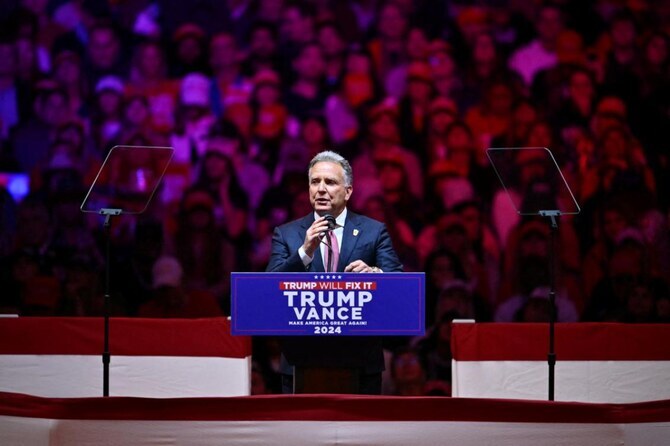
“Well, I think we’re making a lot of progress, and I don’t want to say too much because I think they’re doing a really good job back in Doha,” Witkoff said at a Trump press conference in Palm Beach, Florida.
Doha has been hosting negotiations on a ceasefire in the Gaza war that would include freeing hostages that Hamas abducted in its Oct. 7, 2023, attack on Israel. Doha is capital of the Gulf state of Qatar, which along with Egypt and the US has been mediating negotiations between Israel and Hamas.
Witkoff said that if he did not travel back to Doha on Tuesday night, he would head there on Wednesday night.
“I think that we’ve had some really great progress, and I’m really hopeful that by the inaugural, we’ll have some good things to announce on behalf of the president,” Witkoff said.
Trump, a Republican who will succeed Democratic President Joe Biden, repeated his threat that “all hell will break out in the Middle East” if Hamas does not release the hostages by the time he takes office.
“It will not be good for Hamas, and it will not be good, frankly, for anyone,” he said.
Hamas-led Islamist militants killed 1,200 people and captured more than 250, including Israeli-American dual nationals, during their Oct. 7 attack, according to Israeli tallies.
More than 100 hostages have been freed through negotiations or Israeli military rescue operations. Of the 101 still held in Gaza, roughly half are believed to be alive.
Israel’s subsequent campaign against Hamas has killed more than 45,000 Palestinians, most of them civilians, according to Palestinian health officials, displaced nearly all of the population in Hamas-ruled Gaza and reduced much of its territory to rubble.


![]()

Trump Middle East envoy predicts ‘good things’ to announce on Gaza hostages before inauguration
Short Url
https://arab.news/4xf36
Trump Middle East envoy predicts ‘good things’ to announce on Gaza hostages before inauguration
- “Well, I think we’re making a lot of progress, and I don’t want to say too much because I think they’re doing a really good job back in Doha,” Witkoff said
- “I’m really hopeful that by the inaugural, we’ll have some good things to announce on behalf of the president“


Latest updates


© 2026 SAUDI RESEARCH & PUBLISHING COMPANY, All Rights Reserved And subject to Terms of Use Agreement.