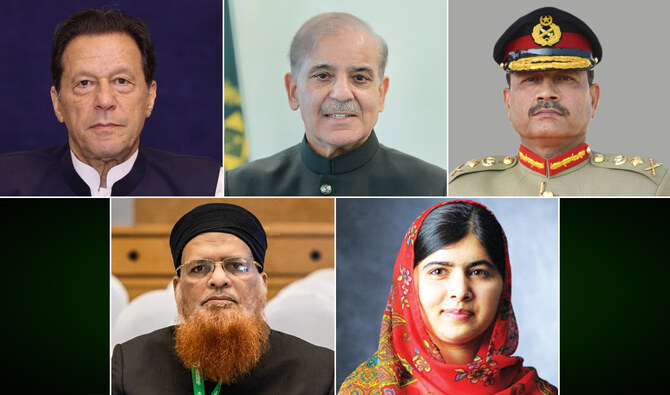
ISLAMABAD: Prime Minister Shehbaz Sharif, Army Chief Asim Munir, former PM Imran Khan, Nobel laureate Malala Yousafzai, religious scholar Mufti Taqi Usmani and several other Pakistanis have been listed among 500 Most Influential Muslims in 2025.
‘The Muslim 500: The World’s 500 Most Influential Muslims’ is an annual publication, first published in 2009, that ranks the most influential Muslims in the world. The publication is compiled by the Royal Islamic Strategic Studies Center in Amman, Jordan.
It ascertains the influence some Muslim figures have on the Ummah culturally, ideologically, financially, politically or otherwise to make a change that will have a significant impact on Muslims around the world.
This year, the publication has named several Pakistanis, from civilian and military rulers to philanthropists and people known for their exceptional work in various disciplines of life.
“Shehbaz Sharif became the 24th Prime Minister of Pakistan in March 2024, having served as the 23rd Prime Minister (2022-23) after a no-confidence motion against former Prime Minister Imran Khan,” the publication wrote about the Pakistan premier.
“Sharif is the brother of former Prime Minister Nawaz Sharif and has himself had a long political career, being the President of the Pakistan Muslim League and serving as the Chief Minister of Punjab three times (1997, 2007 and 2013).”
The list included the name of Pakistan’s Army Chief General Asim Munir.
“A descendant of a religious and scholarly family, Asim is also known as the first army chief in the history of Pakistan to be a Hafiz Qur’an (memorized the entire Qur’an),” the publication wrote.
“He served as chief of both premier military intelligence agencies of Pakistan.”
The Muslim 500 had an honorary mention of former PM Imran Khan, who has been in jail since August 2023 on a slew of charges.
“Imran Khan became the Prime Minister of Pakistan in 2018 amid huge expectations that he could bring the country forward on issues of governance, accountability and reduction of corruption. He endured a tough time before being ousted in April 2022 through a no-confidence motion,” it said.
“Khan still maintains massive popular support in the country as well as with the large and powerful Pakistani diaspora.”
The publication included names of Pakistani religious figures Mufti Muhammad Taqi Usmani, Maulana Tariq Jameel, Maulana Nazur ur-Rahman and Muhammad Ilyas Attar Qadri among the most influential Muslims around the world.
Other Pakistanis mentioned on the list were Nobel laureate Malala Yousafzai, Sharmeen Obaid-Chinoy, an internationally acclaimed journalist, filmmaker and activist, ‘Queen of Sufi mystic singing’ Abida Parveen, Na’atkhuwan Owais Raza Qadri and humanitarian Professor Dr. Adibul Hasan Rizvi.
“Dr. Rizvi is one of Pakistan’s leading humanitarians, having established the largest free health organization in Pakistan. He works as a doctor and an administrator at SIUT (Sindh Institute of Urology and Transplantation) in Karachi, which was founded in 1971 as an eight-bed unit but is now the largest health organization in Pakistan,” the publication wrote.
“SIUT provides free and comprehensive services in urology, nephrology, transplantation, and liver-related diseases. He is the recipient of many awards for his life’s work.”


![]()

PM Sharif, Gen. Munir among several Pakistanis make it to list of 500 Most Influential Muslims for 2025
Short Url
https://arab.news/6xjt3
PM Sharif, Gen. Munir among several Pakistanis make it to list of 500 Most Influential Muslims for 2025
- The list includes honorary mention of former PM Imran Khan as well as several Pakistani religious scholars
- Malala Yousafzai, Sharmeen Obaid-Chinoy, Abida Parveen and Prof. Dr. Adibul Hasan Rizvi have also been named
Latest updates


© 2026 SAUDI RESEARCH & PUBLISHING COMPANY, All Rights Reserved And subject to Terms of Use Agreement.