Pakistan to hire consultant in few weeks for regulatory framework on satellite-based Internet

1 / 2
The Starlink logo is displayed on a smartphone and computer screen in Athens, Greece, on May 24, 2024. (Reuters/File)
2 / 2
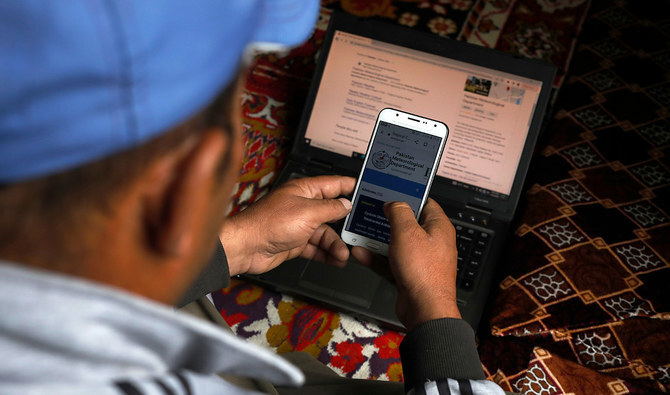
In this file photo taken on October 9, 2023, a man uses Internet to monitor a metrological website on his mobile in Hassanabad village, Pakistan. (REUTERS/File)
Short Url
Updated 07 January 2025
Follow

Pakistan to hire consultant in few weeks for regulatory framework on satellite-based Internet

  • Pakistan, a country of more than 240 million, has witnessed up to 40 percent drop in Internet speeds in the last few months
  • The country is in talks with Elon Musk’s Starlink satellite Internet provider, plans to link up with 2Africa submarine cable

ISLAMABAD: Pakistan will be hiring a consultant to finalize regulations regarding satellite-based Internet services in the country, its information technology (IT) ministry said on Monday.
The statement came after State Minister for IT Shaza Fatima Khawaja chaired a meeting in Islamabad to review progress on licensing of Starlink Services, owned by US billionaire Elon Musk, and regulatory frameworks for Low Earth Orbit (LEO) satellites.
Pakistan, a country of over 240 million, has witnessed up to 40 percent drop in Internet speeds in the last few months, according to the Wireless and Internet Service Providers Association of Pakistan (WISPAP).
The drop came as the federal government last year moved to implement a nationwide firewall to block malicious content and protect government networks from cyberattacks, with IT associations saying the slowdowns have resulted in significant losses.
“During the meeting, it was decided that consultant hiring will be completed in a few weeks, for regulations,” the Pakistani IT ministry said.
“The minister emphasized the need for aligning Pakistan’s policies with global standards to unlock satellite technology’s full potential for national growth.”
Pakistan suffered a total of $1.62 billion losses due to Internet outages and social media shutdowns in 2024, according to a report by global Internet monitor Top10VPN.com, surpassing losses in war-torn countries like Sudan and Myanmar.
The report, released on Jan. 2, said Pakistan experienced 9,735 hours of Internet disruptions that affected 82.9 million users, with elections and protests cited as the primary causes.
The IT state minister last month confirmed that Pakistan was in talks with Musk’s Starlink to bring satellite Internet services to the country.
“Discussions [at Monday’s meeting] focused on expediting these processes to ensure a robust regulatory framework for LEO satellites, enhancing connectivity, and driving technological innovation,” the IT ministry added.
Pakistan also plans to enhance its Internet speeds and connectivity by linking up with the 2Africa submarine cable later this year, according to the Pakistan Telecommunications Authority (PTA), which regulates Internet in the South Asian country.
2Africa, one of the world’s largest submarine cable systems, spans 45,000 kilometers and connects 46 locations across Africa, Europe and the Middle East, offering speeds of up to 180 Tbps.


Nearly 25% of Pakistan’s primary schools enrolling girls operate as single-teacher ones— report

Updated 13 sec ago
Follow

Nearly 25% of Pakistan’s primary schools enrolling girls operate as single-teacher ones— report

  • Pakistan needs over 115,000 more teachers in primary schools enrolling girls to meet global benchmark of one teacher per 30 students, says report
  • Sixty percent of Pakistani primary schools enrolling girls are overcrowded, while 32% lack clean drinking water or toilets, says Tabadlab report

ISLAMABAD: Nearly 25% of Pakistan’s primary schools that enrolls girls operate as single-teacher ones, a report by a leading think tank said this week, calling on the government to devolve teacher recruitment powers, upskill underutilized teachers and introduce reforms to hire and promote faculty members. 

Pakistan faces an acute education crisis which is reflected in the fact that it has the world’s second-highest number of out-of-school children, an estimated 22.8 million aged 5-16 who are not in educational institutions, according to UNICEF. 

While poverty remains the biggest factor keeping children out of classrooms, Pakistan’s education crisis is exacerbated by inadequate infrastructure and underqualified teachers, cultural barriers and the impacts of frequently occurring natural disasters. 

According to “The Missing Ustaani,” a report published by Islamabad-based think tank Tabadlab and supported by Malala Fund and the Pakistan Institute of Education (PIE), Pakistan needs over 115,000 more teachers in primary schools with girls’ enrolment to meet the basic international benchmark of ensuring one teacher per 30 children. Currently, the average Student-to-Teacher Ratio (STR) across Pakistan’s primary schools with girls’ enrolment is 39:1, it said. 

“Approximately 60% of these schools are overcrowded, necessitating the recruitment of over 115,000 additional teachers nationwide,” the report said on Monday. “Compounding this, nearly 25% of primary schools with girls’ enrolment operate as single-teacher schools, placing immense pressure on the quality of education.”

It said the situation is more dire in Pakistan’s poverty-stricken southwestern Balochistan province, where nearly 52% of the schools are single-teacher only ones while the percentage decreases slightly in the southern Sindh province to 51 percent. 

The report said while the STR improves to 25:1 at the middle school level, acute shortages of subject specialists emerge as the top-priority concern for quality education in these schools.

“Furthermore, around 32% of primary schools with girls’ enrolment and 18% of middle schools face ‘critical infrastructural shortages’— lacking clean drinking water or toilets in addition to high STRs— which significantly affects girls’ attendance and learning, particularly during adolescence,” the report said. 

The report cited a set of priority recommendations to address Pakistan’s systemic teacher deployment challenges and improve educational equity for girls. 

It urged the government to devolve recruitment authority to school or cluster levels to enable timely, context-specific hiring. It also called upon authorities to reform teacher transfer and promotion policies to introduce school-specific postings with minimum service terms. 

This, it said, would reduce arbitrary transfers and improving continuity in classrooms. The report advised authorities to upskill surplus or underutilized primary teachers to support instruction at the middle school level, helping address subject-specialist shortages.

“Together, these reforms offer a pathway toward a more equitable, efficient, and responsive teaching workforce— one capable of improving learning outcomes and ensuring that every girl in Pakistan has access to a qualified teacher,” the report said. 

To tackle Pakistan’s education crisis, Prime Minister Shehbaz Sharif declared an ‘education emeregency’ in September 2024, stressing the importance of education for all.