

France marks 10 years since deadly Charlie Hebdo attacks

On January 7, 2015, 12 people were killed, including eight editorial staff members of Charlie Hebdo in the attack on the weekly newspaper by the Kouachi brothers, Frenchmen who had pledged allegiance to al-Qaeda. (File/AFP)
Short Url
Updated 07 January 2025
Follow

France marks 10 years since deadly Charlie Hebdo attacks

  • Macron joined police officers in laying wreaths of flowers against the wall of the former Charlie Hebdo headquarters in the 11th district
  • Germany “shares the pain of our French friends,” Chancellor Olaf Scholz said

BERLIN/PARIS:PARIS: A decade after gunmen stormed the offices of the satirical newspaper Charlie Hebdo in a deadly assault that shook France to its core and ignited a global outcry in defense of freedom of speech, the nation paused on Tuesday to honor the victims and renew its resolve to fight for liberty and democracy.
President Emmanuel Macron and Paris Mayor Anne Hidalgo led solemn tributes at the site of the attack, where 12 people, including some of France’s most beloved cartoonists, were killed on January 7, 2015. Among those remembered was Ahmed Merabet, a police officer who was gunned down on the street while defending the newspaper.
In a poignant ceremony, Macron stood with his wife, Brigitte, alongside former President François Hollande, who had steered France through the aftermath of the attacks. Macron joined police officers in laying wreaths of flowers against the wall of the former Charlie Hebdo headquarters in the 11th district and the gathering observed a minute of silence. A lone trumpet played, resonating through a neighborhood scarred by that day’s bloodshed and later by the Bataclan massacre in November of the same year.
The attacks plunged France into a year of unparalleled terror, beginning with the Charlie Hebdo assault and culminating in the coordinated November attacks, including the Bataclan tragedy. The nation was left grieving, yet public gatherings became acts of resilience, defying fear and standing firm against violence.
The massacre at Charlie Hebdo, carried out by two brothers claiming allegiance to Al-Qaeda, signaled the dawn of a dark new chapter for France. A wave of extremist violence forced the country to reexamine its security measures. In the days following the attack, then German Chancellor Angela Merkel marched arm in arm with Hollande and other world leaders through the streets of Paris — a powerful display of unity in defense of freedom of expression that reverberated far beyond French borders.
Interior Minister Bruno Retailleau, speaking on RTL Tuesday, acknowledged how far France has come. while warning of the persistent dangers. “France has rearmed considerably, but the threat is still there,” he said, pointing to both external dangers and the rise of homegrown radicalization.
“The nature of the threat has changed,” Retailleau added. “It is now primarily endogenous — young individuals radicalized through social media. Last year alone, our services foiled nine attacks, the highest number since 2017.”
The attacks’ impact continued to extend beyond France itself. German Chancellor Olaf Scholz shared a message of solidarity on social media, writing, “#JeSuisCharlie spread around the world after the barbaric attack on Charlie Hebdo 10 years ago. Today, as then, we share the grief of our French friends. The attack targeted our shared values of freedom and democracy— we will never accept this.”
The attack on Charlie Hebdo, carried out in retaliation for the newspaper’s irreverent caricatures of the Prophet Muhammad, ignited fierce global debates about the limits of free expression. In the days that followed, millions marched in solidarity, brandishing pens and signs declaring, Je Suis Charlie (I am Charlie).
But 10 years on, the unity of that moment has given way to deeper divisions. Charlie Hebdo said its research shows that while a majority of French still believe in the fundamental right to caricature, younger generations increasingly criticize satire they see as divisive or insensitive, particularly toward marginalized communities.
“Are we all still Charlie?” one television special asked. For some, the answer is a resounding yes — a tribute to those who paid the ultimate price for freedom of expression. For others, French media say, it’s a more complicated question.
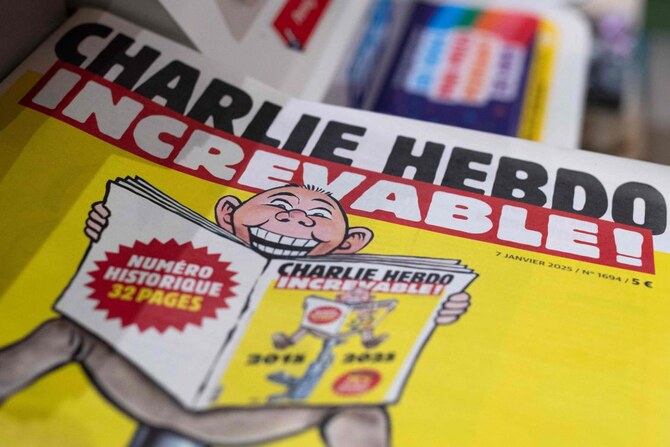
The newspaper remains unapologetic. Its 10th-anniversary edition features a cover cartoon of a reader perched on an AK-47, captioned “Indestructible.” In an editorial, the magazine’s director, Laurent Sourisseau, known as “Riss,” defended the power of satire. “If you want to laugh, it means you want to live,” he wrote.

Germany “shares the pain of our French friends,” Chancellor Olaf Scholz said Tuesday on the 10th anniversary of a deadly attack on French satirical newspaper Charlie Hebdo that claimed 12 lives.
The “barbaric attack... targeted our common values of liberty and democracy — which we will never accept,” Scholz said in a post in French on X.


Trump says Iran ‘want to negotiate’ after reports of hundreds killed in protests

Updated 57 min 24 sec ago
Follow

Trump says Iran ‘want to negotiate’ after reports of hundreds killed in protests

  • US President Donald Trump said Sunday that Iran’s leadership had called him seeking “to negotiate” after he repeatedly threatened to intervene militarily if Tehran killed protesters

WASHINGTON: US President Donald Trump said Sunday that Iran’s leadership had called him seeking “to negotiate” after he repeatedly threatened to intervene militarily if Tehran killed protesters.
For two weeks, Iran has been rocked by a protest movement that has swelled in spite of a crackdown rights groups warn has become a “massacre.”
Initially sparked by anger over the rising cost of living, the demonstrations have evolved into a serious challenge of the theocratic system in place since the 1979 revolution.
Information has continued to trickle out of Iran despite a days-long Internet shutdown, with videos filtering out of capital Tehran and other cities over the past three nights showing large demonstrations.
As reports emerge of a growing protest death toll, and images show bodies piled outside a morgue, Trump said Tehran indicated its willingness to talk.
“The leaders of Iran called” yesterday, Trump told reporters aboard Air Force One, adding that “a meeting is being set up... They want to negotiate.”
He added, however, that “we may have to act before a meeting.”
The US-based Center for Human Rights in Iran (CHRI) said it had received “eyewitness accounts and credible reports indicating that hundreds of protesters have been killed across Iran during the current Internet shutdown.”
“A massacre is unfolding,” it said.
The Norway-based NGO Iran Human Rights (IHR) said it confirmed the killing of at least 192 protesters but that the actual toll could be much higher.
“Unverified reports indicate that at least several hundreds, and according to some sources, more than 2,000 people may have been killed,” said IHR.
More than 2,600 protesters have been arrested, IHR estimates.
A video circulating on Sunday showed dozens of bodies accumulating outside a morgue south of Tehran.
The footage, geolocated by AFP to Kahrizak, showed bodies wrapped in black bags, with what appeared to be grieving relatives searching for loved ones.
Near paralysis
In Tehran, an AFP journalist described a city in a state of near paralysis.
The price of meat has nearly doubled since the start of the protests, and many shops are closed. Those that do open must close at around 4:00 or 5:00 pm, when security forces deploy en masse.
There were fewer videos showing protests on social media Sunday, but it was not clear to what extent that was due to the Internet shutdown.
One widely shared video showed protesters again gathering in the Pounak district of Tehran shouting slogans in favor of the ousted monarchy.
The protests have become one of the biggest challenges to the rule of supreme leader Ayatollah Ali Khamenei, 86, coming in the wake of Israel’s 12-day war against the Islamic republic in June, which was backed by the United States.
State TV has aired images of burning buildings, including a mosque, as well as funeral processions for security personnel.
But after three days of mass actions, state outlets were at pains to present a picture of calm returning, broadcasting images of smooth-flowing traffic on Sunday. Tehran Governor Mohammad-Sadegh Motamedian insisted in televised comments that “the number of protests is decreasing.”
The Iranian government on Sunday declared three days of national mourning for “martyrs” including members of the security forces killed.
President Masoud Pezeshkian also urged Iranians to join a “national resistance march” Monday to denounce the violence.
In response to Trump’s repeated threats to intervene, Iran’s parliament speaker Mohammad Bagher Ghalibaf said Iran would hit back, calling US military and shipping “legitimate targets” in comments broadcast by state TV.
‘Stand with the people’
Reza Pahlavi, the US-based son of Iran’s ousted shah, who has emerged as an anti-government figurehead, said he was prepared to return to the country and lead a democratic transition.
“I’m already planning on that,” he told Fox News on Sunday.
He later urged Iran’s security forces and government workers to join the demonstrators.
“Employees of state institutions, as well as members of the armed and security forces, have a choice: stand with the people and become allies of the nation, or choose complicity with the murderers of the people,” he said in a social media post.
He also urged protesters to replace the flags outside of Iranian embassies.
“The time has come for them to be adorned with Iran’s national flag,” he said.
The ceremonial, pre-revolution flag has become an emblem of the global rallies that have mushroomed in support of Iran’s demonstrators.
In London, protesters managed over the weekend to swap out the Iranian embassy flag, hoisting in its place the tri-colored banner used under the last shah.