

UN envoy in rare Yemen visit to push for peace

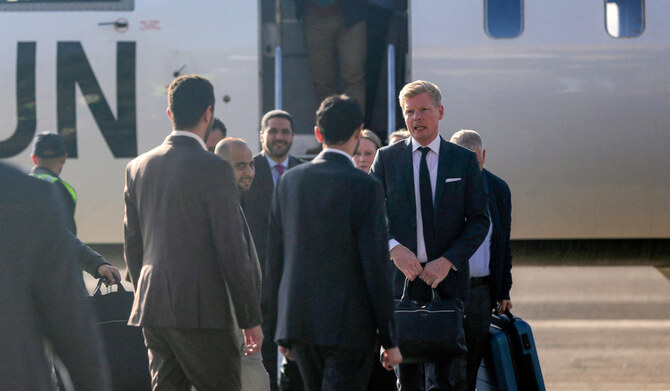
UN Special Envoy for Yemen Hans Grundberg is received by officials upon his arrival at Sanaa International Airport in the Huthi-held Yemeni capital on January 6, 2025. (AFP)
Short Url
Updated 07 January 2025
Follow

UN envoy in rare Yemen visit to push for peace

  • Grundberg’s office said his visit would also “support the release of the arbitrarily detained UN, NGO, civil society and diplomatic mission personnel”

SANAA: Hans Grundberg, the United Nation’s special envoy for war-torn Yemen, arrived Monday in the rebel-held capital in a bid to breathe life into peace talks, his office said.
Grundberg last visited the capital Sanaa, controlled by the Iran-backed Houthis, in May 2023 for meetings with the rebels’ leaders in an earlier effort to advance a roadmap for peace.
The envoy’s current visit “is part of his ongoing efforts to urge for concrete and essential actions... for advancing the peace process,” Grundberg’s office said in a statement.
Yemen has been at war since 2014, when the Houthis forced the internationally recognized government out of Sanaa. The rebels have also seized population centers in the north.
A UN-brokered ceasefire in April 2022 calmed fighting and in December 2023 the warring parties committed to a peace process.
But tensions have surged during the Israel-Hamas war in Gaza, as the Houthis struck Israeli targets and international shipping in the Red Sea and Gulf of Aden, in a campaign the rebels say is in solidarity with Palestinians.
In response to the Houthi attacks, Israel as well as the United States and Britain have hit Houthi targets in Yemen over the past year. One Israeli raid hit Sanaa’s international airport.
Grundberg’s office said his visit would also “support the release of the arbitrarily detained UN, NGO, civil society and diplomatic mission personnel.”
Dozens of staff from UN and other humanitarian organizations have been detained by the rebels, most of them since June, with the Houthis accusing them of belonging to a “US-Israeli spy network,” a charge the United Nations denies.


Turkiye ‘deeply disturbed’ over Israel-US strikes, Iran attacks on Gulf

Updated 7 sec ago
Follow

Turkiye ‘deeply disturbed’ over Israel-US strikes, Iran attacks on Gulf

  • “We are deeply disturbed over the US-Israel attacks on our neighbor Iran,” Erdogan said
  • “In order to prevent our region from experiencing greater suffering, all actors, especially the Islamic world, must take action“

ISTANBUL: Turkish President Recep Tayyip Erdogan said Saturday he was “deeply disturbed” by the Israeli-US attacks on Iran, but also condemned Tehran’s retaliatory strikes on the Gulf, demanding action to end the conflict.
The confrontation began earlier on Saturday with the Israeli and US strikes and quickly broadened regionally as Tehran retaliated against Gulf states and Israel.
“We are deeply disturbed over the US-Israel attacks on our neighbor Iran,” Erdogan said in a televised address, in which he also denounced Iran’s drone and missile attacks against the Gulf as “unacceptable, regardless of the reason.”
“In order to prevent our region from experiencing greater suffering, all actors, especially the Islamic world, must take action,” he added.
Turkiye had “worked hard for a long time to resolve the conflicts at the negotiating table... but the trust deficit between the parties could not be overcome,” he said, vowing to “accelerate Turkiye’s diplomatic efforts” to bring the parties back to the table.
Earlier Saturday, Foreign Minister Hakan Fidan spoke by phone with his Iranian counterpart Abbas Araghchi and six other top diplomats about ways to “end the attacks,” a foreign ministry source said.
Erdogan also said Turkiye had not seen any problem “in terms of border security” along the 500-kilometer (300-mile) frontier it shares with Iran.
“The police, gendarmerie and intelligence services are taking all necessary measures,” he said.
Earlier, Turkiye’s Interior Minister Mustafa Ciftci also held calls with his Azerbaijani counterpart Vilayet Eyvazov and Iraq’s Interior Minister Abdul?Amir al?Shammari on “strengthening areas of cooperation,” the ministry wrote on X.
All three countries share a border with Iran.
Iran’s neighbors have long feared that a new round of strikes on the country could destabilize the entire region, with concerns focused on a possible influx of refugees.
Turkiye currently hosts more than 74,000 Iranians with residence permits and some 5,000 refugees.