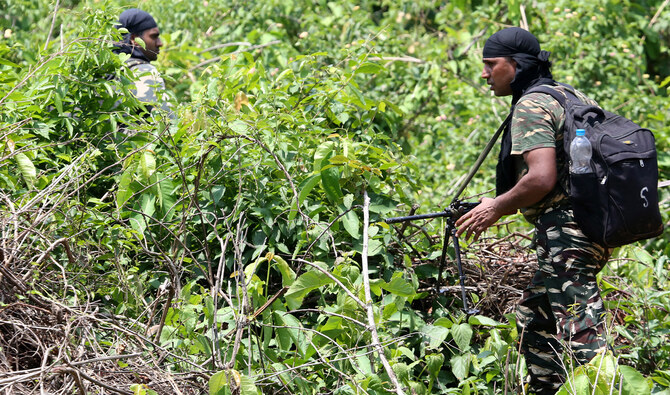
NEW DELHI: Indian security forces on Sunday battled with Maoist rebels in their forested heartland, police said, with at least four guerillas and one policeman killed.
More than 10,000 people have died in the decades-long insurgency waged by Naxalite rebels, who say they are fighting for the rights of marginalized indigenous people in India’s resource-rich central regions.
Government forces stepped up efforts last year to crush the long-running armed conflict, with some 287 rebels killed in 2024, according to government figures.
Clashes broke out late Saturday in Abujhmarh district of Chhattisgarh state, a key battleground in the insurgency.
“Four bodies of Maoists, who were in their battle uniform, have been recovered after an encounter with police forces,” police inspector general P. Sunderraj told AFP, adding one police constable had also been killed.
“Action is still on,” he said.
Around 1,000 suspected Naxalites were arrested and 837 surrendered during 2024.
Amit Shah, India’s interior minister, warned the Maoist rebels in September to surrender or face an “all-out” assault, saying the government expected to quash the insurgency by early 2026.
The insurgency has been drastically restricted in area in recent years.
The Naxalites, named after the district where their armed campaign began in 1967, were inspired by the Chinese revolutionary leader Mao Zedong.
They demanded land, jobs and a share of the region’s immense natural resources for local residents, and made inroads in a number of remote communities across India’s east and south.
The movement gained in strength and numbers until the early 2000s when New Delhi deployed tens of thousands of security personnel against the rebels in a stretch of territory known as the “Red Corridor.”
Authorities have since invested millions of dollars in local infrastructure and social projects to combat the Naxalite appeal.


Indian forces clash with Maoist rebels, five dead
https://arab.news/buy4u
Indian forces clash with Maoist rebels, five dead

- Over 10,000 people have died in the insurgency by Naxalite rebels who say they are fighting for rights of marginalized people
- Government forces stepped up efforts last year to crush the long-running armed conflict, with some 287 rebels killed in 2024

Europol warns Iran crisis raises threat of terror, extremism and cyberattacks
- Oorth said groups linked to Iran could seek to carry out “destabilising activities” within the EU
- “The level of terrorist threat and violent extremism in EU territory is considered high“
MADRID: The Middle East conflict will have “immediate repercussions” for European Union security with an increased threat of terrorism, serious and organized crime as well as violent extremism and cyberattacks, European police body Europol told Spanish news agency EFE on Thursday.
Europol spokesman Jan Op Gen Oorth said he expected to see more cyberattacks against European infrastructure and an increase in online fraud using increasingly sophisticated Artificial Intelligence and exploiting the flurry of information swirling about the conflict online, EFE reported.
Groups linked to Iran could seek to carry out “destabilising activities” within the EU, he added, referring to groups linked to the so-called Axis of Resistance, the network of anti-American and Israeli Shiite militias in countries including Iraq, Lebanon and Yemen. These could include terrorist attacks, intimidation campaigns, terrorist financing and cybercrime.
“The level of terrorist threat and violent extremism in EU territory is considered high,” he told the news agency.
The terror threat could be heightened by individuals acting alone or small cells acting on their own initiative, he said.
“The rapid spread of polarizing content on the Internet can accelerate short-term radicalization processes among diaspora communities within the EU and other individuals,” he said.
Europol did not immediately return a Reuters request for comment on the reported statements.
Iran and Israel on Thursday were exchanging fire on a sixth day of war after Israel and the United States launched joint air strikes on Iran on the weekend. So far the attacks have killed more than 1,000 people including Iran’s Supreme Leader, prompted Iran to attack neighbors including Qatar and UAE along with energy shipments.


