

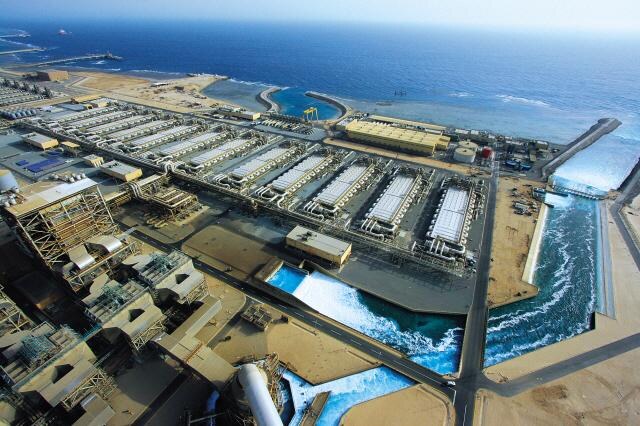
Saudi Arabia boosts desalinated water supply to 50% in Vision 2030 push

This surge reflects the Kingdom’s strategic efforts to bolster sustainable water resources as part of its Vision 2030 agenda, aimed at reducing dependency on non-renewable groundwater. File
Short Url
Updated 05 January 2025
Follow

Saudi Arabia boosts desalinated water supply to 50% in Vision 2030 push

RIYADH: Saudi Arabia’s water sector witnessed significant shifts in 2023, with a 31 percent increase in desalinated seawater production, now comprising 50 percent of the country’s distributed water supply, up from 44 percent in 2022, official data showed. 

According to the General Authority for Statistics’ latest Water Accounts report, non-renewable groundwater consumption by the agricultural sector dropped by 7 percent to 9,356 million cubic meters, compared to 10,044 million m³ in 2022. 

This surge reflects the Kingdom’s strategic efforts to bolster sustainable water resources as part of its Vision 2030 agenda, aimed at reducing dependency on non-renewable groundwater.  

In 2023, renewable groundwater abstraction rose to 21 percent of total groundwater use, while non-renewable abstraction fell by 6 percent, aligning with the country’s emphasis on resource preservation. Additionally, water reuse consumption increased by 12 percent to 555 million m³, signaling progress in recycling initiatives. 

Agriculture remained the largest consumer of water, using 12,298 million m³, but its expenditure share accounted for only 0.5 percent of total water costs. Meanwhile, industry dominated water-related expenditures at 61.4 percent, reflecting its significant reliance on distributed water for operations. 

The shift toward desalinated and renewable water sources is pivotal for Saudi Arabia, which faces acute water scarcity challenges. With groundwater resources depleting and the per capita household water consumption declining from 112.8 liters per day in 2022 to 102.1 liters in 2023, the Kingdom’s investments in desalination and reuse technologies underscore its commitment to long-term water security. 

Industrial sectors saw a notable increase in water consumption, with the share of distributed water used by industries rising to 30 percent in 2023 from 22 percent in 2022. This surge mirrors the Kingdom’s push for industrial expansion under Vision 2030, which emphasizes economic diversification. 

Despite these strides, non-renewable groundwater still constitutes 62 percent of the natural water supply, a decline from 68 percent in 2022 but still a dominant figure. The agriculture sector’s significant water use highlights opportunities for adopting more efficient irrigation techniques and exploring crop diversification to enhance sustainability. 

Saudi Arabia’s water strategy is set to play a critical role in achieving its economic and environmental goals. As the Kingdom continues to expand its desalination infrastructure and promote water reuse, it positions itself as a regional leader in tackling water scarcity through innovation and sustainable practices. 


Saudi Arabia set to attract $500bn in private investment, Al-Falih tells conference

Updated 09 December 2025
Follow

Saudi Arabia set to attract $500bn in private investment, Al-Falih tells conference

RIYADH: Sustainability, technology, and financial models were among the core topics discussed by financial leaders during the first day of the Momentum 2025 Development Finance Conference in Riyadh.

The three-day event features more than 100 speakers and over 20 exhibitors, with the central theme revolving around how development financial institutions can propel economic growth.

Speaking during a panel titled “The Sustainable Investment Opportunity,” Saudi Investment Minister Khalid Al-Falih elaborated on the significant investment progress made in the Kingdom.

“We estimate in the midterm of 2030 or maybe a couple of years more or so, about $1 trillion of infrastructure investment,” he said, adding: “We estimate, as a minimum, 40 percent of this infrastructure is going to be financed by the private sector, so we’re talking in the next few years $400 (billion) to $500 billion.”

The minister drew a correlation between the scale of investment needs and rising global energy demand, especially as artificial intelligence continues to evolve within data processing and digital infrastructure in global spheres.

“The world demand of energy is continuing to grow and is going to grow faster with the advent of the AI processing requirements (…) so our target of the electricity sector is 50 percent from renewables, and 50 percent from gas,” he added.

Al-Falih underscored the importance of AI as a key sector within Saudi Arabia’s development and investment strategy. He made note of the scale of capital expected to go into the sector in coming years, saying: “We have set a very aggressive, but we believe an achievable target, for AI, and we estimate in the short term about $30 billion immediately of investments.”

This emphasis on long-term investment and sustainability targets was echoed across panels at Momentum 2025, during which discussions on essential partnerships between public and private sectors were highlighted.

The shared ambition of translating the Kingdom’s goals into tangible outcomes was particularly essential within the banking sector, as it plays a central role in facilitating both projects and partnerships.

During the “Champions of Sectoral Transformation: Development Funds and Their Ecosystems” panel, Saudi National Bank CEO Tareq Al-Sadhan shed light on the importance of partnerships facilitated via financial institutions.

He explained how they help manage risk while supporting the Kingdom’s ambitions.

“We have different models that we are working on with development funds. We co-financed in certain projects where we see the risk is higher in terms of going alone as a bank to support a certain project,” the CEO said.

Al-Sadhan referred to the role of development funds as an enabler for banks to expand their participation and support for projects without assuming major risk.

“The role of the development fund definitely is to give more comfort to the banking sector to also extend the support … we don’t compete with each other; we always complement each other” he added.