ISLAMABAD: Prime Minister Shehbaz Sharif on Saturday described Pakistan’s small and medium enterprises (SMEs) as the backbone of national economy, issuing directives to take necessary measures to integrate them into the global supply chain, according to a statement from his office.
Pakistan has been striving to attract foreign investment as it recovers from a prolonged economic crisis characterized by a tough balance of payments situation, dwindling foreign currency reserves and a depreciating national currency.
While the government has signed various agreements with close allies and sought to promote business-to-business partnerships to drive growth, Sharif recently noted that foreign investment would remain elusive without first strengthening domestic investment.
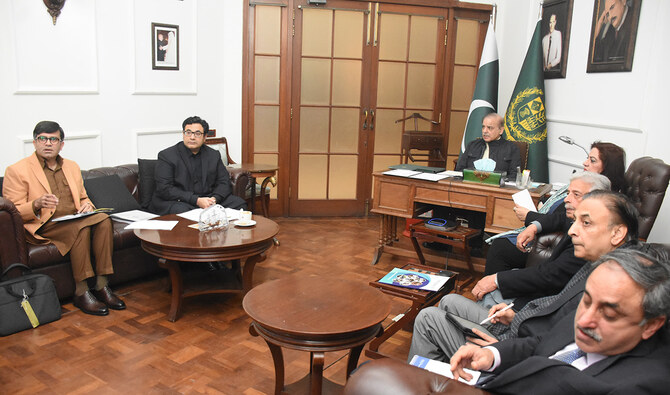
“Small and medium enterprises are the backbone of the economy,” he said while presiding over a meeting in Lahore to evaluate the SME sector, according to the statement. “Comprehensive steps are needed to make Pakistani industries a part of the global supply chain.”
The prime minister received a detailed briefing on the operations of the Small and Medium Enterprise Development Authority (SMEDA) and was told its board of directors had been constituted and had started holding regular meetings.
“The process of hiring international-standard experts for the development of the SME sector has been initiated,” the official statement said.
“The State Bank of Pakistan has also instructed banks to simplify and streamline the loan application forms for SMEs,” it added.
The meeting was also informed that authorities were in the process of gathering data on SMEs across Pakistan to enable informed decision-making for the sector.

Pakistan PM calls SMEs ‘backbone’ of national economy, seeks steps for their global integration
https://arab.news/ytk7h
Pakistan PM calls SMEs ‘backbone’ of national economy, seeks steps for their global integration
- The government has initiated the process of hiring experts for the development of the SME sector
- State Bank of Pakistan has also directed banks to simplify the loan application process for SMEs
Pakistan, Iraq agree on tighter coordination over pilgrims under new regulated travel system
- New system requires all Iraq-Iran pilgrimages to be organized by licensed groups under state oversight
- Long-running “Salar” model relied on informal caravan leaders, leading to overstays and missing pilgrims
ISLAMABAD: Pakistan and Iraq this week agreed to closely coordinate on the management and security of Pakistani pilgrims, as Islamabad rolls out a new, tightly regulated travel system aimed at preventing overstays, undocumented migration and security breaches during religious visits to Iraq and Iran.
The understanding was reached during a meeting between Pakistan’s Interior and Narcotics Control Minister Mohsin Naqvi and Iraq’s Interior Minister General Abdul Amir Al-Shammari on Thursday evening, where both sides discussed measures to facilitate pilgrims while strengthening oversight, Pakistan’s interior ministry said.
The agreement comes as Pakistan dismantles its decades-old pilgrim travel model and replaces it with a centralized, licensed system after authorities confirmed that tens of thousands of Pakistani pilgrims had overstayed or gone missing abroad over the past decade, triggering concerns from host governments.
“You have, for the first time during your tenure, taken effective measures to organize pilgrim groups, which are commendable,” Al-Shammari told Naqvi, according to Pakistan’s interior ministry.
“All pilgrims included in the list provided by Pakistan’s Ministry of Interior will be allowed to enter Iraq,” he added, making clear that only travelers cleared under the new system would be permitted.
Naqvi said Pakistan would strictly enforce return timelines under the revised framework.
“Pilgrims traveling to Iraq will not be allowed to stay beyond the designated period,” he said, adding that relevant authorities in both countries would remain in close coordination.
Both interior ministers also agreed to strengthen information-sharing and joint mechanisms on security cooperation, counterterrorism and the prevention of human smuggling, officials said.
“The safety, dignity, and facilitation of Pakistani pilgrims is the top priority of the Government of Pakistan,” Naqvi said.
Al-Shammari said he would visit Pakistan soon to finalize a joint roadmap to further improve pilgrim facilitation, security coordination and broader bilateral cooperation, according to the interior ministry.
Pakistan’s government has overhauled its pilgrim travel regime this year, abolishing the long-running “Salar” system under which informal caravan leaders managed pilgrimages. The move followed official confirmation that around 40,000 Pakistani pilgrims had overstayed or disappeared in Iran, Iraq and Syria over the past ten years.
Under the new Ziyarat Management Policy, only licensed Ziyarat Group Organizers (ZGOs) are allowed to arrange pilgrimages, with companies held directly responsible for ensuring pilgrims return on time. Authorities have completed security clearance for 585 companies seeking registration, while scrutiny of applications remains ongoing.
Islamabad has also barred overland travel for major pilgrimages, including Arbaeen, citing security risks in Pakistan’s southwestern Balochistan province, meaning all travel to Iraq and Iran is now restricted to regulated air routes.
Tens of thousands of Pakistani pilgrims travel each year to Iraq and Iran to visit some of the most revered shrines in Shia Islam, including the mausoleums of Imam Ali in Najaf and Imam Hussain in Karbala in Iraq, and major religious sites in Mashhad and Qom in Iran. Pilgrimages peak during religious occasions such as Arbaeen, when millions of worshippers converge on Karbala from across the region. The scale of travel, often involving long stays and cross-border movements, has long posed logistical, security and migration-management challenges for Pakistani authorities and host governments alike.


