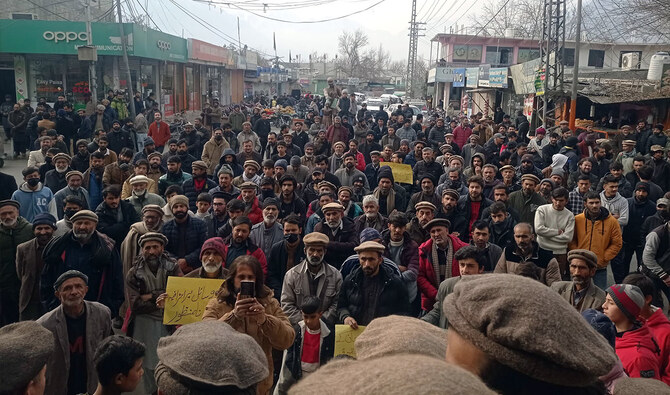
KHAPLU, Gilgit-Baltistan: A key land route connecting Pakistan and China was blocked indefinitely by angry protesters in northern Gilgit-Baltistan on Friday, as hundreds of them staged sit-ins against prolonged power outages in the region.
The Karakoram Highway (KKH), a vital trade route between the two countries, was obstructed at Ali Abad, a significant point in the Hunza Valley. The area has witnessed a gradual increase in trade activity following an agreement between Pakistan and China to keep the Khunjerab Pass open year-round to facilitate economic exchanges.
Last month, Pakistan’s National Logistics Corporation conducted its first international cargo transportation via the border, moving goods from China to the United Arab Emirates.
“Hunza is experiencing severe power outages,” Zahoor Ilahi, a protest leader from the Awami Workers Party, told Arab News over the phone. “That’s why we have blocked the Karakoram Highway.”
“The highway has been blocked for all kinds of traffic at Ali Abad since afternoon, and we will not end the sit-in until our demands are met,” he added. “The government is not running the thermal station generators, and all parts of Hunza are facing over 20 hours of power crisis.”
Protests were also held in other parts of Hunza, including Sost and Gulmit, with shutter-down strikes observed against the prolonged power crisis.
“There has been no progress in the power sector for the last three to four years in Hunza,” Rehan Shah, a local resident of the area, told Arab News. “The speed of work on the power projects is very slow, and all residents want an uninterrupted supply of electricity.”
Shah said the protests were jointly organized by various political parties and trade associations in the region.
Meanwhile, protests were also observed in other parts of Gilgit-Baltistan, including Danyor in Gilgit city.
Speaking to Arab News, Advocate Ehsan Ali, president of the Awami Action Committee, said that most districts in the region were facing prolonged power cuts.
“The duration of the power crisis in Gilgit city is about 20 hours,” he said. “Skardu is facing 21 to 22 hours of power cuts, and Hunza is also experiencing the same. Similarly, districts like Ghizer and Chilas are also dealing with the worst kind of power outages.”
“Millions of rupees have been spent on power projects, but unfortunately, none are producing enough electricity,” he said. “In the 21st century, electricity is still unavailable here.”
Hamid Hussain, an engineer at the Gilgit-Baltistan Water and Power Department, acknowledged the issue but attributed it to technical reasons, saying the region heavily relied on hydropower, which often faced disruption in winter due to the freezing of rivers and lakes.
“There are 137 power stations in Gilgit-Baltistan,” he told Arab News. “The installed capacity of these power stations is 190 megawatts. However, power generation is 140 megawatts during the summer while 76 megawatts during the winter due to the low flow of water.”
“The residents of Hunza are demanding thermal generators,” he added. “But we can’t run them due to financial reasons. There are many thermal generators in Gilgit, but we can’t fulfill people’s demand due to the high fuel cost.”
Hussain said his department would run the thermal generators to reduce the power crisis if the government decided to release funds.


![]()

Protesters block key Pakistan-China trade route over power outages in Gilgit-Baltistan
Short Url
https://arab.news/mqnqp
Protesters block key Pakistan-China trade route over power outages in Gilgit-Baltistan
- Residents report facing 20-hour outages despite the construction of several power stations
- Officials say the region relies on hydropower, which is disrupted in winter due to freezing rivers
Latest updates


© 2026 SAUDI RESEARCH & PUBLISHING COMPANY, All Rights Reserved And subject to Terms of Use Agreement.