

Canary Islands received record 46,843 migrants in 2024

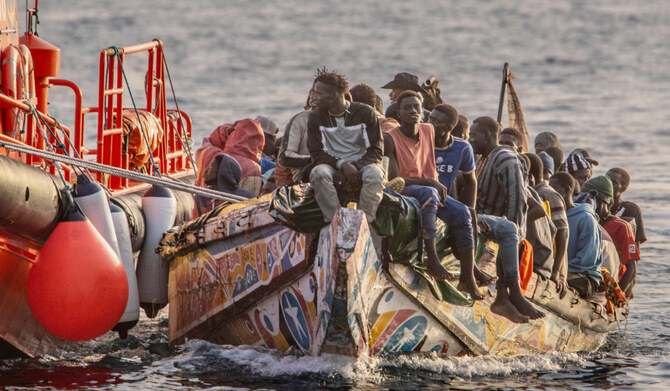
A boat with 136 migrants onboard including 40 women and 17 children arrives at La Restinga port on the Canary island of El Hierro. (AFP)
Short Url
Updated 04 January 2025
Follow

Canary Islands received record 46,843 migrants in 2024

  • Sanchez government ‘maintains a transversal policy that prioritizes human rights’

MADRID: A record 46,843 migrants reached Spain’s Canary Islands illegally in 2024 via the increasingly deadly Atlantic route, the second consecutive year of unprecedented arrival numbers, official data showed.

The landmark came as the European country received 63,970 irregular migrants last year, the vast majority in the Atlantic archipelago, up from 56,852 in 2023, the Interior Ministry said.
Spain has moved to the forefront of the EU’s migration crisis as tighter controls in the Mediterranean push more migrants to attempt the perilous trip from West Africa to the Canaries.

BACKGROUND

Spain, a major gateway to Europe along with Italy and Greece, has emerged as an outlier in European migration policy.

EU border agency Frontex has said irregular crossings into the bloc from January to November 2024 fell 40 percent overall.
However, they grew 19 percent on the Atlantic route, with Mali, Senegal, and Morocco being the most common nationalities.
The latest figures confirmed data published in December that showed the record for annual migrant arrivals by boat in the Canaries had been broken for the second year running by November.
Last year’s arrivals surpassed the 39,910 migrants who reached the islands off northwestern Africa by sea in 2023, a level that had smashed the previous record from 2006.
The national figure for 2024 fell short of the record of 64,298 arrivals set in 2018 but exceeded the 56,852 migrants who reached Spain illegally in 2023.
A report last week by NGO Caminando Fronteras said at least 10,457 migrants died or disappeared while trying to reach Spain by sea from Jan. 1 to Dec. 5, 2024.
Caminando Fronteras said it was a 50-percent increase on 2023.
The highest toll since its tallies began in 2007, attributing it to the use of ramshackle boats, dangerous waters and a lack of resources for rescues.
“The loss of a single life is a cause for sadness, and we regret every one of them,” the Migration Ministry said in reaction to the report.
“This government maintains a transversal policy that prioritizes human rights and works in collaboration with other ministries and countries of origin and transit to promote regular and safe migration.”
Local authorities in the Canaries say they are overwhelmed by the waves of arrivals.
Spain’s political parties, however, have failed to agree on a plan to distribute thousands of unaccompanied minors nationwide to ease the burden.
Government minister Angel Victor Torres criticized the conservative opposition Popular Party, or PP, for the impasse.
The children would go to school, “learning our language and integrating into our society” if the PP adopted an attitude of “true solidarity,” Torres told Cadena SER radio.
Despite the crisis, Spain, a major gateway to Europe along with Italy and Greece, has emerged as an outlier in European migration policy.
Socialist Prime Minister Pedro Sanchez defends the necessity of migration to support the welfare state and workforce needs as Europe’s population ages.
His successive leftist governments since 2018 have eased regularization rules for illegal migrants in Spain, even as far-right parties with anti-immigration platforms have surged in Italy, France, Germany, the Netherlands, and beyond.
Sanchez last year embarked on a tour of Senegal, Mauritania, and The Gambia, the main departure points for Spain-bound boats, to promote local efforts to curb illegal migration.
PP spokesman Borja Semper slammed the government for presiding over rising immigration numbers while levels fell in other frontline countries such as Italy.
The government uses immigration “frivolously because there is no policy, and when it puts forward something, it’s behind a banner,” he said.


Cuba says attacking speedboat had nearly 13,000 rounds of ammunition

Updated 9 sec ago
Follow

Cuba says attacking speedboat had nearly 13,000 rounds of ammunition

  • Firefight took place at a range of 20 meters, Cuba says
  • Incoming crew originally ‌set out on two vessels but ditched one
HAVANA: A commando of Cuban exiles who intended to infiltrate Cuba on a speedboat was armed with nearly 13,000 rounds of ammunition, 13 rifles and 11 pistols, Cuban officials said on Friday, providing new details about Wednesday’s deadly exchange of gunfire at sea. The government in Havana has said 10 Cuban nationals coming from the United States entered Cuban waters and opened fire on a border guard vessel, leading Cuban forces to return fire killing four and wounding six others, who were taken into custody.
In an attempt to dispel doubts about its account to date, senior Cuban Interior Ministry officers displayed the captured armaments from the studio on a special television program, including bins full of at least some of the 12,846 recovered rounds. They also showed pictures of the vessels, each peppered with bullet holes from ‌the firefight they ‌said took place at a range of 20 meters (66 feet).
The confrontation took place ‌at ⁠a fraught moment ⁠in US-Cuban relations, with US President Donald Trump pressuring the island by imposing a virtual oil blockade after capturing and ousting Venezuelan President Nicolas Maduro, a crucial Cuban ally, on January 3.
Cuba has identified the assailants as Cuban exiles, some of whom had been previously placed on a list of accused terrorists, who came from the United States with the intent to sow chaos and attack military units on the Communist-ruled island.
“The intent of this group is to infiltrate, to promote public disorder. To incite the people to unite. To carry out something violent. Attack military units ⁠in order to incite social unrest and to unite the people in order to ‌steal the revolution. That has been duly proven,” said Col. Victor Alvarez ‌of the Interior Ministry.
Cuba says response ‘proportional’
US politicians have expressed skepticism over Cuba’s version of events. Secretary of State Marco ‌Rubio on Wednesday said his government would independently investigate, adding that it was not a US operation and ‌that no US government personnel were involved.
Cuban officers said the infiltrators set out from Marathon in the Florida Keys on two vessels but ditched one at some point due to technical difficulties. They united on one speedboat, which a US official said was reported stolen in Florida. Cuba said it recovered a drone, radios, knives, a portable power plant, bolt cutters and ‌other materiel. They also found emblems of the November 30th Movement and People’s Self-Defense, anti-communist groups that oppose the Cuban government.
Cuba says a patrol of five ⁠border guard members on ⁠a 9-meter boat spotted the incoming vessel shortly after 7 a.m., with some members of the incoming crew in the water, about one nautical mile off a cay on the Caribbean island’s northern coast, about 100 miles (160 km) from Marathon.
The infiltrators opened fire at a distance of 185 meters, striking the captain of the Cuban vessel in the abdomen, Cuba said. Bleeding heavily, the wounded captain remained at the helm and steered toward the enemy vessel, leading to a firefight at a distance of about 20 meters, the officers said.
Cuba called its response “proportional.”
“It is a defensive model that practically never uses firearms, and the use of firearms is proportional to the type of action being carried out against our force,” said Interior Ministry Col. Ybey Carballo.
The captured Cuban nationals were receiving medical care and face charges including armed aggression, illegal entry into national territory, crimes associated with terrorist acts, and arms trafficking, prosecutor Edward Robert Campbell told the program. He said they face prison terms of up to 10 to 15 years for the lesser offenses and 20 to 30 years — or even the death penalty — for the more serious charges.