

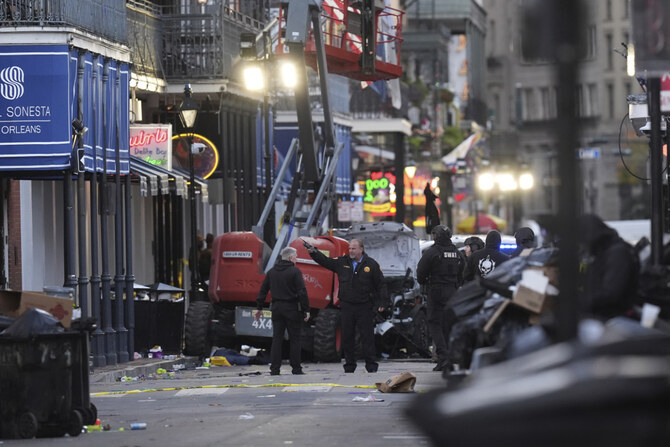

NEW ORLEANS: A US Army veteran driving a pickup truck that bore the flag of the Daesh group wrought carnage on New Orleans’ raucous New Year’s celebration, killing 15 people as he steered around a police blockade and slammed into revelers before being shot dead by police.
The FBI said it is investigating the attack early Wednesday as a terrorist act and does not believe the driver acted alone. Investigators found guns and what appeared to be an improvised explosive device in the vehicle, along with other devices elsewhere in the city’s famed French Quarter.
The rampage turned festive Bourbon Street into a macabre mayhem of maimed victims, bloodied bodies and pedestrians fleeing for safety inside nightclubs and restaurants. In addition to the dead, dozens of people were hurt. A college football playoff game at the nearby Superdome was postponed until Thursday.
Zion Parsons, 18, of Gulfport, Mississippi, said he saw the truck “barreling through, throwing people like in a movie scene, throwing people into the air.”
“Bodies, bodies all up and down the street, everybody screaming and hollering,” said Parsons, whose friend Nikyra Dedeaux was among the people killed.
“This is not just an act of terrorism. This is evil,” New Orleans Police Superintendent Anne Kirkpatrick said.

Ramming suspect Shamsud-Din Jabbar. (FBI/Handout via REUTERS)
The driver “defeated” safety measures in place to protect pedestrians, Kirkpatrick said, and was “hell-bent on creating the carnage and the damage that he did.”
The FBI identified the driver as Shamsud-Din Jabbar, 42, a US citizen from Texas, and said it is working to determine his potential associations with terrorist organizations.
“We do not believe that Jabbar was solely responsible,” FBI Assistant Special Agent in Charge Alethea Duncan said at a news conference.
Investigators found multiple improvised explosives, including two pipe bombs that were concealed within coolers and wired for remote detonation, according to a Louisiana State Police intelligence bulletin obtained by The Associated Press.
The bulletin, relying on preliminary information gathered soon after the attack, also said surveillance footage showed three men and a woman placing one of the devices, but federal officials did not immediately confirm that detail and it wasn’t clear who they were or what connection they had to the attack, if any.
Jabbar drove a rented pickup truck onto a sidewalk, going around a police car that was positioned to block vehicular traffic, authorities. A barrier system meant to prevent vehicle attacks was being repaired in preparation for the Super Bowl in February.
Jabbar was killed by police after he exited the truck and opened fire on responding officers, Kirkpatrick said. Three officers returned fire. Two were shot and are in stable condition.
Investigators recovered a handgun and AR-style rifle, according to a law enforcement official who was not authorized to discuss the investigation publicly and spoke on condition of anonymity.
Deadly explosions also rocked Honolulu and Las Vegas, though authorities haven’t said if they’re related to the New Orleans attack.
A photo circulated among law enforcement officials showed a bearded Jabbar wearing camouflage next to the truck after he was killed. The intelligence bulletin obtained by the AP said he was wearing a ballistic vest and helmet. The flag of the Daesh group was on the truck’s trailer hitch, the FBI said.
“For those people who don’t believe in objective evil, all you have to do is look at what happened in our city early this morning,” US Sen. John Kennedy, a Louisiana Republican, said. “If this doesn’t trigger the gag reflex of every American, every fair-minded American, I’ll be very surprised.”
Jabbar joined the Army in 2007, serving on active duty in human resources and information technology and deploying to Afghanistan from 2009 to 2010, the service said. He transferred to the Army Reserve in 2015 and left in 2020 with the rank of staff sergeant.
Hours after the attack, several coroner’s office vans were parked on the corner of Bourbon and Canal streets, cordoned off by police tape with crowds of dazed tourists standing around, some trying to navigate their luggage through the labyrinth of blockades.
Louisiana Gov. Jeff Landry urged people to avoid the area, which remained an active crime scene.
“We looked out our front door and saw caution tape and dead silence and it’s eerie,” said Tessa Cundiff, an Indiana native who moved to the French Quarter a few years ago. “This is not what we fell in love with, it’s sad.”
Nearby, life went on as normal in the city known to some for a motto that translates to “let the good times roll.” At a cafe a block from where the truck came to rest, people crowded in for breakfast as upbeat pop music played. Two blocks away, people drank at a bar, seemingly as if nothing happened.
President Joe Biden, speaking to reporters in Delaware, said he felt “anger and frustration” over the attack but that he would refrain from further comment until more is known.
“My heart goes out to the victims and their families who were simply trying to celebrate the holiday,” Biden said in a statement. “There is no justification for violence of any kind, and we will not tolerate any attack on any of our nation’s communities.”
The attack is the latest example of a vehicle being used as a weapon to carry out mass violence, a trend that has alarmed law enforcement officials and that can be difficult to protect against.
If confirmed as Daesh-inspired, the attack would represent the deadliest such assault on US soil in years. FBI officials have repeatedly warned about an elevated international terrorism threat due to the Israel-Hamas war.
In the last year, the FBI has disrupted other potential attacks inspired by the militant group, including in October when agents arrested an Afghan man in Oklahoma accused of plotting an Election Day attack targeting large crowds.


