

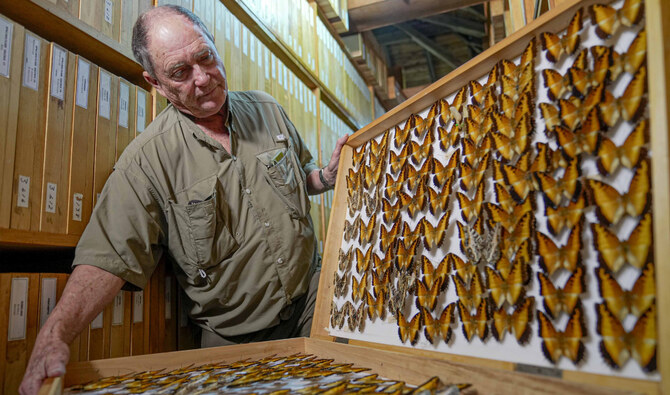

NAIROBI: What began as a childhood hobby more than six decades ago has led to what might be Africa’s largest butterfly collection in a suburb of Kenya’s capital.
Steve Collins, 74, was born and raised in western Kenya. By the age of 5, he was fascinated by butterflies and started building a collection that has grown to more than 4.2 million, representing hundreds of species.
“My parents encouraged us to look for butterflies after visiting the Congo and were gifted a trapping net by some friends,” Collins said. “By the time I was 15 years old, I was already visiting other countries like Nigeria to study more about butterflies.”
During his 20-year career as an agronomist, Collins dedicated his free time to research. He established the African Butterfly Research Institute in 1997.
Now, running out of space and time, he hopes to hand it over to the next generation.
On his 1.5 acres of land, hundreds of indigenous trees and flowering bushes form a well-knit forest. Hundreds of butterflies dance from one flower to another, at times landing on Collins’ hand.
His collection is private, although it was initially open to the public when he ran it as an education center between 1998 and 2003.
Collins has 1.2 million butterflies from across Africa delicately pinned in frames and stored in rows of shelves, with another 3 million in envelopes.
“They need to be kept in dark spaces,” he said. “The form of storage also ensures the dried butterflies are not eaten by other insects, parasites and predators. We also ensure we apply insecticides once a year to keep them safe.”
Julian Bayliss, an ecologist specializing in Africa and a visiting professor at Oxford Brookes University, said he has collected butterflies for Collins over two decades.
“There is a large part of that collection that is completely irreplaceable because a large part of Africa’s habitat is being destroyed,” Bayliss said.
Africa is vulnerable to climate change, with periods of prolonged drought and serious flooding destroying forests and other butterfly habitats.
Bayliss suggested digitizing the collection to make it accessible worldwide.
Whoever takes it over “needs to be an institution that is well-founded, well-funded and secure,” he said.
Scott Miller, an entomologist at the Smithsonian Institution, met Collins almost 30 years ago. He said such collections provide critical information that could show environmental changes over 60 years.
“These physical specimens, you can actually keep going back to them to get new layers of information as you learn more or you get a different technology or you get different questions,” he said.
Collins is concerned that soon he will no longer be able to sustain his research. He said his most prized butterfly costs $8,000 — which he keeps from sight, concerned about possible theft — and hopes to sell the collection to an individual or research institution.
The costs of running his institute are high. An annual budget posted in 2009 on the Lepidopterists’ Society of Africa website was $200,000.
Collins estimates that the specimens and other assets are worth $8 million.
“This has been my hobby for decades, and I can’t put a price on what I have done so far. I’m currently seeking to ensure the species are in safe hands when I’m out of this world,” he said.


