Carter ‘saved countless lives’: WHO chief

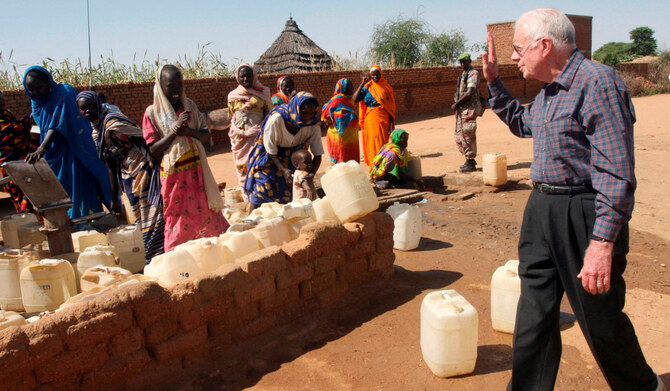
Former US President Jimmy Carter from the Elders Group waves to internally displaced women at a water point in Kebkabiya town in North Darfur, Sudan, October 3, 2007. (REUTERS)
Short Url
Updated 30 December 2024
Follow

Carter ‘saved countless lives’: WHO chief

  • “His work through the Carter Center has saved countless lives and helped bring many neglected tropical diseases close to elimination

GENEVA: Former US president Jimmy Carter, who died on Sunday aged 100, “saved countless lives” through his work to eliminate diseases, the head of the World Health Organization said.
WHO chief Tedros Adhanom Ghebreyesus said he was deeply saddened to hear of Carter’s passing, calling him a “true leader who inspired so many.”
“His unwavering commitment to people’s wellbeing in the United States and around the world will be remembered forever,” Tedros said on X.
“His work through the Carter Center has saved countless lives and helped bring many neglected tropical diseases close to elimination.
“President Carter’s leadership was instrumental in facilitating peace negotiations in the Middle East decades ago, and is a reminder of what our world needs the most today.
“Dear President Carter, you will be greatly missed. Rest in peace.”
The Carter Center works to fight six preventable diseases — Guinea worm, river blindness, trachoma, schistosomiasis, lymphatic filariasis, plus malaria in Haiti and the Dominican Republic — through health education and simple, low-cost prevention and treatment methods.


Over 1,400 Indonesians left Cambodian scam groups in five days: embassy

Updated 37 min 52 sec ago
Follow

Over 1,400 Indonesians left Cambodian scam groups in five days: embassy

  • Scammers working from hubs across Southeast Asia lure Internet users globally into fake romances and cryptocurrency investments
  • Some foreign nationals have evacuated suspected scam compounds across Cambodia this month

PHNOM PENH: More than 1,400 Indonesians have left cyberscam networks in Cambodia in the last five days, Jakarta said on Wednesday, after Phnom Penh pledged a fresh crackdown on the illicit trade.
Scammers working from hubs across Southeast Asia, some willingly and others trafficked, lure Internet users globally into fake romances and cryptocurrency investments, netting tens of billions of dollars each year.
Some foreign nationals have evacuated suspected scam compounds across Cambodia this month as the government pledged to “eliminate” problems related to the online fraud industry, which the United Nations says employs at least 100,000 people in Cambodia alone.
Between January 16-20, 1,440 Indonesians left sites operated by online scam syndicates around Cambodia and went to the Indonesian embassy in Phnom Penh for help, the mission said in a statement.
The “largest wave of arrivals” occurred on Monday when 520 Indonesians came to the embassy, it said.
Recent Cambodian law enforcement measures against scam operators meant more citizens would likely continue showing up at the embassy, it added.
“The main problem for them is that they do not possess passports and they are staying in Cambodia without valid immigration permits,” according to the embassy.
It urged Indonesians leaving scam sites to report to the embassy, which could assist them with securing travel documents and overstay fine waivers in order to return home.
Indonesia said this week that its embassy in Phnom Penh handled more than 5,000 consular service cases for citizens in Cambodia last year — more than 80 percent of which were related to Indonesians who “admitted to being involved with online scam syndicates.”
Cambodia arrested and deported Chinese-born tycoon Chen Zhi, accused of running Internet scam operations from Cambodia, to China this month.
Chen, a former adviser to Cambodia’s leaders, was indicted by US authorities in October.
Analysts say Chen’s extradition has left some of those running Internet scams from Cambodia fearing legal consequences — after the criminal enterprises ballooned for years — with some operators opting to release people or evacuate their compounds.