

Pakistan minister says May 2023 protests ‘unforgivable’ despite talks with Imran Khan’s party

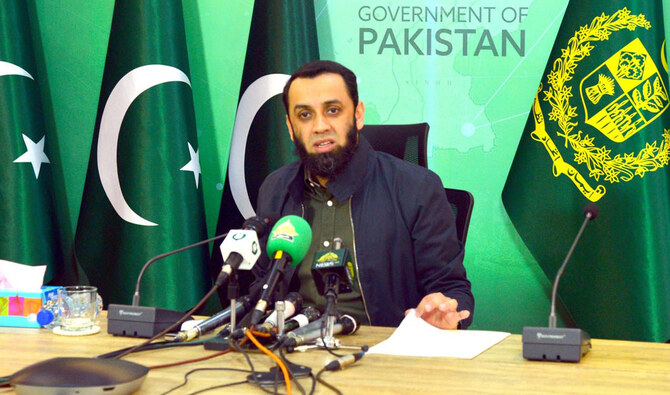
Pakistan’s information minister Attaullah Tarar speaks during a news conference in Islamabad, Pakistan, on November 23, 2024. (PID/File)
Short Url
Updated 29 December 2024
Follow

Pakistan minister says May 2023 protests ‘unforgivable’ despite talks with Imran Khan’s party

  • Pakistan’s government this week kicked off negotiations with Khan’s party to ease political tensions
  • May 9, 2023, protests saw people carrying flags of Khan’s party attacking government, military installations

ISLAMABAD: Pakistan’s Information Minister Ataullah Tarar has said that the violent protests of May 2023 led by former prime minister Imran Khan’s Pakistan Tehreek-e-Insaf (PTI) party were “unforgivable,” despite the government’s ongoing negotiations with the PTI, state-run media reported this week. 

Tarar was referring to the violent countrywide protests of May 9, 2023, that saw people carrying PTI flags attack government and military installations. Khan’s party denies involvement in the protest, saying that the May 9 incident was a “false flag” operation designed to crush the party. 

Pakistan’s military this month sentenced 85 civilians to prison, which included Khan’s nephew, for sentences ranging from two years to 10, for their involvement in the protests. The decision was criticized by the European Union, the US and the UK, who raised questions over the transparency of the trials. 

Pakistan’s government this week opened talks with Khan’s PTI party to ease political tensions in the country. The PTI has demanded the release of political prisoners and the establishment of judicial commissions to investigate protests on May 9, 2023, and Nov. 26 this year. 

“He [Tarar] said incidents of violence like May 9 cannot be overlooked and anyone who commits acts of violence has to face the law,” Tarar told journalists at a press conference in Gujranwala, state broadcaster Radio Pakistan said. 

The minister said that there was “irrefutable evidence” against people sentenced by the military for the May 9 protests, categorically stating that the right to fair trial was ensured.

“The government wants to build on a momentum of hard-earned economic progress during the last few months and political stability is inevitable to this end,” Radio Pakistan said. 

Khan’s ouster in a parliamentary vote of no-confidence in 2022 has plunged the country into a long-term political crisis, particularly since the PTI founder was jailed in August last year on corruption and other charges and remains behind bars. 

His party and supporters regularly hold protests calling for his release, with many of the demonstrations turning violent, including one last month in which the government says four troops were killed and the PTI says 12 of its supporters died. 

The next session of talks between the government and the PTI is scheduled to be held on Jan. 2 in which it is expected that the PTI will present their demands in writing.


Pakistan’s defense chief accuses ‘Indian-sponsored proxies’ of fueling violence in Balochistan

Updated 4 sec ago
Follow

Pakistan’s defense chief accuses ‘Indian-sponsored proxies’ of fueling violence in Balochistan

  • Field Marshal Syed Asim Munir speaks to participants of 18th National Workshop on Balochistan
  • Warns violation of Pakistan’s territorial integrity will be met with a “firm and decisive response”

ISLAMABAD: Pakistan’s Chief of Defense Forces (CFD) Field Marshal Syed Asim Munir on Wednesday blamed militant groups allegedly sponsored by India for fueling violence and disrupting development in the province, warning the military will foil their designs. 

Munir was speaking to participants of the 18th National Workshop on Balochistan (NWB) at the General Headquarters of the military in Rawalpindi. The NWB features discussions on Pakistan’s policies on security, development and other challenges related to Balochistan by officials, leaders and citizens. 

Pakistan accuses India of sponsoring militant groups in its southwestern Balochistan province, who demand independence from Islamabad. India rejects the allegations. These ethnic Baloch militant groups accuse Pakistan’s government and military of denying locals a share in the province’s mineral wealth, charges that both deny. 

“Highlighting the security challenges, the COAS & CDF remarked that Indian-sponsored proxies continue to propagate violence and disrupt development in Balochistan,” the Inter-Services Public Relations (ISPR), the military’s media wing, said in a statement.

“He reaffirmed that such inimical designs will be thwarted through stern actions by security forces to rid the province of terrorism and unrest.”

The Pakistani army chief lauded the federal and provincial governments’ initiatives for Balochistan’s development, underscoring a people-centric approach to unlock the province’s “vast economic potential.”

Munir appreciated the civil society for its constructive role in debunking propaganda, the military’s media wing said. 

“He stressed the importance of rejecting vested political agendas to ensure that Balochistan’s future is shaped by long-term prosperity for all its residents,” the ISPR said. 

The CDF reaffirmed Pakistan’s commitment to regional peace but stressed that any violation of the country’s territorial integrity will be met with a decisive response. 

Pakistan suffered a surge in militant attacks in its northwestern and Balochistan provinces this year. As per the Pakistan Institute for Conflict and Security Studies (PICSS) think tank, combat-related deaths in 2025 rose by 73 percent to 3,387, compared with 1,950 in 2024. 

These deaths included 2,115 militants, 664 security forces personnel, 580 civilians and 28 members of pro-government peace committees (combatants), the think tank said in a press release. 

“PICSS noted that most violence remained concentrated in Pashtun-majority districts of Khyber Pakhtunkhwa, including the tribal districts (erstwhile FATA), and in Balochistan,” the think tank said in its report on Sunday. 

Islamabad also accuses Afghanistan of sheltering militants who launch attacks on Pakistan soil. Kabul rejects these allegations and says it cannot be held responsible for Pakistan’s security lapses.