

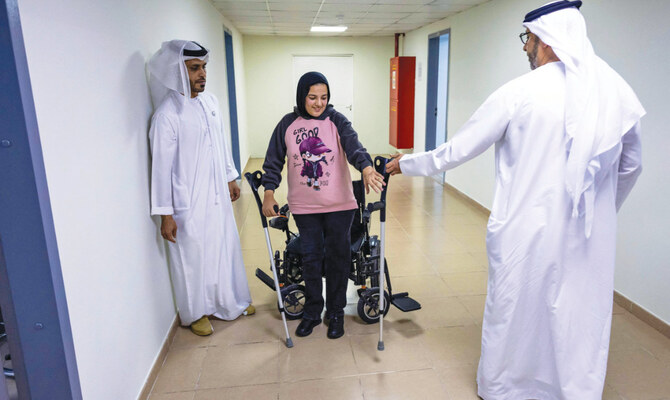

ABU DHABI: Layan Al Nasr, 14, thought she would never walk again after both of her legs were amputated following an Israeli bombing in Gaza one year ago.
Now, she stands proudly on artificial limbs fitted in the UAE. But fear for her family, still living under the attacks, gnaws away.
“When I was told about prosthetics when I arrived, I didn’t even know they existed,” she jokes, taking a few steps supported by crutches.
She is able to smile as she describes her operations, rehabilitation and her newfound hope. But emotion eventually catches up with her.
“What scares me today is losing my brothers, my sisters and my father,” she confides, bursting into tears.
Nasr is one of more than 2,000 wounded or seriously ill Palestinians flown with their closest relatives to the UAE during the Israel-Hamas war.
Plucked from shattered Gaza, much of it in ruins, they are lucky to escape a conflict that has left more than 45,000 people dead in the Palestinian territory.
The survivors brought to the UAE are haunted by their memories of war and their terror of losing loved ones, despite their new existence in calm, quiet Abu Dhabi.
“I don’t care what happens to me, the important thing is that nothing happens to them,” insists Nasr.
The complex housing them in the UAE capital has a school, mosque, grocery store and a hairdresser, as well as a care center offering physiotherapy, speech therapy and counseling.
“Thanks to the prosthetics and the care provided, patients have regained their autonomy,” says physiotherapist Mustafa Ahmed Naji Awad.
But the hardest thing to treat is the psychological impact, he admits.
Faten Abu Khoussa, who came with her 10-year-old daughter Qamar, can testify to this.
The little girl was caught in an air raid in Gaza when she went out to buy a packet of crisps, losing a leg from her injuries.
Qamar’s spirits have gradually improved over time, but “it remains very difficult for her. She loved nothing more than playing on her scooter,” says her mother.
“She feels alone without her brothers and sisters” who have fled to Egypt, Abu Khoussa adds.
The single mother, now separated from the other children she has been raising since her husband’s death, is desperately trying to reunite her family in the UAE.
Until then she feels her life is “suspended,” leaving her unable to plan for the future.
The Emirati authorities say the afflicted Palestinians and their family members will be asked to return home when conditions allow.
Ahmad Mazen, 15, who came with his mother to have a lower-leg prosthesis fitted, was looking forward to being reunited with his father and brother.
But shortly after his arrival, he learned that they had been killed in a bombing raid.
His only consolation is football, his passion, and the “indescribable feeling” of finally being able to kick a ball again, he says.


