KYIV: Five months after their shock offensive into Russia, Ukrainian troops are bloodied and demoralized by the rising risk of defeat in Kursk, a region some want to hold at all costs while others question the value of having gone in at all.
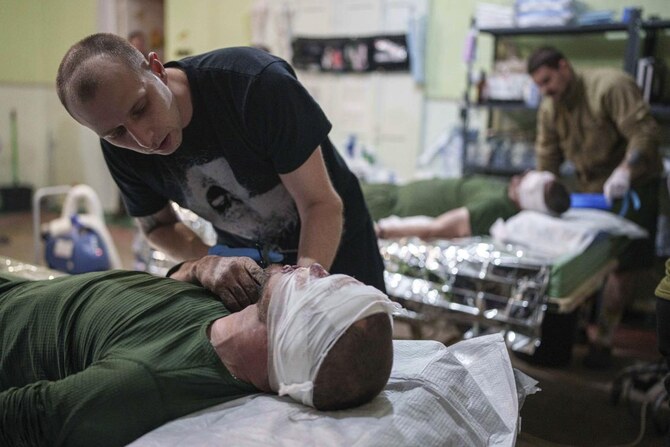
Battles are so intense that some Ukrainian commanders can’t evacuate the dead. Communication lags and poorly timed tactics have cost lives, and troops have little way to counterattack, seven front-line soldiers and commanders told The Associated Press on condition of anonymity so they could discuss sensitive operations.
Since being caught unaware by the lightning Ukrainian incursion, Russia has amassed more than 50,000 troops in the region, including some from its ally North Korea. Precise numbers are hard to obtain, but Moscow’s counterattack has killed and wounded thousands and the overstretched Ukrainians have lost more than 40 percent of the 984 square kilometers (380 square miles) of Kursk they seized in August.
Its full-scale invasion three years ago left Russia holding a fifth of Ukraine, and Ukrainian President Volodymyr Zelensky has hinted that he hopes controlling Kursk will help force Moscow to negotiate an end to the war. But five Ukrainian and Western officials in Kyiv who spoke on condition of anonymity to freely discuss sensitive military matters said they fear gambling on Kursk will weaken the whole 1000-kilometer front line, and Ukraine is losing precious ground in the east.
“We have, as they say, hit a hornet’s nest. We have stirred up another hot spot,” said Stepan Lutsiv, a major in the 95th Airborne Assault Brigade.
The border raid that became an occupation
Army chief Oleksandr Syrskyi has said that Ukraine launched the operation because officials thought Russia was about to launch a new attack on northeast Ukraine.
It began on Aug. 5 with an order to leave Ukraine’s Sumy region for what they thought would be a nine-day raid to stun the enemy. It became an occupation that Ukrainians welcomed as their smaller country gained leverage and embarrassed Russian President Vladimir Putin.
Gathering his men, one company commander told them: “We’re making history; the whole world will know about us because this hasn’t been done since World War II.
Privately, he was less certain.
“It seemed crazy,” he said. “I didn’t understand why.”
Shocked by success achieved largely because the Russians were caught by surprise, the Ukrainians were ordered to advance beyond the original mission to the town of Korenevo, 25 kilometers into Russia. That was one of the first places where Russian troops counterattacked.
By early November the Russians began regaining territory rapidly. Once in awe of what they accomplished, troops’ opinions are shifting as they come to terms with losses. The company commander said half of his troops are dead or wounded.
Some front-line commanders said conditions are tough, morale is low and troops are questioning command decisions, even the very purpose of occupying Kursk.
Another commander said that some orders his men have received don’t reflect reality because of delays in communication. Delays occur especially when territory is lost to Russian troops, he said.
“They don’t understand where our side is, where the enemy is, what’s under our control, and what isn’t,” he said. “They don’t understand the operational situation, we so act at our own discretion.”
One platoon commander said higher ups have repeatedly turned down his requests to change his unit’s defensive position because he knows his men can’t hold the line.
“Those people who stand until the end are ending up MIA,” he said. He said he also knows of at least 20 Ukrainian soldiers whose bodies had been abandoned over the last four months because the battles were too intense to evacuate them without more casualties.
No option to retreat as Russia doubles down
Ukrainian soldiers said they were not prepared for the aggressive Russian response in Kursk, and cannot counterattack or pull back.
“There’s no other option. We’ll fight here because if we just pull back to our borders, they won’t stop; they’ll keep advancing,” said one drone unit commander.
The AP requested comment from Ukraine’s General Staff but did not receive a response before publication.
American longer-range weapons have slowed the Russian advance and North Korean soldiers who joined the fighting last month are easy targets for drones and artillery because they lack combat discipline and often move in large groups in the open, Ukrainian troops said.
On Monday, Zelensky said 3,000 North Korean soldiers had been killed and wounded. But they appear to be learning from their mistakes, soldiers added, by becoming more adept at camouflaging near forested lines.
One clash took place last week near Vorontsovo tract, a forested area between the settlements of Kremenne and Vorontsovo.
Until last week, the area was under Ukraine’s control. This week part of it has been lost to Russian forces and Ukrainian troops fear they will reach a crucial logistics route.
Eyeing frontline losses in the eastern region known as the Donbas — where Russia is closing on a crucial supply hub — some soldiers are more vocal about whether Kursk has been worth it.
“All the military can think about now is that Donbas has simply been sold,” the platoon commander said. “At what price?”

Bloodied Ukrainian troops risk losing more hard-won land in Kursk to Russia
Short Url
https://arab.news/przgv
Bloodied Ukrainian troops risk losing more hard-won land in Kursk to Russia
- Battles are so intense that some Ukrainian commanders cannot evacuate the dead
- Communication lags and poorly timed tactics have cost lives, and troops have little way to counterattack
Brown University shooting leaves students, community frustrated with official response
- On Sunday, officials released a person of interest without charges, leaving investigators scrambling for new leads
- The FBI and Providence police have released footage but have not identified the suspect. Students and community members are frustrated by security gaps
PROVIDENCE: The ongoing effort to find a man who walked onto Brown University ‘s campus during a busy exam season and shot nearly a dozen students in a crowded lecture hall has raised questions about the school’s security systems and the urgency of the investigation itself.
A day after Saturday’s mass shooting, officials said a person of interest taken into custody would be released without charges, leaving investigators with little actionable insight from the limited security video they had recovered and scrambling to develop new leads.
Law enforcement officials were still doing the most basic investigative work two days after the shooting that killed two students and wounded nine, canvassing local residences and businesses for security camera footage and looking for physical evidence. That’s left students and some Providence residents frustrated at gaps in the university’s security and camera systems that helped allow the shooter to disappear.
“The fact that we’re in such a surveillance state but that wasn’t used correctly at all is just so deeply frustrating,” said Li Ding, a student at the nearby Rhode Island School of Design who dances on a Brown University team.
A petition for increased security
Ding is among hundreds of students who have signed a petition to increase security at school buildings, saying that officials need to do a better job keeping the campus secure against threats like active shooters.
“I think honestly, the students are doing a more effective job at taking care of each other than the police,” Ding said.
Kristy dosReis, chief public information officer for the Providence Police Department, said that at no point did the investigation stand down even after officials appeared to have a breakthrough in the case, detaining a Wisconsin man who they now believe was not involved.
“The investigation continued as the scenes were still active. Nothing was cleared,” said dosReis.
Police and the FBI on Monday released new video and photographs of a man they believe carried out the attack. The man wore a mask in the footage captured before and after the attack.
Investigation is ‘painstaking work’
FBI Boston Special Agent in Charge Ted Docks said a $50,000 reward was being offered for information that would lead to the identification, arrest and conviction of the shooter.
Docks described the investigation, including documenting the trajectory of bullets at the shooting scene, as “painstaking work.”
“We are asking the public to be patient as we continue to run down every lead so we can give victims, survivors, their families and all of you the answers you deserve,” Docks told reporters.
A lack of campus security footage
While Brown University is dotted with cameras, there were few in the Barus and Holley building, home of the engineering school that was targeted.
“Reality is, it’s an old building attached to a new one,” Rhode Island Attorney General Peter Neronha told reporters about the lack of cameras nearby.
The lack of campus footage left police seeking tips from the public.
Katherine Baima said US marshals came to her door on Monday, seeking footage from a security camera pointing toward the street.
“This is the first time any of us in my building, as far as I know, had heard from anyone,” Baima said.
Students said the school’s emergency alert system kept them relatively well-informed about the presence of an active shooter. But they were uncertain what to do during a prolonged campus lockdown.
Chiang-Heng Chien, a 32-year-old doctoral student in engineering, hid under desks and turned off the lights after receiving an alert about the shooting at 4:22 p.m. Saturday in a campus lab.
“While I was hiding in the lab, I heard the police yelling outside but my friends and I were debating whether we should open the door, since at that moment the shooter was believed to be (nearby),” he said in a text.
Experts say colleges can be at disadvantage when it comes to security
Law enforcement experts say colleges are often at a disadvantage when responding to threats like an active shooter. Their security officers are typically less trained and paid less than in other law enforcement departments. They also don’t always have close partnerships with better-resourced agencies.
Often, funding for campus police departments is not a top priority, even for schools with ample resources, said Terrance Gainer, a former Illinois law enforcement official who later served as the US Senate’s sergeant-at-arms.
“They just aren’t as flush in law enforcement as you would think. They don’t like a lot of uniformed presence, they don’t like a lot of guns around,” said Gainer, who is now a consultant. “Whether it’s Brown or someone else, a key question is, what type of relationship do they have with the local police department?”
At Utah Valley University, where conservative leader Charlie Kirk was assassinated by a shooter on a school building roof last summer, the undersized campus police department never asked neighboring agencies to assist with security at the outdoor Kirk event that attracted thousands, an Associated Press review found.
Changes in Providence’s alert system
Providence has an emergency alert system, but it switched from a mobile app to a web-based system in March. The new system requires someone to register online to receive alerts — something not all residents knew.
Emely Vallee, 35, lives about a mile (1.6 kilometers) from Brown with her two young children. She said she received “absolutely nothing” in alerts. She relied instead on texts from friends and the news.
Vallee had expected to be notified through the city’s 311 app, but hadn’t realized that Mayor Brett Smiley phased out the app in March. Smiley said his administration sent out multiple alerts the day of the shooting using the new 311 system and has continued to send them.
Hailey Souza, 23, finished her shift at a smoothie shop just off-campus minutes before the shooting. Everything seemed normal and quiet, Souza said.
But driving home, she saw a boy bleeding on the sidewalk. “Then everyone started running and screaming,” she said. Souza said she saw a bystander rip off his T-shirt to help.
The shop Souza manages, In The Pink, is a block from the engineering building. One of the shooting victims, Ella Cook, was a regular at the store, Souza said. Cook had come in a few days earlier and said her last final was Saturday.
Souza later learned that police came by the store to tell her co-workers about an active shooter. But Souza never received an emergency alert. “Nothing,” she said.
A day after Saturday’s mass shooting, officials said a person of interest taken into custody would be released without charges, leaving investigators with little actionable insight from the limited security video they had recovered and scrambling to develop new leads.
Law enforcement officials were still doing the most basic investigative work two days after the shooting that killed two students and wounded nine, canvassing local residences and businesses for security camera footage and looking for physical evidence. That’s left students and some Providence residents frustrated at gaps in the university’s security and camera systems that helped allow the shooter to disappear.
“The fact that we’re in such a surveillance state but that wasn’t used correctly at all is just so deeply frustrating,” said Li Ding, a student at the nearby Rhode Island School of Design who dances on a Brown University team.
A petition for increased security
Ding is among hundreds of students who have signed a petition to increase security at school buildings, saying that officials need to do a better job keeping the campus secure against threats like active shooters.
“I think honestly, the students are doing a more effective job at taking care of each other than the police,” Ding said.
Kristy dosReis, chief public information officer for the Providence Police Department, said that at no point did the investigation stand down even after officials appeared to have a breakthrough in the case, detaining a Wisconsin man who they now believe was not involved.
“The investigation continued as the scenes were still active. Nothing was cleared,” said dosReis.
Police and the FBI on Monday released new video and photographs of a man they believe carried out the attack. The man wore a mask in the footage captured before and after the attack.
Investigation is ‘painstaking work’
FBI Boston Special Agent in Charge Ted Docks said a $50,000 reward was being offered for information that would lead to the identification, arrest and conviction of the shooter.
Docks described the investigation, including documenting the trajectory of bullets at the shooting scene, as “painstaking work.”
“We are asking the public to be patient as we continue to run down every lead so we can give victims, survivors, their families and all of you the answers you deserve,” Docks told reporters.
A lack of campus security footage
While Brown University is dotted with cameras, there were few in the Barus and Holley building, home of the engineering school that was targeted.
“Reality is, it’s an old building attached to a new one,” Rhode Island Attorney General Peter Neronha told reporters about the lack of cameras nearby.
The lack of campus footage left police seeking tips from the public.
Katherine Baima said US marshals came to her door on Monday, seeking footage from a security camera pointing toward the street.
“This is the first time any of us in my building, as far as I know, had heard from anyone,” Baima said.
Students said the school’s emergency alert system kept them relatively well-informed about the presence of an active shooter. But they were uncertain what to do during a prolonged campus lockdown.
Chiang-Heng Chien, a 32-year-old doctoral student in engineering, hid under desks and turned off the lights after receiving an alert about the shooting at 4:22 p.m. Saturday in a campus lab.
“While I was hiding in the lab, I heard the police yelling outside but my friends and I were debating whether we should open the door, since at that moment the shooter was believed to be (nearby),” he said in a text.
Experts say colleges can be at disadvantage when it comes to security
Law enforcement experts say colleges are often at a disadvantage when responding to threats like an active shooter. Their security officers are typically less trained and paid less than in other law enforcement departments. They also don’t always have close partnerships with better-resourced agencies.
Often, funding for campus police departments is not a top priority, even for schools with ample resources, said Terrance Gainer, a former Illinois law enforcement official who later served as the US Senate’s sergeant-at-arms.
“They just aren’t as flush in law enforcement as you would think. They don’t like a lot of uniformed presence, they don’t like a lot of guns around,” said Gainer, who is now a consultant. “Whether it’s Brown or someone else, a key question is, what type of relationship do they have with the local police department?”
At Utah Valley University, where conservative leader Charlie Kirk was assassinated by a shooter on a school building roof last summer, the undersized campus police department never asked neighboring agencies to assist with security at the outdoor Kirk event that attracted thousands, an Associated Press review found.
Changes in Providence’s alert system
Providence has an emergency alert system, but it switched from a mobile app to a web-based system in March. The new system requires someone to register online to receive alerts — something not all residents knew.
Emely Vallee, 35, lives about a mile (1.6 kilometers) from Brown with her two young children. She said she received “absolutely nothing” in alerts. She relied instead on texts from friends and the news.
Vallee had expected to be notified through the city’s 311 app, but hadn’t realized that Mayor Brett Smiley phased out the app in March. Smiley said his administration sent out multiple alerts the day of the shooting using the new 311 system and has continued to send them.
Hailey Souza, 23, finished her shift at a smoothie shop just off-campus minutes before the shooting. Everything seemed normal and quiet, Souza said.
But driving home, she saw a boy bleeding on the sidewalk. “Then everyone started running and screaming,” she said. Souza said she saw a bystander rip off his T-shirt to help.
The shop Souza manages, In The Pink, is a block from the engineering building. One of the shooting victims, Ella Cook, was a regular at the store, Souza said. Cook had come in a few days earlier and said her last final was Saturday.
Souza later learned that police came by the store to tell her co-workers about an active shooter. But Souza never received an emergency alert. “Nothing,” she said.
© 2025 SAUDI RESEARCH & PUBLISHING COMPANY, All Rights Reserved And subject to Terms of Use Agreement.


