


BETHELHEM: Amid the ongoing suffering in Gaza, Rev. Munther Isaac, the Palestinian pastor of the Evangelical Lutheran Christmas Church in Bethlehem, told Arab News that his enduring source of hope is his “faith in God and the resilience of our Palestinian people.”
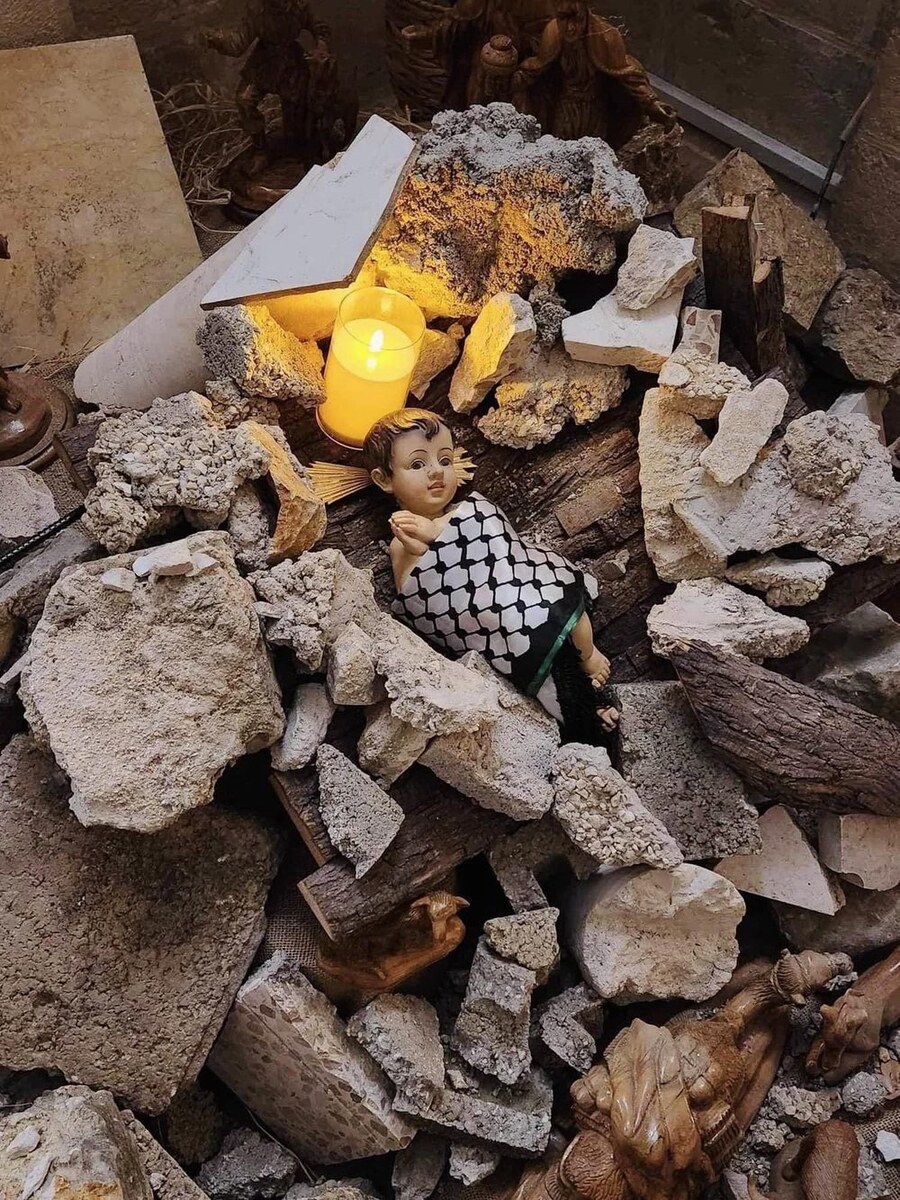
Isaac, who last Christmas drew global attention after his church displayed a nativity featuring the baby Jesus draped in a keffiyeh amid a heap of rubble, representing the war in Gaza, said he had been taken aback by the worldwide response to his imagery.
“It has been a year since we installed Christ in the rubble in our church here in Bethlehem, and honestly I am shocked and horrified to my core that this war is still going on and that all our efforts, demonstrations around the world, the cries and the images of people, children killed didn’t stop this war,” he said.
Israel mounted a devastating military operation in Gaza in retaliation for the Hamas-led Oct. 7, 2023, attack on southern Israel, which killed some 1,200 people, most of them Israeli civilians, and saw around 250 taken hostage, including scores of foreign nationals.
The bombardment of Gaza and strangulation of aid flows into the embattled territory has resulted in more than 43,000 deaths, some 70 percent of the women and children, according to health ministry officials, leading to accusations of genocide.

Worshippers walk outside after Christmas Eve mass at the Roman Catholic Church of the Holy Family in the Zaytoun neighbourhood of Gaza City on December 24, 2024. (AFP)
Isaac said the widespread revulsion inspired by the conflict had created a worldwide movement in support of the Palestinian cause, with several churches around the globe copying the imagery of Jesus in the rubble to show their support.
“I still receive these days, a year on, images of churches around the world that have created something similar, whether in their churches or church leaders carrying signs with the image of Jesus in the rubble or using that metaphor that if Jesus was born today he would be found in the rubble,” he said.
The Palestinian pastor said he has been “overwhelmed” by that response and the media attention.
“I am grateful that this has enabled us to speak about the suffering of our people, that it enabled us to try as much as we can to humanize our message that this is about children, about real people,” he said.
“We are seeing people united together in churches and sometimes in synagogues with the aim of convincing the warlords, which they called them, to stop this war.”
But the native of the Bethlehem district town of Beit Sahour, where the biblical story of the Shepherds watching their flock by night occurred, called on supporters and those who can show solidarity with Palestinians to visit the occupied territories.
Isaac, who is also the academic dean at the Bethlehem Bible College, oversaw an international conference in May titled “Christ at the Checkpoint,” which drew hundreds of attendees from across the globe.
“It was great to see people come from around the world to express their support and solidarity, to stay in our hotels and cater to our restaurants and shops,” said Isaac.

Debris and rubble litter the ground a day after the Greek Orthodox Saint Porphyrius Church, the oldest church still in use in Gaza, was damaged in a strike on Gaza City on October 20, 2023. (AFP/File)
Bethlehem’s tourism industry has been badly hit by the dramatic fall in visitor numbers since the outbreak of war in Gaza in October 2023. Prior to the conflict, well over a million pilgrims and tourists would visit the birthplace of Jesus every year.
Isaac has become a global voice for Christians and Palestinians, attending meetings with national security officials at the White House, participating in pro-Palestinian demonstrations in London, and recently speaking in a South Africa mosque.
He was damning in his assessment of the US President-elect Donald Trump’s new cabinet picks, including the new US ambassador to Israel, Michael Huckabee, who has said he does not believe there is an Israeli occupation.
“When you look at what they are saying, that there is no occupation, that it is Judea and Samaria (rather than the West Bank), it clearly shows their imagined reality of Palestine from their biblical understanding, Trump’s (understanding), (removed from) any reality on the ground, whether it is international law or the reality we are living in,” said Isaac.
“When he says there is no occupation, I want to take him with me when we take our kids to school every day, and we pass by a checkpoint with (Israeli) soldiers pointing their guns at us.”
Isaac said the most dangerous thing about the holders of this ideology is that they “have a totally different sphere or reality to them. It is the imagined biblical times. God has given the land to Israel, and it does not matter what international law says.
“It does not matter that Palestinians have lived on this land for generations. To them, the only reality that matters is the way they understand the Bible.
“I find it strange that these are the very same people that preach to the world about the separation of state and religion, yet here they are imposing their own religious beliefs on me and our people, and they want all of us in the Middle East to accept not only their religion but to accept the way they interrupt the Bible, which is something not all Christians agree on.
“And they want to impose it on Arabs, on Palestinians, even on Palestinian Christians with a total disregard for reality or international law.”

A woman lights a candle inside the Evangelical Lutheran Church in Bethlehem. (AFP/File)
However, Isaac said he is seeing changes, or what he called “cracks in the wall,” in how Christians are responding. “I receive lots of messages and I begin to see this change, and the crimes that Israel is committing are so hard to ignore,” he said.
In his Christmas sermon last year, Isaac said the conflict in Gaza had divided the world. Now he says Gaza “has created a division also among Christians in how they see the world.”
“Some still believe and continue with the narrative in the West that Israel is defending itself and that this is a legitimate war or the Christian Zionist brand that says that this is Israel’s land to begin with, while others who are more concerned about justice and human rights are beginning to speak out,” he said.
“Many have had their eyes opened for the first time. Let us not forget that many in the West do not even realize Palestinian Christians exist. So, when they see and hear from pastors that even the church in Gaza was attacked and that Christians in Gaza are killed, women were shot dead in the church yard, it challenges their perspectives that this change is not enough to stop the war.”
Isaac says there are many parallels between the Christmas story and what Palestinians are living through today.
“Jesus was born under occupation, became a refugee, and survived the massacre of children,” he said. “All these are stories in the gospel. When we look at Jesus, we find hope. When we look at God, who is good and just, we have hope.
“That is why, this Christmas season, our hope comes from our faith. We will continue to pray.”
“I am shocked and horrified to my core that this war is still going on,” said Rev. Munther Isaac. (Supplied)
Like last year, Bethlehem’s festive decorations will again be more muted in a sign of respect to those killed and suffering in Gaza. “Yes, we will not light Christmas trees and Santas,” said Isaac. “That enables us to talk about the true meaning of Christmas.”
The heads of the various churches of Jerusalem have also called on church leaders to share messages of hope during this year’s Christmas celebrations. “Our faith is being tested and we need to keep the faith,” said Isaac.
“This is the place that Christianity started, there has been an ongoing Christian presence in Bethlehem in Jerusalem and in Nazareth for 2,000 years, and I believe there will be Christian presence after this.
“As long as we are committed to keep the witness from the place where it all started, I think we can survive this period.”


