

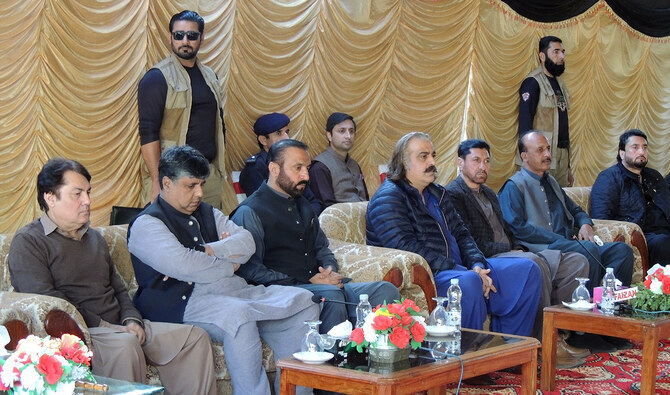

PESHAWAR: A government-backed council of tribal elders leading peace talks in a Pakistani district where at least 136 people have been killed since last month in sectarian clashes will resume meetings in two days and expects to sign a “durable” peace agreement, a government official said on Monday.
Kurram, a tribal district of around 600,000 in Khyber Pakhtunkhwa province where federal and provincial authorities have traditionally exerted limited control, has frequently experienced violence between its Sunni and Shia Muslim communities over land and power. Travelers to and from the town ride in convoys escorted by security officials.
The latest feuding started on Nov. 21 when gunmen ambushed a vehicle convoy and killed 52 people, mostly Shias. Nobody claimed responsibility for the assault, which triggered road closures and other measures that have disrupted people’s access to medicine, food, fuel, education and work.
Earlier this month, the provincial government of the Pakistan Tehreek-e-Insaf party formed a ‘grand jirga’ of political and tribal heavyweights to convince rival tribes to shun violence.
“The jirga will resume meetings after two days and is expected to sign a durable peace agreement to the dispute,” Khyber Pakhtunkhwa (KP) government spokesman Muhammad Ali Saif said in a statement, which came after two Shias were killed in the Ochat area of Kurram on Sunday night.
“The two persons were coming to their villages but on the main road unidentified men shot them dead at around 8pm,” Kurram police spokesman Riaz Khan told Arab News on Monday.
“One of the victims was from Alam Sher village and the other was from Zerran, Parachinar.”
Khan said at least 136 people had been killed in the violence since last month. If you added those who had died due to lack of access to hospitals and medicines following the road closures, the number reached at least 200, the police officer said.
Last week, Saif said authorities had decided to dismantle private bunkers, observation posts used in the fighting by both sides, and given a deadline of Feb. 1 for tribesmen in Kurram to handover heavy weapons. Local tribesmen have so far reportedly refused to surrender their weapons, citing concerns about their safety.
A tribal elder who is part of the jirga, however, said most tribes had agreed to the council’s recommendations.
“The jirga faces no big hurdles because both the sides have expressed willingness to abide by the jirga decisions, including removal of bunkers and surrendering of heavy weapons,” jorga member Muneer Bangash told Arab News on Monday.
“Once there are no heavy weapons, I’m sure there will be no mass killings at the scale that we have recently witnessed.”
He said both the sides wanted “communal coexistence and harmony” and realized that the decades-old clash had only brought destruction.
“We will give good news very soon. Half of the threat will be gone once the heavy weapons are collected. Peace will gradually take root,” Bangash added.
Meanwhile, the KP government has launched a helicopter service to evacuate people and transport aid and medicines to Kurran as a major highway connecting Kurram’s main city of Parachinar to the provincial capital of Peshawar has been blocked since last month, triggering a humanitarian crisis with reports of starvation, lack of medicine and oxygen shortages.
On Sunday, two flights evacuated 27 individuals and 16 government staffers and jirga members, according to KP chief minister’s office. Since last week, over 180 people, including women, children and patients, have been transported via helicopter, with priority given to those in need of urgent medical attention.
In a meeting on Monday, the KP cabinet decided to establish a special police force to secure the Peshawar-Parachinar road, for which 399 people would be recruited.
Shia Muslims dominate parts of Kurram, although they are a minority in the rest of the country. The area has a history of sectarian conflict, with militant groups like the Pakistani Taliban and Daesh also previously targeting the minority group.


