

Pakistan defense minister blames judiciary for delayed verdicts in May 9 cases

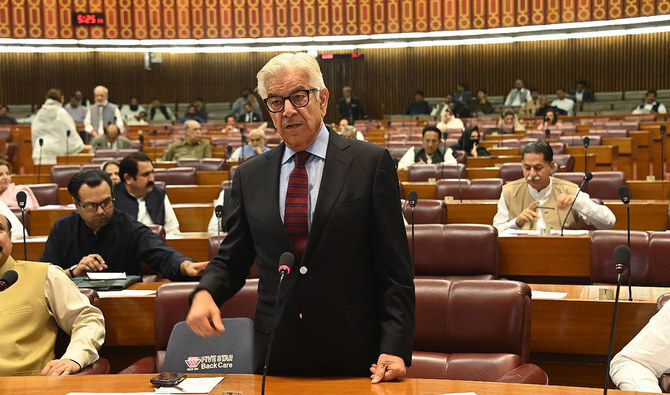
Pakistan Defense Minister Khawaja Asif addresses on the floor of the National Assembly of Pakistan in the federal capital Islamabad on May 3, 2023. (National Assembly of Pakistan/File)
Short Url
Updated 23 December 2024
Follow

Pakistan defense minister blames judiciary for delayed verdicts in May 9 cases

  • National problems require decisions at the earliest, says Khawaja Asif while talking to media in London
  • Protests erupted in several Pakistani cities on May 9, 2023, over ex-PM Imran Khan’s arrest in a graft case

ISLAMABAD: Pakistan’s Defense Minister Khawaja Asif on Sunday blamed the judiciary for delaying verdicts in the May 9, 2023, cases, which have so far led to the conviction of 25 supporters of former Prime Minister Imran Khan’s Pakistan Tehreek-e-Insaf (PTI) party for attacking government buildings and military properties last year.

On Dec. 21, the Pakistan Army sentenced 25 people for participating in the violent protests that erupted in several Pakistani cities following Khan’s brief detention on corruption charges, resulting in damage to major military facilities and martyrs’ monuments in the country.

However, several suspects are also facing legal charges in anti-terrorism courts, with the military hoping for early verdicts in their cases, according to a statement announcing the sentencing of the 25 individuals, which described the rioting as “politically provoked violence.”

The PTI has denied any involvement in the violence, describing the May 9 incident as a “false flag” operation aimed at crushing the party.

“The judiciary created the biggest hurdle in this [the conviction of May 9 suspects] while this thing was allowed to linger for one and a half years,” Asif said while speaking to the media in London, the city he is currently visiting.

Describing the May 9 protests as a national problem, he said all the cases related to it required verdicts at the earliest.

The conviction of the 25 individuals followed a ruling by a seven-member Constitutional Bench of the Supreme Court of Pakistan on Dec. 13, allowing military courts to share their verdicts. Prior to that, the court had unanimously declared last year that prosecuting civilians in military courts violated the Constitution.

Khan’s PTI party rejected the military’s announcement, with opposition leader Omar Ayub Khan saying they were “against the principles of justice.”

The sentencing of the 25 individuals also raises concerns about Khan, who faces charges of inciting attacks against the armed forces and may potentially be tried in a military court.

Earlier, Asif had regretted the delay in announcing the verdicts, saying that it “raised the morale of the accused and their facilitators.”

“Right now, only the workers, who were used [to generate violence], have been punished under the law,” he had said. “This will not end until the ones, who planned this terrible day, are not brought before the law.”


Pakistan consumer confidence rises by 4 percentage points in two years, survey shows

Updated 6 sec ago
Follow

Pakistan consumer confidence rises by 4 percentage points in two years, survey shows

  • Four in 10 Pakistanis believed the country is on the right track, with optimism higher among men
  • Economic concerns remained most worrying, but their quantum fell drastically across all issues

ISLAMABAD: Consumer confidence in Pakistan has risen by 4 percentage points from 31.5 to 35.5 over the last two years, which highlights improving public optimism under the government’s tenure, Ipsos market research firm said in a recent survey.

The survey was conducted through computer-assisted telephonic interviews (CATI) and included more than a thousand participants from all provinces and Azad Kashmir and Gilgit Baltistan regions on Feb. 2-14.

It comes at a time when Pakistan has undergone a difficult period of stabilization, though international rating agencies have acknowledged improvements after Islamabad began implementing structural reforms as part of its $7 billion International Monetary Fund (IMF) program.

The Ipsos survey revealed a “measurable” improvement in Pakistan’s economic sentiment, marked by a decline in inflation alongside notable reductions in poverty and unemployment, since the current government took charge two years ago.

“These findings point to a clear two-year transformation in the Consumer Confidence Index, demonstrating the perceived impact of consistent governance and policy measures,” read the key takeout in the survey.

“Sustained performance, coupled with transparent communication of achievements, will be essential to maintain momentum, reinforce optimism, and support further improvements in economic confidence.”

Four in 10 Pakistanis believed the country is on the right track, with optimism higher among men, while confidence in the country’s direction being right increased more than three times, from 12 percent to 40 percent, since the government came to power, according to the survey.

Economic concerns remained most worrying, but their quantum fell drastically across all issues since the first quarter of 2024. Inflation has dropped by 23 percent, unemployment by 10 percent, poverty by 20 percent, electricity prices by 34 percent and the burden of additional taxes was reduced by 18 percent in Q1 2026 as compared to Q1 2024.

“One in 3 Pakistanis expect the economy to strengthen,” the survey read. “Confidence to invest has grown steadily over two years, rising from 11 percent to 16 percent, with even stronger optimism among urban residents.”