

Gaza rescuers say Israeli strikes kill 35

1 / 4
People search for survivors at the site of an Israeli strike that targeted the Abu Samra family home in Deir el-Balah in the central Gaza Strip on December 22, 2024, amid the ongoing war between Israel and the Palestinian militant group Hamas. (AFP)
2 / 4
Palestinians look on, at the site of an Israeli strike on a house, amid the Israel-Hamas conflict, in Deir Al-Balah, in the central Gaza Strip, December 22, 2024. (REUTERS)
3 / 4
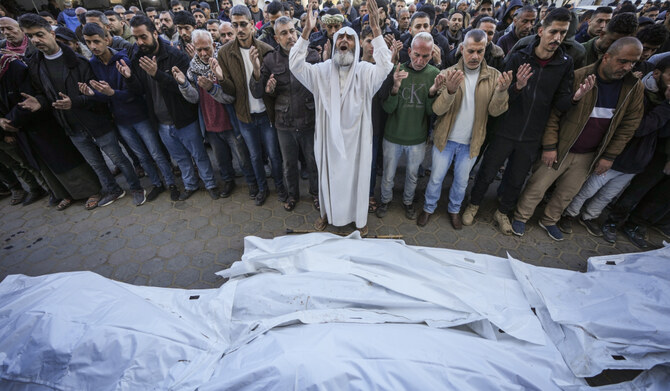
Palestinians pray over the bodies of the victims of an Israeli strike on a home late Saturday before the funeral outside the Al-Aqsa Martyrs Hospital in Deir al-Balah Sunday, Dec. 22, 2024. (AP)
4 / 4
Palestinians look at home destroyed by an Israeli strike late Saturday in Deir al-Balah Sunday, Dec. 22, 2024. (AP)
Short Url
Updated 23 December 2024
Follow

Gaza rescuers say Israeli strikes kill 35

  • Hossam Abu Safia, director of Kamal Adwan Hospital, said in a statement that the facility’s generators were hit and that “the army is attempting to target the fuel tank, which is full of fuel and poses a significant fire risk”
  • Bassal said eight people including four children were killed in the attack on the school, which had been repurposed as a shelter for Palestinians displaced by the war

GAZA STRIP, Palestinian Territories: Gaza’s civil defense agency said on Sunday that Israeli strikes killed at least 35 Palestinians across the territory, more than 14 months into the Israel-Hamas war.
The violence came even as Palestinian groups involved in the fighting said a ceasefire deal was “closer than ever.”
Israel has faced growing criticism of its actions during the war, triggered by Hamas’s October 7, 2023 attack, including from rights groups accusing it of “acts of genocide” which the Israeli government strongly denies.
Pope Francis denounced on Sunday the “cruelty” of Israel’s bombardment, highlighting the deaths of children and attacks on schools and hospitals in Gaza.
It was his second such comment in as many days, despite Israel’s accusing the pontiff of “double standards.”
On the ground in Gaza, civil defense agency spokesman Mahmud Bassal said at least 13 people were killed in an air strike on a house in central Gaza’s Deir el-Balah belonging to the Abu Samra family.
An AFP photographer saw residents searching through the debris for survivors, while others looked for belongings they could salvage.
In a nearby compound, bodies covered in blankets lay on the sandy ground.
The military said it targeted an Islamic Jihad militant who was operating in Deir el-Balah.
“According to an initial examination, the reported number of casualties resulting from the strike does not align with the information held by the IDF (military),” it said to AFP in a statement, which did not give its own toll.
“We are... losing loved ones every day,” said Deir el-Balah resident Naim Al-Ramlawi.
“I pray to God that a truce will be reached soon” and would allow Gazans to finally “live a decent life, instead of this miserable life,” he said.
The military also confirmed a separate strike further north, on a school in Gaza City.
Bassal said eight people including four children were killed in the attack on the school, which had been repurposed as a shelter for Palestinians displaced by the war.
It was the latest of numerous similar strikes against schools-turned-shelters during the war.
The military says the facilities are used by Hamas Palestinian militants.
In this case it said it carried out a “precise strike” that targeted a Hamas “command and control center” inside the school compound.

AFP images showed mangled concrete slabs and iron beams strewn amid patches of blood at the damaged school building.
Bassal said in a statement that a separate strike, overnight into Sunday, killed three people in Rafah, in the south.
And a drone strike on Sunday morning hit a car in Gaza City, killing four people, the spokesman added.
Late on Sunday, the civil defense agency said seven people were killed when Israeli drones struck tents in the humanitarian area of Al-Mawasi in western Khan Yunis, while the Israeli military said it had targeted a “Hamas terrorist.”
Israel in early October began a major military operation in Gaza’s north, which it said aimed to prevent Hamas from regrouping there.
A United Nations official who visited Gaza City said late last month that people were living in “inhumane conditions with severe food shortages and terrible sanitary conditions.”
On Sunday a hospital director in northern Gaza said Israeli forces were bombing buildings near the facility.
Hossam Abu Safia, director of Kamal Adwan Hospital, said in a statement that the facility’s generators were hit and that “the army is attempting to target the fuel tank, which is full of fuel and poses a significant fire risk.”
Contacted by AFP, the military said it was unaware of any strikes on the hospital, one of only two still operating in northern Gaza.
The unprecedented Hamas attack last year that sparked the war resulted in the deaths of 1,208 people, most of them civilians, according to an AFP tally based on official Israeli figures.
Militants also took 251 hostages, of whom 96 remain in Gaza, including 34 the Israeli military says are dead.
Israel’s retaliatory offensive in Gaza has killed at least 45,259 people, a majority of them civilians, according to figures from the Hamas-run territory’s health ministry that the United Nations considers reliable.
Hamas and two other Palestinian armed groups said in a rare joint statement on Saturday that an agreement to end the bloodshed was “closer than ever,” after Qatari-hosted talks that followed months of stalled negotiations.


Israel bars Al-Aqsa imam from entering mosque in Ramadan

Updated 17 February 2026
Follow

Israel bars Al-Aqsa imam from entering mosque in Ramadan

  • ‘This ban is a grave matter for us as our soul is tied to Al-Aqsa, Al-Aqsa is our life’

JERUSALEM: A senior imam of the Al-Aqsa Mosque in East Jerusalem said on Tuesday that Israeli authorities had barred him from entering the compound, just days before the start of the holy month of Ramadan.

“I have been barred from the mosque for a week, and the order can be renewed,” Sheikh Muhammad Al-Abbasi said.
He said he was not informed of the reason for the ban, which came into effect from Monday.

FASTFACT

A Waqf source said 33 of its employees had been barred from entering the compound in the week leading up to Ramadan.

“I had only returned to Al-Aqsa a month ago after spending a year in the hospital following a serious car accident,” Abbasi said. “This ban is a grave matter for us, as our soul is tied to Al-Aqsa. Al-Aqsa is our life.”
On Monday, Israeli police said they had recommended issuing 10,000 permits for Palestinians from the occupied West Bank, who require special permission to enter Jerusalem.
Arad Braverman, a senior Israeli police officer in occupied Jerusalem, said forces would be deployed “day and night” across the compound.
He said thousands of police would also be on duty for Friday prayers, which draw the largest crowds of Muslim worshippers.
The Palestinian Jerusalem Governorate said it had been informed that permits would again be restricted to men over 55 and women over 50, mirroring last year’s criteria.
It added that Israeli authorities had prevented the Islamic Waqf — the Jordanian-run body that administers the site — from carrying out routine preparations, including installing shade structures and setting up temporary medical clinics.
A Waqf source said 33 of its employees had been barred from entering the compound in the week leading up to Ramadan.
Under long-standing arrangements, Jews may visit the Al-Aqsa compound —  but they are not permitted to pray there.
Palestinians fear the status quo it is being eroded.
In a separate development, Israeli NGOs have raised the alarm over a settlement plan signed by the government which they say would mark the first expansion of Jerusalem’s borders into the occupied West Bank since 1967. Palestinians view East Jerusalem as the capital of their future state.
The proposal, published in early February but reported by Israeli media only on Monday, comes as international outrage mounts over creeping measures aimed at strengthening Israeli control over the West Bank.
Critics say these actions by the Israeli authorities are aimed at the de facto annexation of the Palestinian territory.
The planned development, announced by Israel’s Ministry of Construction and Housing, is formally a westward expansion of the Geva Binyamin, or Adam, settlement situated northeast of Jerusalem in the West Bank.
In a statement, the ministry said the development agreement included the construction of around 2,780 housing units for the settlement, with an investment of roughly $38.7 million.
But the area to be developed lies on the Jerusalem side of the separation barrier built by Israel in the early 2000s, while Geva Binyamin sits on the West Bank side of the barrier, and the two are separated by a road.
Israeli settlement watchdog Peace Now said there would be no “territorial or functional connection” between the area to be developed and the settlement.
“The new neighborhood will be integral to the city of Jerusalem,” Lior Amihai, Peace Now’s executive director, said.
“What is unique about that one is that it will be connected directly to Jerusalem, but it will be beyond the annexed municipal border. So it will be in complete West Bank territory, but just adjacent to Jerusalem,” he said.