DEIR AL-BALAH: Israeli strikes across the Gaza Strip overnight and into Sunday killed at least 16 people, Palestinian medical officials said.
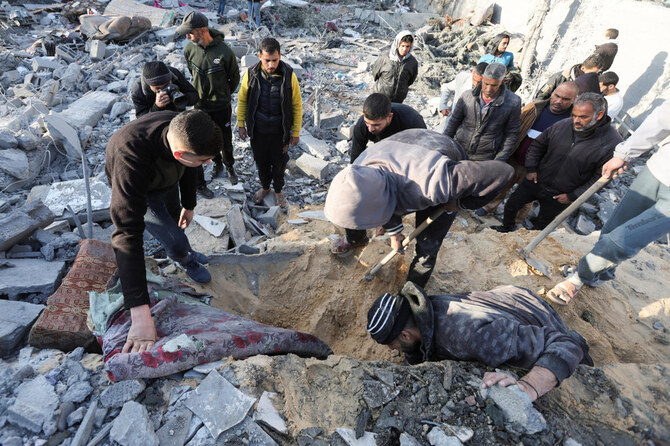
A strike on a school housing displaced people in Gaza City killed at least six people, including four children, according to the Civil Defense, first responders affiliated with the Hamas-run government. The Israeli military said it carried out a precise strike on Hamas militants sheltering there.
A strike on a home in the central city of Deir Al-Balah late Saturday killed at least eight people, according to the Al-Aqsa Martyrs Hospital, which received the bodies. A further two people were killed in a strike in the southern city of Khan Younis on Sunday, just after midnight, according to the nearby Nasser Hospital.
There was no immediate comment from the military on those strikes.
Israel has continued to carry out daily strikes in Gaza more than 14 months into the war with Hamas. It says it only targets militants, whom it accuses of hiding among civilians, but the bombings frequently kill women and children.
The war began on Oct. 7, 2023, when Hamas-led militants stormed into southern Israel in a surprise attack, killing some 1,200 people, mostly civilians, and abducting around 250. Around 100 hostages are still in Gaza, at least a third of whom are believed to be dead.
Israel’s subsequent bombardment and ground invasion have killed over 45,000 people in Gaza, more than half of them women and children, according to the Gaza Health Ministry, which does not distinguish between fighters and civilians in its count.
The offensive has caused widespread destruction and displaced some 90 percent of Gaza’s 2.3 million people, often multiple times. Hundreds of thousands are packed into squalid tent camps along the coast as the cold, wet winter sets in.
Israel has been carrying out a major operation in northern Gaza since early October, battling Hamas in the most isolated and heavily damaged part of the territory. Tens of thousands have fled as the military has ordered a complete evacuation and allowed almost no humanitarian aid to enter.
The Israeli military body overseeing civilian affairs in Gaza, known as COGAT, said it had facilitated the evacuation of over 100 patients, caregivers and others from the Kamal Adwan Hospital and the Awda Hospital in the far north, which have struggled to function. COGAT said it had also facilitated the delivery of 5,000 liters of fuel and food packages to the hospitals.
Israeli authorities also allowed Cardinal Pierbattista Pizzaballa, the leader of the Catholic Church in the Holy Land, to enter Gaza and celebrate a pre-Christmas Mass with members of the territory’s small Christian community. The Latin Patriarchate confirmed the visit in a brief statement.


Israeli strikes across Gaza kill at least 16, Palestinian officials say
https://arab.news/9qjfx
Israeli strikes across Gaza kill at least 16, Palestinian officials say

- Israel has continued to carry out daily strikes in Gaza more than 14 months into the war with Hamas


Pakistani on trial in US says Trump, Biden were possible targets in Iran-linked assassination plot
- Asif Merchant, who paid money to hitmen, tells court Iranian contact named three potential targets
- The Pakistani national says he anticipated getting arrested, acted out of fear for his relatives in Iran
NEW YORK: The allegation sounded like the stuff of spy movies: A Pakistani businessman trying to hire hit men, even handing them $5,000 in cash, to kill a US politician on behalf of Iran ‘s powerful paramilitary Revolutionary Guard.
It was true, and potential targets of the 2024 scheme included now-President Donald Trump, then-President Joe Biden and former presidential candidate and ex-UN Ambassador Nikki Haley, the man told jurors at his attempted terrorism trial in New York on Wednesday. But he insisted his actions were driven by fear for loved ones in Iran, and he figured he’d be apprehended before anything came of the scheme.
“My family was under threat, and I had to do this,” the defendant, Asif Merchant, testified through an Urdu interpreter. “I was not wanting to do this so willingly.”
Merchant said he had anticipated getting arrested before anyone was killed, intended to cooperate with the US government and had hoped that would help him get a green card.
US authorities were, indeed, on to him — the supposed hit men he paid were actually undercover FBI agents — and he was arrested on July 12, 2024, a day before an unrelated attempt on Trump’s life in Butler, Pennsylvania. Merchant did sit for voluntary FBI interviews, but he ultimately ended up with a trial, not a cooperation deal.
“You traveled to the United States for the purpose of hiring Mafia members to kill a politician, correct?” Assistant US Attorney Nina Gupta asked during her turn questioning Merchant Wednesday in a Brooklyn federal court.
“That’s right,” Merchant replied, his demeanor as matter-of-fact as his testimony was unusual.
The trial is unfolding amid the less than week-old Iran war, which killed Iranian Supreme Leader Ayatollah Ali Khamenei in a strike that Trump summed up as “I got him before he got me.” Jurors are instructed to ignore news pertaining to the case.
The Iranian government has denied plotting to kill Trump or other US officials.
Merchant, 47, had a roughly 20-year banking career in Pakistan before getting involved in an array of businesses: clothing, car sales, banana exports, insulation imports. He openly has two families, one in Pakistan and the other in Iran — where, he said, he was introduced around the end of 2022 to a Revolutionary Guard intelligence operative. They initially spoke about getting involved in a hawala, an informal money transfer system, Merchant said.
Merchant testified that his periodic visits to the US for his garment business piqued the interest of his Revolutionary Guard contact, who trained him on countersurveillance techniques.
The US deems the Revolutionary Guard a “foreign terrorist organization.” Formally called the Islamic Revolutionary Guard Corps, the force has been prominent in Iran under Khamenei.
Merchant said the handler told him to seek US residents interested in working for Iran. Then came another assignment: Look for a criminal to arrange protests, steal things, do some money laundering, “and maybe have somebody murdered,” Merchant recalled.
“He did not tell me exactly who it is, but he told me — he named three people: Donald Trump, Joe Biden and Nikki Haley,” he added.
After US immigration agents pulled Merchant aside at the Houston airport in April 2024, searched his possessions and asked about his travels to Iran, he concluded that he was under surveillance. But still he researched Trump rally locations, sketched out a plot for a shooting at a political rally, lined up the supposed hit men and scrambled together $5,000 from a cousin to pay them a “token of appreciation.”
He even reported back to his Revolutionary Guard contact, sending observations — fake, Merchant said — tucked into a book that he shipped to Iran through a series of intermediaries.
Merchant said he “had no other option” than to play along because the handler had indicated that he knew who Merchant’s Iranian relatives were and where they lived.
In a court filing this week, prosecutors noted that Merchant didn’t seek out law enforcement to help with his purported predicament before he was arrested. He testified that he couldn’t turn to authorities because his handler had people watching him.
Prosecutors also said that in his FBI interviews, Merchant “neglected to mention any facts that could have supported” an argument that he acted under duress.
Merchant told jurors Wednesday that he didn’t think agents would believe his story, because their questions suggested “they think that I’m some type of super-spy.”
“And are you a super-spy?” defense lawyer Avraham Moskowitz asked.
“No,” Merchant said. “Absolutely not.”


