

Students in Pakistan’s north embark on over 150-kilometer march for road safety awareness

1 / 2
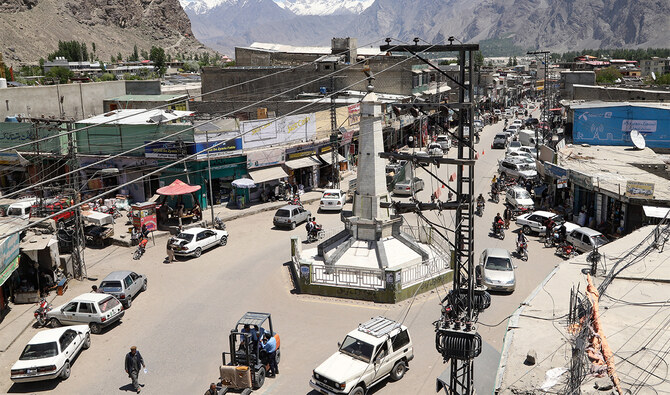
This photograph taken on May 9, 2024 shows commuters riding past electric poles installed along a street at Skardu in Pakistan's Gilgit-Baltistan region. (AFP/File)
2 / 2
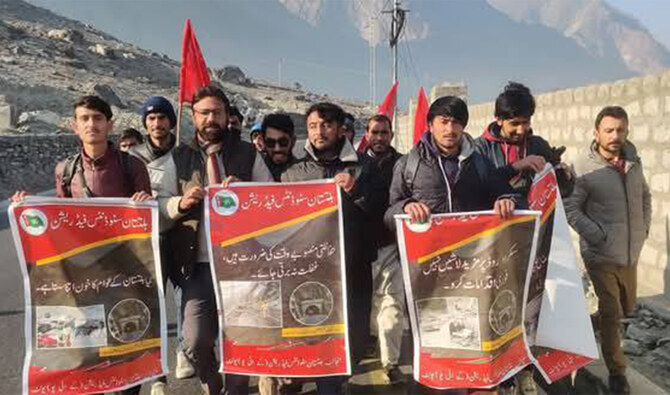
The image shows a group of students marching for road safety awareness in the Pakistan's northern Baltistan region on December 21, 2024. (Hassnain Abbas Khan Tayis/Facebook)
Short Url
Updated 22 December 2024
Follow

Students in Pakistan’s north embark on over 150-kilometer march for road safety awareness

  • The marchers aim to press the government to build tunnels on 167-kilometer Juglot-Skardu Road to avoid accidents, blockades
  • They say the original construction plan of JSR included five tunnels, but not a single one was constructed by authorities

KHAPLU, Gilgit-Baltistan: A group of students on Saturday embarked on a more than 150-kilometer march from Pakistan’s northern Gilgit district to Skardu, aiming to raise awareness about road safety.

The marchers called for making the 167-km single-carriage Juglot-Skardu Road (JSR), which connects the Gilgit division with Skardu district in the Baltistan division, safer for travelers by building tunnels at various locations prone to landslides in the mountainous region.

Skardu is a major tourism, trekking and mountaineering hub in Pakistan’s northern Gilgit-Baltistan region and home to Askole and Hushe villages, often referred to as gateways to snow-capped peaks, including K2, the Gasherbrums and Broad Peak, as well as the Baltoro, Biafo and Trango glaciers.

“We are marching just with a single agenda and our slogan is: ‘Build tunnels, save lives,’” Shehbaz Shareef, a member of the Baltistan Students Federation (BSF), told Arab News.

“We have organized this walk to raise awareness about the need for safer and reliable routes between Skardu and other parts of the country.”

Sharif was among over a dozen students who initiated the march, but they were joined by religious clerics, members of rights group, who came to show their support to the cause, at various locations.

The BSF member said the original construction plan for JSR included five tunnels, but none were built.

“This route has been constructed by FWO [Frontier Works Organization],” he added. “However, the tunnels were not built, and this road has become more dangerous.”

Arab News contacted FWO, a construction and engineering organization managed by the Pakistan Army, for its version. However, it was referred to the local chapter of the military’s media wing, the Inter-Services Public Relations, which did not respond to the query until the filing of this report.

The Awami Action Committee (AAC), a civic rights body in the region, announced its support for the march.

“We are very thankful to the BSF who are raising a very important issue. They are demanding the government to make this road safer through this march because this road is the only land route to the Baltistan division,” Najaf Ali, chairman of the AAC Baltistan chapter, told Arab News.

“It has become a well of death. Accidents are common on this road, and it has devoured many precious lives. A few days ago, five people were killed after a landslide buried their car. We have grown tired of lifting bodies due to accidents.”

Ali urged the government to build the requisite tunnels on the road.

“This is a matter of life and death, so we are with the students, and we will warmly receive them in Skardu,” he said. “Additionally, we also held a meeting with trade bodies and decided to launch a big drive to press the government to make this road safe.”

Mesam Kazim, opposition leader in the Gilgit-Baltistan Assembly, said they would do their utmost to press the government for the construction of tunnels on JSR.

“In 2022, we adopted a unanimous resolution demanding the federal government to order the construction of tunnels on the Gilgit-Skardu road to avoid frequent blockades of the artery due to landslides,” Kazim said.

“In the initial PC-1 [survey] uploaded by NHA [National Highway Authority], the construction of tunnels was part of the plan. Tunnels have been missed, and international standards [of construction] have been violated by FWO on JSR.”

He lamented that there were no parking lots, safety barriers, or speed limit boards on the road, and more than 100 people had lost their lives in accidents on JSR over the last few years.

“Who is responsible for these casualties?” Kazim questioned.


Pakistan sets expectations for Trump-backed Gaza Board of Peace at UN

Updated 4 sec ago
Follow

Pakistan sets expectations for Trump-backed Gaza Board of Peace at UN

  • The country calls for ceasefire enforcement and reconstruction of the war-ravaged territory
  • Pakistani diplomat warns Gaza recovery must proceed without annexation or forced displacement

ISLAMABAD: Pakistan on Wednesday highlighted its expectations of US President Donald Trump’s Board of Peace (BoP) in Gaza, saying it joined the United Nations-backed body alongside other Muslim nations since it expected concrete steps toward a permanent ceasefire, reconstruction of Gaza and a lasting and just peace grounded in the Palestinian right to statehood.

Prime Minister Shehbaz Sharif signed the Gaza Board of Peace charter earlier this week along with other world leaders on the sidelines of the 56th Annual Meeting of the World Economic Forum in Davos.

Pakistan’s Permanent Representative to the UN, Ambassador Asim Iftikhar Ahmad, told an open Security Council debate on the Middle East that the decision was driven by the need to address the “unresolved Palestinian question,” which he described as “the core of the instability” in the region.

“We hope that the BoP under the framework of resolution 2803 will lead to concrete steps toward the implementation of a permanent ceasefire, further scaling up of humanitarian aid, reconstruction of Gaza, and realization of the right to self-determination of the people of

Palestine through a credible, time-bound political process, consistent with international legitimacy and relevant UN resolutions resulting in an independent, sovereign and contiguous state of Palestine based on pre-1967 borders with Al-Quds Al-Sharif as its capital,” Ahmad said while addressing the council.

“That is the ultimate goal supported by the international community,” he added. “Palestinian-led governance and institutional strengthening, with a central role of the Palestinian Authority, are indispensable in this regard.”

Ahmad maintained Pakistan was deeply concerned about the fragile situation in Gaza, pointing to Israel’s continued ceasefire violations that he said were putting civilian lives at risk. He stressed that the ceasefire must be fully respected with a view to a permanent cessation of hostilities.

The Pakistani diplomat said recovery and reconstruction should begin without delay and must proceed without annexation, forced displacement or any alteration of the territorial unity of the Occupied Palestinian Territory.

“The contiguity of Gaza and the West Bank is indispensable for the viability of the Palestinian state,” he said.

Ahmad also called for a credible, irreversible and time-bound political process culminating in the realization of Palestinian statehood in accordance with international legitimacy.

“The international community, particularly this council, bears the responsibility to translate renewed engagement into measurable change on the ground for the betterment of the Palestinian people,” he said, adding that Pakistan was ready to work with “members of the council, regional and international partners, and the United States to advance a just and lasting solution to the Palestinian question, and comprehensive peace in the Middle East.”