CAIRO: Hamas and two other Palestinian militant groups said on Saturday that a Gaza ceasefire deal with Israel is “closer than ever,” provided Israel does not impose new conditions.
Last week, indirect negotiations between Israel and Hamas mediated by Qatar, Egypt, and the United States were held in Doha, rekindling hope of an agreement.
“The possibility of reaching an agreement (for a ceasefire and prisoner exchange deal) is closer than ever, provided the enemy stops imposing new conditions,” Hamas, Islamic Jihad and the leftist Popular Front for the Liberation of Palestine said in a rare joint statement issued after talks in Cairo on Friday.
A Hamas leader told AFP on Saturday that talks had made “significant and important progress” in recent days.
“Most points related to the ceasefire and prisoner exchange issues have been agreed upon,” he said on condition of anonymity as he was not authorized to speak publicly on the issue.
“Some unresolved points remain, but they do not hinder the process. The agreement could be finalized before the end of this year, provided it is not disrupted by (Israeli Prime Minister Benjamin) Netanyahu’s new conditions.”
He said that if an agreement is reached it will be implemented in phases, ending with “a serious prisoner exchange deal, a permanent ceasefire and a complete withdrawal (of Israeli forces) from Gaza.”
On Wednesday, US Secretary of State Antony Blinken said he was “hopeful” for a deal, but avoided making any predictions as to when it would actually materialize.
“I don’t want to hazard a guess as to what the probability is,” he said at the Council on Foreign Relations.
“It should happen. It needs to happen. We need to get people home,” he said, referring to the release of hostages under a ceasefire deal.
Palestinian militants led by Hamas abducted 251 hostages during their attack on Israel on October 7 last year. Of those, 96 are still held in Gaza, including 36 the Israeli military says are dead.
Efforts to strike a truce and hostage release deal have repeatedly failed over key stumbling blocks.
Despite numerous rounds of indirect talks, Israel and Hamas have agreed just one truce, which lasted for a week at the end of 2023.
Negotiations have faced multiple challenges since then, with the primary point of contention being the establishment of a lasting ceasefire.
Netanyahu has repeatedly stated that he does not want to withdraw Israeli troops from the Philadelphi Corridor, a strip of land cleared and controlled by Israel along Gaza’s border with Egypt.
Another unresolved issue is the governance of post-war Gaza.
It remains a highly contentious issue, including within the Palestinian leadership.
Israel has said repeatedly that it will not allow Hamas to run the territory ever again.


Hamas, two other Palestinian groups say Gaza ceasefire deal ‘closer than ever’
https://arab.news/65f4r
Hamas, two other Palestinian groups say Gaza ceasefire deal ‘closer than ever’

- Last week, indirect negotiations between Israel and Hamas mediated by Qatar, Egypt, and the United States were held in Doha


Trump says he thinks Iran’s new supreme leader is alive but ‘damaged’
WASHINGTON: President Donald Trump said that he thinks new Iranian Supreme Leader Mojtaba Khamenei, whose father, the former supreme leader, was killed on the first day of the US and Israel’s war on Iran, is alive but “damaged.”
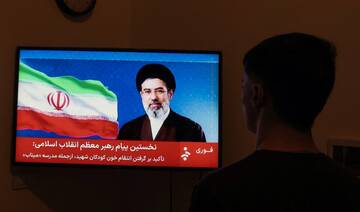
Khamenei has not been seen by Iranians since his selection on Sunday by a clerical assembly, and his first comments were read out by a television presenter on Thursday.
An Iranian said on Wednesday that the newly appointed supreme leader was lightly injured but was continuing to operate, after state television described him as war-wounded.
“I think he probably is (alive). I think he is damaged, but I think he’s probably alive in some form, you know,” Trump said in an interview on Fox News’ “The Brian Kilmeade Show.” His remarks were published by Fox News late on Thursday.
In Khamenei’s first comments, he vowed to keep the Strait of Hormuz shut and called on neighboring countries to close US bases on their territory or risk Iran targeting them.
The US and Israel began attacks on Iran on February 28. Iran has responded with its own strikes on Israel and Gulf countries with US bases.
As the war approached the two-week mark, having killed thousands and shaken financial markets, the leaders of Iran, Israel and the United States all voiced defiance and have vowed to fight on.