

US delegation to Syria says Assad’s torture-prison network is far bigger than previously thought

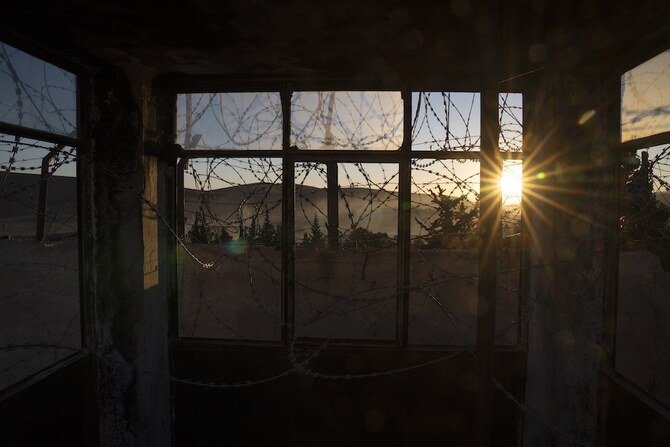
Above, barbed and razor wires hang over the windows of a guardhouse at the infamous Saydnaya military prison, on the outskirts of Damascus on Dec. 19, 2024. (AP)
Short Url
Updated 21 December 2024
Follow

US delegation to Syria says Assad’s torture-prison network is far bigger than previously thought

  • In first official visit to Syria by US officials in 12 years, team led by secretary of state for near eastern affairs meets the country’s interim leadership
  • As they search for missing Americans, delegates discover the number of regime prisons could be as high as 40, much more than the 10 or 20 they suspected

CHICAGO: There are “many more” regime prisons in Syria than previously believed, a high-level delegation of US diplomats said on Friday as they searched for missing Americans in the country.

In the first official visit to Syria by American officials in 12 years, the delegation met on Friday with members of the country’s interim leadership both to urge the formation of an inclusive government and to locate US citizens who disappeared during the conflict.

Western countries have sought to establish connections with senior figures in the Hayat Tahrir Al-Sham militant group that led the offensive which forced President Bashar Assad from power this month.

Secretary of State for Near Eastern Affairs Barbara Leaf, who led the US delegation, told journalists, including Arab News, that the delegates attended a commemorative event for “the tens of thousands of Syrians and non-Syrians alike who were detained, tortured, forcibly disappeared or are missing, and who brutally perished at the hands of the former regime.”

Among the missing Americans are freelance journalist Austin Tice, who was kidnapped in 2012, and Majid Kamalmaz, a psychotherapist from Texas who disappeared in 2017 and is thought to have died.

Special Presidential Envoy for Hostage Affairs Roger Carstens, who is part of the delegation, said the number of prisons in which detainees were tortured and killed by the Assad regime is much higher than suspected.

“We thought there’d be maybe 10 or 20,” he said. “It’s probably more like 40; it might even be more. They’re in little clusters at times. Sometimes they’re in the far outreaches of Damascus.

“Over 12 years, we’ve been able to pinpoint about six facilities that we believe have a high possibility of having had Austin Tice at one point or another. Now, over the last probably 11 or 12 days, we’ve received additional information based on the changing conditions, which leads us to add maybe one or two or three more facilities to that initial number of six.”

Carstens said the US has limited resources available in Syria and will focus on six of the prisons in an attempt to determine Tice’s fate. But he said the search would eventually expand to cover all 40 prison locations.

“We’re going to be like bulldogs on this,” he said. “We’re not going to stop until we find the information that we need to conclude what has happened to Austin, where he is, and to return him home to his family.”

He said the FBI cannot be present on the ground in Syria for an extended period of time to search for missing Americans “right now,” but suggested this might change in the future. Meanwhile, the US continues to work with “partners,” including nongovernmental organizations and the news media in Syria, he added.

Leaf confirmed the delegation met Ahmad Al-Sharaa, the commander of Hayat Tahrir Al-Sham, an Islamist group that was once aligned with Al-Qaeda and is still designated as a terrorist organization by Washington. She said she told Al-Sharaa the US would not pursue the $10 million reward for his capture, and hoped the group will be able to help locate Tice and other missing Americans.

The delegation received “positive messages” from the Syrian representatives they met during their short visit, Leaf said. America is committed to helping the Syrian people overcome “over five decades of the most horrifying repression,” she added.

“We will be looking for progress on these principles and actions, not just words,” she said. “I also communicated the importance of inclusion and broad consultation during this time of transition.

“We fully support a Syrian-led and Syrian-owned political process that results in an inclusive and representative government which respects the rights of all Syrians, including women and Syria's diverse ethnic and religious communities.”

Leaf said the US would be able to help with humanitarian assistance and work with Syrians to “seize this historic opportunity.”

She added: “We also discussed the critical need to ensure terrorist groups cannot pose a threat inside of Syria or externally, including to the US and our partners in the region. Ahmad Al-Sharaa committed to this.”

Bringing Assad to justice for his crimes, particularly those carried out during the civil war, which started in 2011, remains a priority for the US government, Leaf said.

“Syrians desperately want that,” she added.

She called on the international community to offer technical expertise and other support to help document Assad’s crimes, including evidence from the graves and mass graves that have been uncovered since his downfall on Dec. 8.


Inaction over UAE’s role is prolonging ‘worst proxy war in the world,’ Sudan justice minister says

Updated 58 min 44 sec ago
Follow

Inaction over UAE’s role is prolonging ‘worst proxy war in the world,’ Sudan justice minister says

  • Had international community characterized it as ‘military rebellion’ and countered Emirati sponsorship of ‘terrorist militia’ it would not have endured, he tells UN Human Rights Council
  • He accuses paramilitary Rapid Support forces of ‘targeting basic infrastructure, strategic facilities and public services,’ and ‘atrocities beyond our capacity to describe’

NEW YORK CITY: Sudan’s justice minister on Wednesday blamed the prolongation of the near-three-year conflict in his country on what he described as the failure of the international community to properly label the war as a rebellion.

He also accused the UAE of sponsoring and arming a militia, the Rapid Support Forces, he said was responsible for widespread abuses.

“The war has outstayed its welcome and it should not have gone on for this long had the international community, and particularly the UN and its bodies, fulfilled their responsibility in rightly characterizing this military rebellion,” said Abdullah Mohammed Dirif, “and had they called a spade a spade and countered the Abu Dhabi government, which sponsored this terrorist militia and provided it with high-tech arms and provided it with mercenaries.”

Speaking during the high-level segment of the 61st session of the UN Human Rights Council in Geneva, he warned that “the misleading characterization of this war has given a green light for the militia to keep its flagrant violations.”

The minister, who said he was speaking “on behalf of the government of Sudan and its people,” described the conflict between the Sudanese Armed Forces and the RSF, which began in April 2023, as “one of the worst proxy wars in the world,” which had “targeted the very existence of Sudan and its people.”

The RSF has “continued its methodic targeting of basic infrastructure and strategic facilities and all public services,” Dirif said, adding that “the aim is to displace civilians against whom it has committed atrocities beyond our capacity to describe them.

“The violations and crimes of the militia are going unabated. Yesterday it invaded Moustahiliya region in northern Darfur. It targeted civilians, killed them. It looted. It scorched villages and cities.”

Sudan’s military was “conducting its constitutional responsibility by standing up to the militia, protecting the civilians, preserving the unity of the country and the rule of law,” he said, and it remains “committed to international humanitarian law and the rules governing military engagement, and taking into account proportionality principles in order to protect civilians.”

Khartoum remains “open to genuine efforts which aim to end the war and the rebellion” based on a road map presented by the president of the Transitional Sovereignty Council, and a peace initiative submitted by the prime minister to the UN Security Council on Dec. 22, he added.

Dirif stressed his government’s commitment to continued “cooperation and coordination with human rights mechanisms in Sudan,” including the presence of the UN’s Office of the High Commissioner for Human Rights in the country and the UN special rapporteur on the human rights situation in Sudan.

“We recall, nationally, that achieving justice and redress to victims and ensuring impunity is a top priority for us,” he said, adding that authorities had made progress by investigating violations of national laws and international humanitarian laws.

He also underscored Sudan’s “commitment to continue facilitating and expediting delivery of humanitarian assistance to those affected by the war, including those under the control of the rebellious militia.”

Later, Sudan’s representative to the UN in Geneva exercised his right of reply and responded to prior remarks by the representative from the UAE.

“This is not a mere accusation, it is a well-known fact that is predicated on a number of evidence and documented proofs,” he said, referring to the UAE’s sponsorship of the RSF.

He cited in particular a report by a UN panel of experts on Sudan published on Jan. 15, 2024, which he described as “an official document of the Security Council” that referred to “lines of transferring weapons from Abu Dhabi International Airport” based on “clear-cut evidence.”

Other major international organizations and Sudan’s national commission of inquiry have provided further proof, he added, and Khartoum had submitted “a number of complaints, with proof, to the Security Council of the proven sabotage by the Abu Dhabi authority.”

The Sudanese representative continued: “It is paradoxical that the same authority that is sponsoring criminal militia, that the whole world is seeing and is attesting to its crimes, is now talking about peace in the Sudan. Peace is a noble value, that you have to be full of peace before you talk about it.

“The people of Sudan are only requesting this country stop sponsoring this criminal militia that is killing the innocent people in my country on a daily basis.”

The UAE has denied accusations that it provides military support to armed groups in Sudan, and says it supports efforts to achieve a peaceful resolution to the conflict.