

Sweden doubles aid to Gaza, but ends UNRWA funding

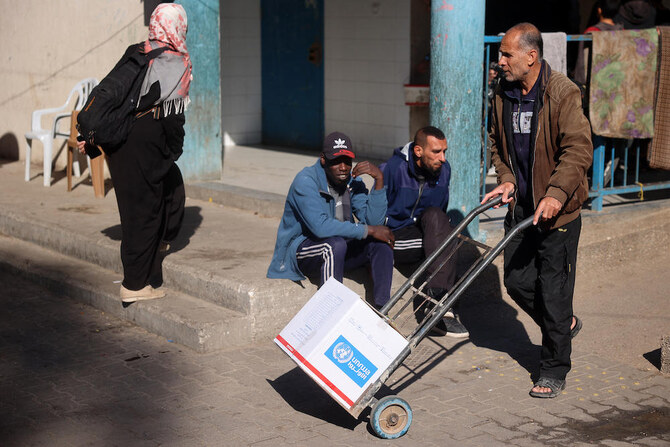
A man transports a box of relief food delivered by the UN agency supporting Palestinian refugees at Bureij camp in the Gaza Strip on Dec. 5, 2024. (AFP)
Short Url
Updated 20 December 2024
Follow

Sweden doubles aid to Gaza, but ends UNRWA funding

  • Nordic country plans to increase its overall humanitarian assistance to Gaza next year
  • Sweden’s decision to end funding for UNRWA was in response to the Israeli ban

STOCKHOLM: Sweden has announced plans to stop funding to the UN's Palestinian refugee agency in response to an Israeli ban but pledged to increase its aid to Gaza via other groups.
The government said funding earmarked for Gaza would total 800 million kronor ($72 million) in 2025, but aid to UNRWA, which totaled 451 million kronor in 2024, would be stopped.
Israeli MPs have passed legislation to bar UNRWA from operating in Israel and East Jerusalem while raising the prospect of similar measures against other aid agencies.
Lawmakers backed the legislation after years of harsh Israeli criticism of UNRWA, which has only increased since the start of the war in Gaza following the deadly Oct. 7 attacks last year.
"Israel's two decisions in the Knesset, which Sweden has criticized, will make many of UNRWA's activities more difficult and impossible," Benjamin Dousa, minister for international development cooperation, said in a post to X.
UNRWA assists nearly 6 million Palestinian refugees across Gaza, the West Bank, Lebanon, Jordan, and Syria.
"Swedish aid must reach its destination, not get stuck in a bank account along the way. Due to Israel's decision in the Knesset, we are therefore forced to pass on the aid to other organizations," Dousa said, giving the UN's World Food Programme and UN children's charity UNICEF as examples.
Dousa added that UNRWA was "also going through a crisis of confidence."
The new Israeli law does not directly ban UNRWA's operations in the West Bank and Gaza, but it will have a severe impact on UNRWA's ability to work.
Top UN officials describe UNRWA as the backbone of Gaza's aid response.
The Palestinian Embassy in Stockholm said in a statement: "We reject the idea of finding alternatives to UNRWA, which has a special mandate to provide services to Palestinian refugees."
The refugee population relies on UNRWA healthcare, education, emergency relief, and humanitarian assistance.
The UN General Assembly threw its support behind UNRWA this month, demanding that Israel respect the agency's mandate and "enable its operations to proceed without impediment or restriction."
UNRWA chief Philippe Lazzarini said on X: "Defunding UNRWA now will undermine decades of Sweden’s investment in human development including by denying access to education for hundreds of thousands of girls and boys across the region."
Israeli Deputy Foreign Minister Sharren Haskel thanked Dousa for their meeting this week and for Sweden's decision to drop its support for UNRWA.
"There are worthy and viable alternatives for humanitarian aid, and I appreciate the willingness to listen and adopt a different approach," she said.


Syrian Alawites protest in coastal heartland after mosque bombing

Updated 5 sec ago
Follow

Syrian Alawites protest in coastal heartland after mosque bombing

  • Syrian Alawites took to the streets on Sunday in the coastal city of Latakia to protest after a mosque bombing that killed eight people in Homs two days before
LATAKIA: Syrian Alawites took to the streets on Sunday in the coastal city of Latakia to protest after a mosque bombing that killed eight people in Homs two days before.
The attack, which took place in an Alawite area of Homs city, was the latest against the religious minority, which has been the target of several episodes of violence since the December 2024 fall of longtime ruler Bashar Assad, himself an Alawite.
Security forces were deployed in the area, and intervened to break up clashes between demonstrators and counter-protesters, an AFP correspondent witnessed.
“Why the killing? Why the assassination? Why the kidnapping? Why these random actions without any deterrent, accountability or oversight?” said protester Numeir Ramadan, a 48-year-old trader.
“Assad is gone, and we do not support Assad... Why this killing?“
Sunday’s demonstration came after calls from prominent spiritual leader Ghazal Ghazal, head of the Islamic Alawite Council in Syria and Abroad, who on Saturday urged people to “show the world that the Alawite community cannot be humiliated or marginalized.”
“We do not want a civil war, we want political federalism. We do not want your terrorism. We want to determine our own destiny,” he said in a video message on Facebook.
Protesters carried pictures of Ghazal along with banners expressing support for him, while chanting calls for decentralized government authority and a degree of regional autonomy.
“Our first demand is federalism to stop the bloodshed, because Alawite blood is not cheap, and Syrian blood in general is not cheap. We are being killed because we are Alawites,” Hadil Salha, a 40-year-old housewife said.
Most Syrians are Sunni Muslim, and the city of Homs — where Friday’s bombing took place — is home to a Sunni majority but also has several areas that are predominantly Alawite, a community whose faith stems from Shiite Islam.
The community is otherwise mostly present across their coastal heartland in Latakia and Tartus provinces.
Since Assad’s fall, the Syrian Observatory for Human Rights monitor and Homs province residents have reported kidnappings and killings targeting members of the minority community.

- Alawite massacres -

The country has also seen several bloody flare-ups of sectarian violence.
Syria’s coastal areas saw the massacre of Alawite civilians in March, with authorities accusing armed Assad supporters of sparking the violence by attacking security forces.
A national commission of inquiry said at least 1,426 members of the minority were killed, while the Syrian Observatory for Human Rights monitor put the toll at more than 1,700.
Late last month, thousands of people demonstrated on the coast to protest fresh attacks targeting Alawites in Homs and other regions.
Before and after the March bloodshed, authorities carried out a massive arrest campaign in predominantly Alawite areas, which are also former Assad strongholds.
Protesters on Sunday also demanded the release of detainees.
On Friday, Syrian state television reported the release of 70 detainees in Latakia “after it was proven that they were not involved in war crimes,” saying more releases would follow.
Despite assurances from Damascus that all Syria’s communities will be protected, the country’s minorities remain wary of their future under the new Islamist authorities, who have so far rejected calls for federalism.