GAZIANTEP, Turkiye: Turkiye gained renown as a haven for refugees by welcoming more than 3 million Syrians fleeing violence between forces from Bashar Assad ‘s government and a patchwork of rebel groups.
But the Syrian president’s ouster this month has led many in Turkiye to argue that the refugees have no reason to stay, part of the global backlash against migration. Some Syrians are panicking about returning to a devastated nation.
“There’s no work, electricity, or water. There is no leader. Who will it be? I have no idea,” said Mahmut Cabuli, who fled airstrikes by Syrian government forces and violence by rebel groups in his hometown Aleppo a decade ago. “I’m scared and don’t know what the authorities will do.”
‘My children were born here’
Cabuli spent several years in a refugee camp before he found a job at a textile factory in Gaziantep, a southern Turkish city near the Syrian border. After he met another Syrian refugee, they married and had two children.
“My children were born here,” he said. “I am working, thank God. I am happy here. I don’t want to go back now.”
Many Turks baselessly accuse Syrians of taking their jobs and straining health care and other public services. Riots have damaged Syrian-owned shops, homes or cars, including one in July in the central city of Kayseri following allegations that a Syrian refugee sexually assaulted a child. The riots sparked counterprotests in northern Syria.
Turkish authorities said that the alleged perpetrator was arrested and the victim placed under state protection.
“A spark between Syrians and Turkish citizens can immediately cause a big fire, a big flame,” said Umit Yılmaz, the mayor of Sehitkamil, which hosts 450,000 Syrians.
“The Syrians need to be reunited with their homeland immediately,” he said. “I have come to a point where I am even willing to get in my own car and take them away if necessary.”
Was staying in Turkiye temporary or for good?
In 2014, Turkish authorities gave Syrians universal access to health care, education and the right to work by granting them a legal status known as temporary protection.
As a result, Turkiye has taken in more Syrian refugees than any other nation — more than 3.8 million at its peak in 2022, or roughly 60 percent of all the Syrians logged by UN refugee agency UNHCR.
But more recently, anti-refugee sentiment has surged as Turkiye has grappled with problems including persistent inflation — particularly in food and housing — and with high youth unemployment.
“This prolonged stay under temporary protection must end,” said Azmi Mahmutoglu, spokesman for the Victory Party, a right-wing party that has opposed the presence of Syrians in Turkiye and called for their repatriation.
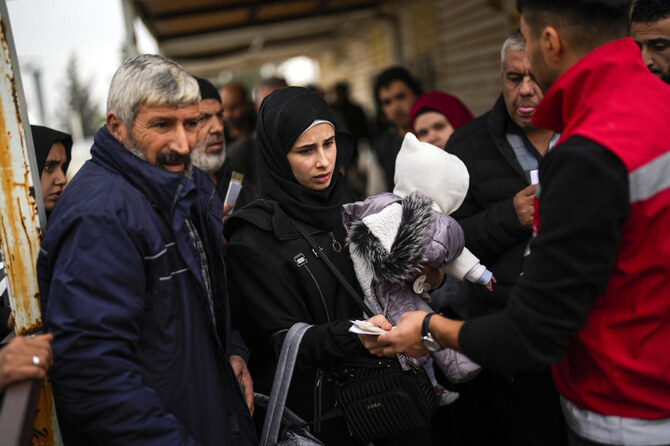
Hundreds of Syrians have gathered at border gates along Turkiye’s 911-kilometer (566 mile) frontier with Syria since Assad’s fall and the returns are expected to accelerate if Syria becomes stable.
Metin Corabatir, director of the Ankara-based Research Center on Asylum and Migration, said most of the departures so far appear to be Syrians checking the situation back in Syria before deciding whether to move their families back.
Muhammed Nur Cuneyt, a 24-year-old Syrian who arrived in 2011 from the northern town of Azaz, was eagerly waiting at one gate on Dec. 10, saying he was grateful to Turkiye for granting refuge but resented hearing anti-Syrian sentiment as his people fought Assad.
“Some were saying ‘Why are the Syrians here? Why don’t you go back and fight with your nation?’” he said.
Are they voluntary returns?
President Recep Tayyip Erdogan has sought ways to encourage the refugees’ voluntary returns — including building housing in Syria close to the Turkish border after Syrian migration helped weaken support for his Justice and Development party.
Erdogan has four more years in office but the main opposition party has a slight lead in polls.
One refugee who returned to Syria said that he had signed a document ending his protected refugee status under Turkish law.
“Would they be allowed to come back to Turkiye? Corabatir said. “Our hope is that it will continue.”
This week, UNHCR said it does not believe that conditions to end Syrian’s refugee status have been met and it still thinks they need protection.
But for Huseyin Basut, the Turkish owner of a pet shop in Gaziantep, Turkiye has done all that it can for the Syrians.
“We did all we could as a country and as citizens,” said Bayut, 52. “Since the war is over, they should return to their homes, build their homes or whatever they need to do and may God help them.”


![]()

The warm Turkish welcome for refugees is ending and Syrians are worried
Short Url
https://arab.news/67n8v
The warm Turkish welcome for refugees is ending and Syrians are worried
- Syrian president’s ouster this month has led many in Turkiye to argue that the refugees have no reason to stay
- Some Syrians are panicking about returning to a devastated nation


Latest updates


© 2026 SAUDI RESEARCH & PUBLISHING COMPANY, All Rights Reserved And subject to Terms of Use Agreement.