

Pakistan naval chief holds defense cooperation, regional security talks during visit to Oman

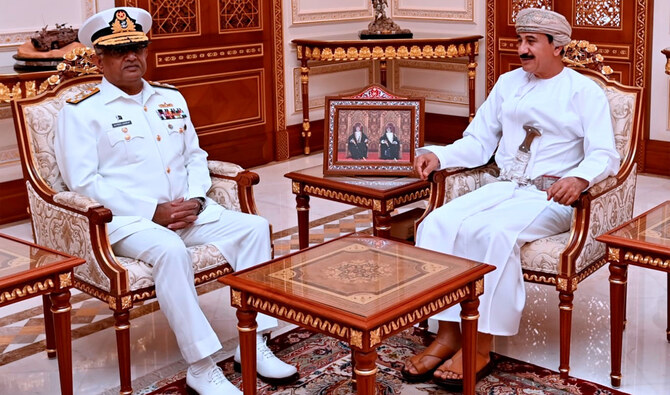
In this handout photograph released by the Pakistan Navy on December 19, 2024, Pakistan’s Chief of the Naval Staff, Admiral Naveed Ashraf, meets the Minister of Royal Office, General Sultan Mohammad Al Nu’amani in Muscat, Oman. (Photo Courtesy: Pakistan Navy)
Short Url
Updated 19 December 2024
Follow

Pakistan naval chief holds defense cooperation, regional security talks during visit to Oman

  • Oman is the nearest Arab country to Pakistan, because of which they share a maritime boundary
  • Last week, the Pakistan navy conducted joint naval exercises and drills with the Royal Oman ship ‘Alseeb’

ISLAMABAD: Pakistani naval chief Admiral Naveed Ashraf is on an official visit to Oman to discuss defense cooperation, smuggling and regional maritime security, the military’s media wing said on Thursday.

Oman is the nearest Arab country to Pakistan, because of which they share a maritime boundary. Pakistan shares a unique ‘blood bond’ with Oman, one third of whose population originates from Pakistan’s Balochistan province, while the southwestern port city of Gwadar, which is 200 nautical miles from Oman, was transferred to Pakistan in 1958, before which it had remained gifted to the Sultan of Oman for 175 years.

“During the meetings, the security situation in the Indian Ocean and joint defense cooperation were discussed,” the military’s media wing said after Ashraf had separate meetings with the minister of the Royal Office of the Sultanate of Oman, and the commanders of the Omani Royal Navy and National Defense College.

“Naval Chief highlighted the role of Pakistan Navy in preventing piracy and smuggling,” the statement said. “Pakistan Navy is a strong supporter of promoting maritime security in collaboration with other regional countries.”

Last week, the Pakistan navy conducted joint naval exercises and drills with Royal Oman ship ‘Alseeb.’ The bilateral naval exercise, “Samar Al-Tayeb,” is conducted regularly between the navies of the two nations.



Pakistan, UK discuss regional security, cross-border attacks as senior official visits Islamabad

Updated 20 January 2026
Follow

Pakistan, UK discuss regional security, cross-border attacks as senior official visits Islamabad

  • British envoy for Afghanistan Richard Lindsay’s visit comes at a time of a surge in militancy in Pakistan’s border regions
  • Pakistani diplomat says both sides reviewed broader security challenges, emphasized coordination to address ‘shared concerns’

ISLAMABAD: Pakistani and British officials have discussed regional security challenges and cross-border attacks during talks in Islamabad, a Pakistani diplomat said on Tuesday, during a visit of the United Kingdom’s Afghanistan envoy, Richard Lindsay, to the Pakistani capital.

Pakistan and the UK regularly cooperate on counterterrorism and security, with a focus on intelligence-sharing to combat militant activity. Lindsay’s visit comes at a time of a rise in militancy in Pakistan’s western provinces, which border Afghanistan.

Mohammad Sadiq, Pakistan’s special representative for Afghanistan, said the discussions in Islamabad focused on the regional security situation, particularly the urgent challenge posed by cross-border attacks.

“We also exchanged views on the latest regional security developments and broader security challenges,” he said on X. “We emphasized the importance of continued cooperation and coordination to address shared concerns and promote regional stability.”

Islamabad frequently accuses Afghanistan of allowing its soil and India of backing militant groups, such as the Tehreek-e-Taliban Pakistan (TTP) and the Balochistan Liberation Army (BLA), for attacks against Pakistan. Kabul and New Delhi deny this.

In recent years, Pakistan and the UK have engaged with each other on counterterrorism and cross-border crimes as part of bilateral cooperation.

Both sides held the second round of the Pakistan-UK Counter Terrorism Dialogue in London in February last year, reviewing global and regional threats and exchanging best practices. Over the years, armed forces of both countries have also maintained close cooperation, particularly in counterterrorism efforts and professional military training.