Modi to visit Kuwait for first trip by Indian PM in four decades

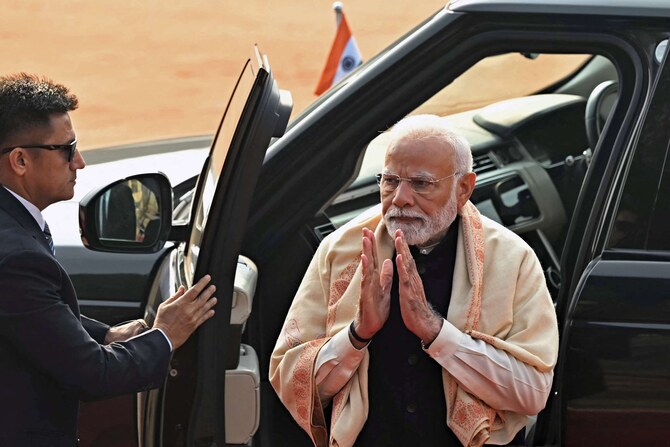
India’s Prime Minister Narendra Modi gestures as he arrives at the presidential palace Rashtrapati Bhavan in New Delhi on Dec. 16, 2024. (AFP)
Short Url
Updated 19 December 2024
Follow

Modi to visit Kuwait for first trip by Indian PM in four decades

  • Indian nationals make up the largest expatriate community in Kuwait 
  • Modi’s visit will likely focus on strengthening economic ties, say experts

NEW DELHI: Prime Minister Narendra Modi will visit Kuwait on Saturday, marking the first trip to the Gulf state by an Indian premier in more than four decades.

With more than 1 million Indian nationals living and working in Kuwait they are the largest expatriate community in the country, making up around 21 percent of its 4.3 million population and 30 percent of its workforce.

Modi’s two-day visit is at the invitation of the Emir of Kuwait, Sheikh Mishal Al-Ahmad Al-Jaber Al-Sabah.

“This will be the first visit of an Indian prime minister to Kuwait in 43 years,” the Indian Ministry of External Affairs said in a statement.

“During the visit, the prime minister will hold discussions with the leadership of Kuwait. (The) prime minister will also interact with the Indian community in Kuwait.”

India is among Kuwait’s top trade partners, with bilateral trade valued at around $10.4 billion in 2023-24.

Experts expect the visit to focus on strengthening economic ties between the two countries.

“Kuwait has a strong Indian expatriate community who have contributed to the economic development of the country,” Muddassir Quamar, associate professor at the Center for West Asian Studies in Delhi’s Jawaharlal Nehru University, told Arab News.

“In my view, the focus would be on the economy. Politically, it underlines that Kuwait is an important regional country and remains an important partner of India.”

Quamar said that trade and economic ties will likely get a boost from the visit, as well as cooperation in energy, infrastructure, financial technology, education and culture.

Modi’s visit reflects how India’s engagement with Arab states has increasingly focused on the economy, said Kabir Taneja, a deputy director with the Strategic Studies program at the Observer Research Foundation.

“India’s engagement with Arab states is increasingly rooted in a ‘new’ Middle East, that is, it is economy-led,” he told Arab News.

“This visit is a good opportunity for India to expand beyond its good relations with UAE and Saudi Arabia and explore opportunities with the smaller Arab states, which includes Kuwait.”



US Justice Department official eyes cases against Cuba leaders as Trump floats ‘friendly takeover’

Updated 07 March 2026
Follow

US Justice Department official eyes cases against Cuba leaders as Trump floats ‘friendly takeover’

  • “Working group” formed to build cases against people connected to the Cuban government
  • Trump’s has increasingly displayed aggressive stance against Cuba’s communist leadership

MIAMI: The top Justice Department prosecutor in Miami is considering criminal investigations of Cuban government officials, according to people familiar with the matter. The inquiry comes as President Donald Trump has raised the possibility of a “friendly takeover” of the communist-run island.
Jason Reding Quiñones, the US attorney for the Southern District of Florida, has created a “working group” that includes federal prosecutors and officials from the Drug Enforcement Administration and other agencies to try to build cases against people connected to the Cuban government and its Communist Party, according to one of the people. They spoke on the condition of anonymity because they were not authorized to publicly discuss the effort.
It was not immediately clear which Cuban officials the office is targeting or what criminal charges prosecutors may be looking to bring.
The Justice Department said in a statement Friday that “federal prosecutors from across the country work every day to pursue justice, which includes efforts to combat transnational crime.”
The effort is taking place against the backdrop of Trump’s increasingly aggressive stance against Cuba’s communist leadership.
Emboldened by the US capture of Cuba’s close ally, Venezuelan President Nicolás Maduro, Trump last month said his administration was in high-level talks with officials in Havana to pursue “a friendly takeover” of the country. He repeated those claims this week, saying his attention would turn back to Cuba once the war with Iran winds down.
“They want to make a deal so bad,” Trump said of Cuba’s leadership.
While Cuba has faded from Washington’s radar as a major national security threat in recent decades, it remains a priority in the US Attorney’s office in Miami, whose political, economic and cultural life is dominated by Cuban-American exiles.
The FBI field office has a dedicated Cuba group that in 2024 was instrumental in the arrest of former US Ambassador Victor Manuel Rocha on charges of serving as a secret agent of Cuba stretching back to the 1970s.
In recent weeks, several Miami Republicans, in addition to Florida Sen. Rick Scott, have called on the Trump administration to reopen its criminal investigation into the 1996 shootdown of four planes operated by anti-communist exiles.
In a letter to Trump on Feb. 13, lawmakers including Reps. Maria Elvira Salazar and Carlos Gimenez highlighted decades-old news reports indicating that former President Raúl Castro — the head of Cuba’s military at the time — gave the order to shoot down the unarmed Cessna aircraft.
“We believe unequivocally that Raúl Castro is responsible for this heinous crime,” lawmakers wrote. “It is time for him to be brought to justice.”
While no indictment against Castro has been announced, Florida’s attorney general said this week that he would open a state-level investigation into the crime.
The Trump administration has also accused Cuba of not cooperating with American counterterrorism efforts, adding it alongside North Korea and Iran to a select few nations the US considers state sponsors of terrorism.
The designation stems from Cuba’s harboring of US fugitives and its refusal to extradite several Colombian rebel leaders while they were engaged in peace talks with the South American nation.