

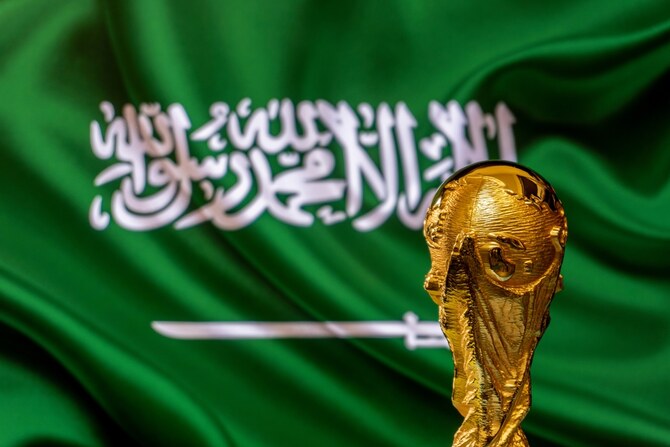

RIYADH: As Saudi Arabia prepares to host the FIFA World Cup in 2034, stock market performance is expected to improve, according to a report.
In its latest analysis, SNB Capital said hosting the major event would also increase the Kingdom’s non-oil gross domestic product by 4 percent to 5 percent in the medium term, estimated between four to eight years.
The firm made this prediction after comparing the growth of the equity markets in South Africa, Russia, and Qatar when they hosted the mega football gala in 2010, 2018, and 2022, respectively.
According to the analysis, hosting the FIFA World Cup in 2034 is expected to significantly impact the Saudi economy, further accelerating the growth driven by Vision 2030 — a national program aimed at diversifying the Kingdom’s economy beyond oil dependence.
“The decision for the host is usually made roughly seven to 12 years in advance. Post announcement, equity markets generally performed well with South Africa showing the strongest return, followed by Qatar and Russia. Therefore, we expect the Saudi market to outperform emerging markets in the coming period,” said SNB Capital.
It added: “FIFA 2034 also reflects positively on the equity market, leading to positive market return, valuation expansion as well as resilience and quick recovery from any potential global market headwinds.”
In the short term, between one to four years, Saudi Arabia will have extensive infrastructure spending, including stadiums, transportation networks, and urban development.
In this period, the infrastructure and construction sectors will be the primary beneficiaries, which include steel, cables, and cement companies in the Kingdom.
In the medium term, between four to eight years, these projects will be near completion, and construction companies will benefit during this period.
In the long term, between eight to 12 years, the tourism and hospitality sectors will receive gains, while the retail industry, including discretionary retailers and car rental companies, is also poised to receive benefits.
In November, experts told Arab News that Saudi Arabia could expect a GDP boost of between $9 billion and $14 billion from the event, as well as the creation of 1.5 million new jobs and the construction of 230,000 hotel rooms developed across five host cities.
SNB Capital estimates that the total cost of hosting the World Cup in Saudi Arabia will be around $26 billion. This cost is considered relatively low, as much of the required infrastructure investment is already part of the Kingdom’s Vision 2030 plans. Additionally, hosting the World Cup follows Expo 2030, another major global event.
In the previous editions of the tournament, Qatar spent a staggering $243 billion, while expenses to host the event in South Africa came in at $7.2 billion.
Brazil’s 2014 hosting involved a spend of $19.7 billion, while Russia invested $16 billion in 2018.
Earlier this month, the bid evaluation report released by FIFA showed that Saudi Arabia is set to deliver a World Cup in 2034 that saves $450 million on costs.
The bid evaluation report added that revenue from ticket and hospitality will surpass FIFA’s baseline projections by 32 percent, or $240 million.
FIFA added that online and licensing revenue streams are forecast to outperform by $7 million, compared to baseline figures.
SNB Capital also echoed similar views and said that the World Cup is expected to improve the outlook of broadcasting and event management companies.
The analysis revealed that FIFA 2034 will boost Saudi Arabia’s tourism sector, leading to higher revenues from the industry.
The event is also expected to create permanent and temporary jobs across various sectors in the Kingdom, reducing unemployment and boosting disposable income.
“A successful hosting of the World Cup will also leave a legacy of high-quality infrastructure which will help Saudi to cater to the potential pickup in tourism demand beyond 2034,” added SNB Capital.


