

Pakistani forces kill 11 militants in restive northwest amid surge in attacks

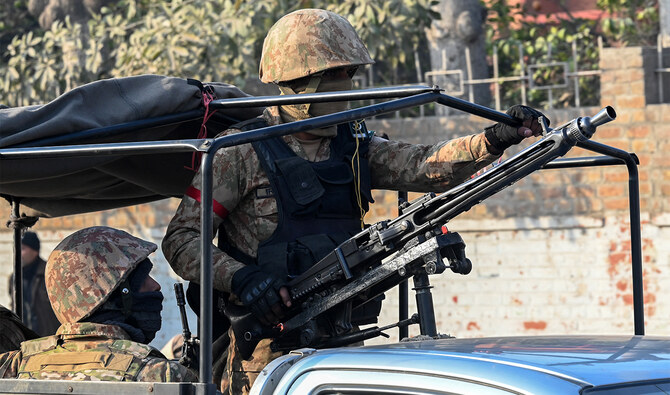
Pakistan Army personnel patrol along a road in Peshawar on February 7, 2024. (AFP/File)
Short Url
Updated 19 December 2024
Follow

Pakistani forces kill 11 militants in restive northwest amid surge in attacks

  • The militants were killed in separate engagements in Tank, North Waziristan and Mohmand districts of the Khyber Pakhtunkhwa province
  • Pakistan has blamed a surge in militancy in Khyber Pakhtunkhwa on militants operating out of Afghanistan, Kabul denies the allegation

ISLAMABAD: Pakistani security forces have killed 11 militants in separate operations in the country’s northwestern Khyber Pakhtunkhwa (KP) province, the Pakistani military said on Wednesday, amid a surge in attacks in the region.

Seven militants were killed during an exchange of fire in an intelligence-based operation (IBO) in KP’s Tank district, according to the Inter-Services Public Relations (ISPR), the military’s media wing.

Two militants were killed in an encounter in North Waziristan district, while a third operation in Mohmand district killed two more militants, following an intense exchange of fire.

“Weapons and ammunition were also recovered from killed khwarij [militants], who remained actively involved in numerous terrorist activities against the security forces as well as innocent civilians,” the ISPR said in a statement late Wednesday.

“Sanitization operations are being carried out to eliminate any other Kharji found in the area.”

Pakistan’s Khyber Pakhtunkhwa, which borders Afghanistan, has witnessed a number of attacks by the Tehreek-e-Taliban Pakistan (TTP) and other militant groups that targeted security forces convoys and check posts, besides targeted killings and kidnappings of law enforcers and government officials in recent months.

Earlier this month, six Pakistani soldiers and 22 militants were killed in three separate gunfights in Tank, North Waziristan and Kurram districts of KP, according to the military.

Pakistan has frequently accused neighboring Afghanistan of sheltering and supporting militant groups, urging the Taliban administration in Kabul to prevent its territory from being used by armed factions to launch cross-border attacks.

Afghan officials, however, deny involvement, insisting Pakistan’s security issues are an internal matter of Islamabad.


Pakistan to begin first phase of Hajj 2026 trainings from today

Updated 31 December 2025
Follow

Pakistan to begin first phase of Hajj 2026 trainings from today

  • Training programs to be held in phases across Pakistan till February, says religion ministry
  • Saudi Arabia allocated Pakistan a total quota of 179,210 pilgrims for Hajj 2026

ISLAMABAD: Pakistan’s religious affairs ministry has said that it will begin the first phase of mandatory Hajj 2026 training for pilgrims intending to perform the pilgrimage from today, Thursday.

The one-day Hajj training programs will be held in phases across the country at the tehsil level until February. The ministry directed intending pilgrims to bring their original identity cards and the computerized receipt of their Hajj application to attend the training sessions.

“Pilgrims should attend the one-day training program according to their scheduled date,” Pakistan’s Ministry of Religious Affairs (MoRA) said in a statement.

The ministry said training schedules are being shared through the government’s Pak Hajj 2026 mobile application as well as via SMS. It added that details of the schedule are also available on its website.

According to the ministry, training programs will be held in Abbottabad on Jan. 2; Ghotki, Thatta and Kotli on Jan. 3; and Tando Muhammad Khan and Khairpur on Jan. 4.

Hajj training sessions will be held in Rawalakot, Badin and Naushahro Feroze on Jan. 5, while pilgrims in Fateh Jang, Dadu and Tharparkar will receive the training on Jan. 6.

The ministry said training programs will be conducted in Umerkot and Larkana on Jan. 7, followed by sessions in Mirpurkhas, Shahdadkot and Mansehra on Jan. 8.

Pakistan’s religious affairs ministry has previously said these trainings will be conducted by experienced trainers and scholars using multimedia.

It said the training has been made mandatory to ensure that intending pilgrims are fully aware of Hajj rituals and administrative procedures.

Saudi Arabia has allocated Pakistan a quota of 179,210 pilgrims for Hajj 2026, of which around 118,000 seats have been reserved under the government scheme, while the remainder will be allocated to private tour operators.

Under Pakistan’s Hajj scheme, the estimated cost of the government package ranges from Rs1,150,000 to Rs1,250,000 ($4,049.93 to $4,236), subject to final agreements with service providers.