



SANGHAR, Sindh: Irum Jatt’s hands gripped the steering wheel tightly as the ambulance she was driving zipped through the roads of the southern Pakistani city of Sanghar earlier this month, sirens blaring to warn other cars and pedestrians to move out of the way.
While a woman driving an ambulance is no anomaly in cities like London or New York, in this remote, conservative town in Sindh province, Jatt, 21 and another colleague Shereen Shah, 22, made history in June when they were hired as the first women ambulance drivers for the Sindh Integrated Emergency & Health Services (SIEHS), a non-profit organization operating around 460 “HOPE” ambulances across the province.
Established in 2021, SIEHS employs 750 Emergency Vehicle Operators (EVOs) and launched operations in Sanghar in October 2023 with three ambulances.
In conservative and patriarchal Pakistan, where the right to education, employment and even voting is sometimes not extended to women, employing female ambulance drivers was a bold move by SIEHS and one that has not even been experimented with in large urban centers of the province such as Karachi and Hyderabad. Women in Sindh in general also face many challenges such as discrimination, violence, and limited access to health, education and job opportunities.
“Many people believed that it wasn’t possible,” Jatt told Arab News in an interview as she drove on a road in main Sanghar city.
“But there’s something within a person, a passion that drives them to do something. I felt the same, I wanted to do it, I wanted to drive an ambulance.”

An ambulance under the Sindh Integrated Emergency & Health Services is pictured in the southern Pakistani city of Sanghar on December 14, 2024. (AN photo)
Jatt, an intermediate degree graduate, saw the job opening for an ambulance driver on social media and applied, having to go through several rounds of tests before her selection.
“On the road, it’s common for people to stare when they see a woman driving,” Jatt said.
“Many people don’t give way. While leaving our Sanghar city, motorcyclists don’t give way, and we have to face all of that.”
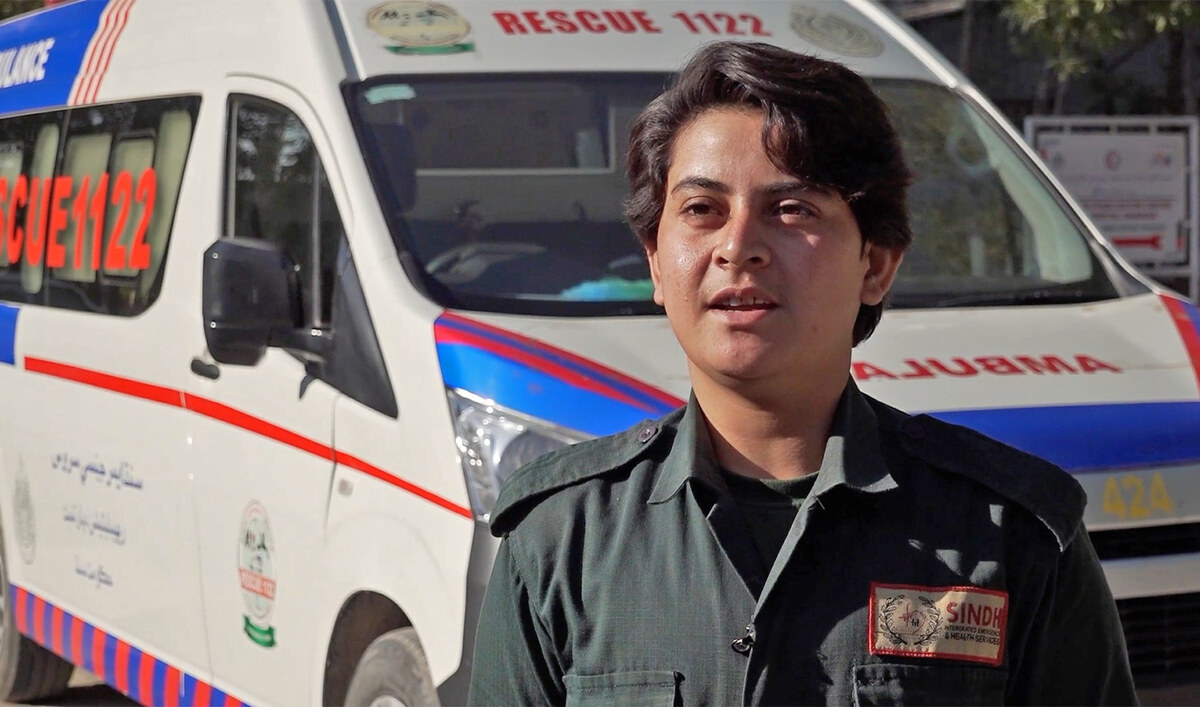
Female ambulance driver Shereen Shah speaks to Arab News in the southern Pakistani city of Sanghar on December 14, 2024. (AN photo)
Negative stereotypes and biases, including that women were bad drivers or drove slowly, also made the job harder, she said.
“Some good people get it but there are communities that don’t understand and say things like, ‘You arrived late,’ or ‘You deliberately delayed’. Some might even think, ‘Because it was a woman driving, it took longer’.”
Mumtaz Ali Pirzada, the district manager at the SIEHS, acknowledged the initial resistance by the community to the women ambulance drivers.
“When we first inducted female drivers in Sanghar, and we did and in the future also we will do it, there was significant backlash on social media, most people asked how can a woman drive an ambulance,” he said.
“But we have broken that stereotype. These women have broken it because they are doing all these things and doing them with a lot of hard work.”

Ambulance driver Irum Jatt closes the trunk of the ambulance in the southern Pakistani city of Sanghar on December 14, 2024. (AN photo)
According to Pirzada, Shah and Jatt often outperformed their male counterparts.
“But their success isn’t due to sympathy or special treatment, it’s purely their hard work and skills,” he added. “They even handle tasks like changing tires, including the heavy tires of ambulances, which challenges the traditional mindset that only men can manage such tasks.”
Shereen Shah, another women ambulance driver from Sanghar, said the response from the community was improving.
“When we first started working here, people were shocked to see women driving ambulances, they thought we wouldn’t be able to handle it, that we might hit something,” she told Arab News as she stood by her vehicle.
“But now, wherever we go, if the traffic police sees us, they salute us and the Sindh police also salute us. They feel proud of us.”
She said it was “so fulfilling” to be able to rescue people from road accidents and other emergencies and deliver them to medical facilities in a timely manner.
“A few years ago, women rarely stepped out of their homes in this city,” she said. “But today, women are driving vehicles here and that’s a matter of pride for Sanghar.”


