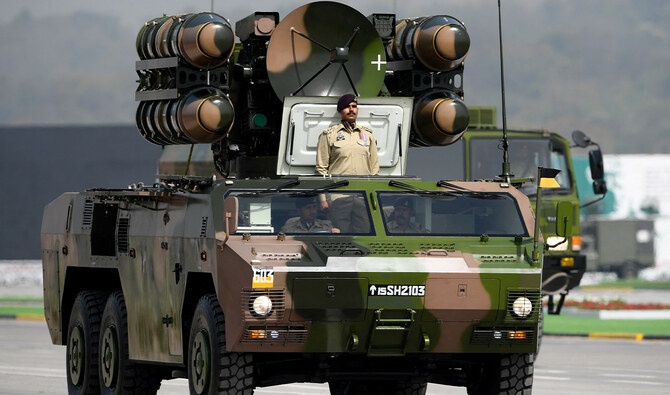

ISLAMABAD: Pakistan’s foreign ministry on Thursday criticized the United States (US) for imposing more sanctions on the South Asian country’s missile program, saying it reflected “double standards and discriminatory practices.”
The statement came hours after US said it was imposing new sanctions related to nuclear-armed Pakistan’s long-range ballistic-missile program, including on the state-owned defense agency that oversees the program. The sanctions freeze any US property belonging to the targeted entities and bars Americans from doing business with them.
State Department spokesperson Matthew Miller said in a statement that the measures slapped on the National Development Complex and three firms were imposed under an executive order that “targets proliferators of weapons of mass destruction and their means of delivery.”
In its reaction to the development, the Pakistani foreign ministry said the US decision was “unfortunate and biased” and that Pakistan’s strategic capabilities were meant to defend its sovereignty and preserve peace and stability in South Asia, regretting the imposition of sanctions on private commercial entities too.
“Similar listings of commercial entities in the past were based on mere doubts and suspicion without any evidence whatsoever. While claiming strict adherence to non-proliferation norms, licensing requirement for advanced military technology to other countries have been waived off in the past,” it said in a statement.
“Such double standards and discriminatory practices not only undermine the credibility of non-proliferation regimes but also endanger regional and international peace and security.”
A State Department factsheet said the Islamabad-based NDC had sought to obtain components for the country’s long-range ballistic-missile program and missile-testing equipment. It said the NDC “is responsible for the development of Pakistan’s ballistic missiles,” including the Shaheen family of missiles.
The Bulletin of the Atomic Scientists research organization says the Shaheen series of missiles is nuclear-capable. Pakistan conducted its first nuclear-weapons test in 1998, becoming the seventh country to do so. The Bulletin estimates Pakistan’s arsenal at about 170 warheads.
Islamabad has refused to sign the Non-Proliferation Treaty, the cornerstone of the international system designed to prevent the spread of nuclear weapons.
The other entities slapped with sanctions were Affiliates International, Akhtar and Sons Private Limited and Rockside Enterprise, all located in Karachi, the factsheet said. It said the companies worked with the NDC to acquire equipment.
“The United States will continue to act against proliferation and associated procurement activities of concern,” Miller said.
The Pakistani foreign ministry said the latest installment of sanctions defied the “objective of peace and security by aiming to accentuate military asymmetries,” an apparent reference to Pakistan’s rivalry with nuclear-armed India.
“Such policies have dangerous implications for strategic stability of our region and beyond,” it said.